
Detonate
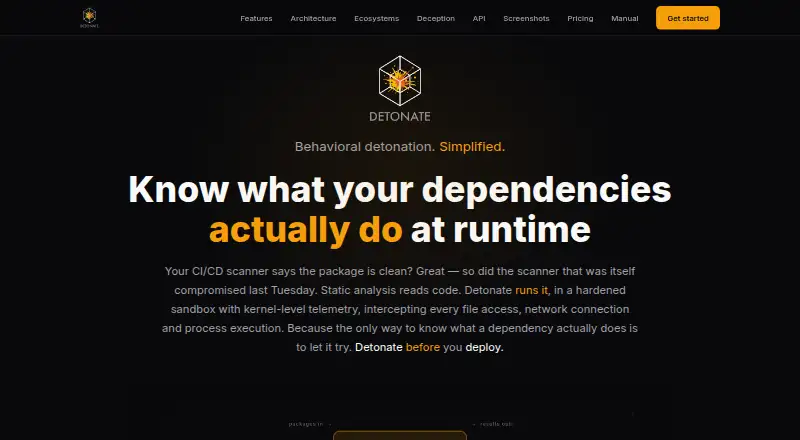
Detonate runs software dependencies in isolated micro-virtual machines and observes their runtime behavior for supply chain security.
What Detonate is
Detonate runs software dependencies in isolated micro-virtual machines and observes their runtime behavior for supply chain security. It accepts npm and PyPI packages, Maven artifacts, binaries, and Docker images, then captures file access, network connections, DNS queries, and process execution. Each run receives a benign, suspicious, or policy-violating verdict with an event timeline. Decoy files such as fake SSH keys, cloud credentials, API tokens, and environment files can reveal access attempts. A token-authenticated REST API supports artifact submission, status checks, verdicts, and reports for CI/CD deployment gates. The sandbox has no internet access by default; outbound connections can be logged and optionally blocked. Described controls include Firecracker microVM and KVM isolation, gVisor support, seccomp-BPF profiles, and read-only root filesystems with tmpfs overlays. Detonate is available through API and web interfaces, with Linux and self-hosted options. Community is free, self-hosted, and includes 2 concurrent sandboxes and 200 API runs/month.
Good
- Analyzes npm, PyPI, Maven, binaries, and Docker images.
- Records file, network, DNS, and process activity.
- Returns verdicts with an event timeline.
- REST API supports CI/CD deployment gates.
- Free self-hosted plan includes 200 API runs/month.
Watch out
- Community is limited to 2 concurrent sandboxes.
- Community event retention is 7 days.
- Containerized deployment requires Linux x86_64, KVM, and Docker 24 or newer.
Who it suits
Detonate suits teams that want to inspect supported software artifacts and connect verdicts to deployment gates. The self-hosted Community plan is an option for users who can meet its deployment requirements, including a Linux x86_64 host with KVM and Docker 24 or newer.
Verdict
Detonate combines runtime observation with API-based verdicts for supported artifacts. Check plan limits and Linux deployment requirements against your workflow before choosing it.
Plans and prices
From Detonate's own pricing page, checked 15 Oct 2026.
| Plan | Price | What it gives you |
|---|---|---|
| Community | Free | all artifact types · 2 concurrent sandboxes · 200 API runs/month · unlimited manual UI · 7-day event retention · 1 admin user · 9 deception packs · gVisor & runc · JSON/CSV/text reports · forever, self-hosted |
| SMB | $4,990 a year | 10 users · 10 concurrent sandboxes · 5,000 runs/month · 30-day event retention · unlimited API tokens · baseline profiles · scheduled re-analysis · SBOM/signature/CVE provenance · Slack/webhook/email notifications · signed PDF reports · billed annually |
| Enterprise | $14,990 a year | unlimited users · unlimited sandboxes · unlimited runs · configurable 1-year retention · SSO/SAML/OIDC · LDAP/Active Directory · fine-grained RBAC · audit-log export · approval workflows · MITRE ATT&CK mapping · custom deception/detection rules · air-gapped deployment · high availability · 24-hour SLA · starting; custom pricing available |
The facts
Each one read from Detonate's own pages, with the date it was checked.
What it does
- Anti-evasion
- Detonate checks long sleeps, VM and CPU fingerprinting, /proc inspection, timing attacks and delayed callbacks.checked 15 Oct 2026
- API endpoints
- The listed endpoints are POST /api/v1/submit, GET /api/v1/status/:id, GET /api/v1/verdict/:id and GET /api/v1/report/:id.checked 15 Oct 2026
- Bare-metal installation
- The manual describes cloning a Gitea repository, installing Bun, building the project and running the generated Node application.checked 15 Oct 2026
- Behavior monitoring
- It captures and classifies artifact file access, network connections, DNS queries, and process execution.checked 8 Oct 2026
- CI/CD integration
- A token-authenticated REST interface supports submission, status polling, verdict retrieval and report downloads.checked 15 Oct 2026
- Community support
- The Community plan lists support through GitHub.checked 8 Oct 2026
- Custom runtimes
- Administrators can build custom rootfs images from Docker images for runtimes not included by default.checked 15 Oct 2026
- Database support
- SQLite is the default database and PostgreSQL 14 or newer is supported through DATABASE_URL.checked 15 Oct 2026
- Deception honeypots
- Nine built-in deception packs plant fake credentials and configuration files whose access triggers alerts.checked 15 Oct 2026
- Dependency API
- Firecracker provides a REST control API for configuring CPUs, starting machines and applying resource rate limits.checked 15 Oct 2026
- Dependency hardware
- Firecracker supports 64-bit Intel, AMD and Arm processors with hardware virtualization.checked 15 Oct 2026
- Dependency isolation
- Firecracker uses KVM isolation and a companion jailer as an additional defense layer.checked 15 Oct 2026
- Dependency licence
- Firecracker, the microVM component used by Detonate, is an open-source project under Apache License 2.0.checked 15 Oct 2026
- Dependency performance
- Firecracker documentation describes microVM startup below 125 milliseconds and memory overhead below 5 MiB.checked 15 Oct 2026
- Deployment
- The recommended installation is a Docker image containing Firecracker, kernel, rootfs images and the monitoring agent.checked 15 Oct 2026
- Deployment requirements
- The manual requires a Linux x86_64 host with KVM support and Docker 24 or newer for containerized deployment.checked 8 Oct 2026
- Documentation
- The manual covers installation, environment variables, databases, artifact submission, policies, reports, tokens, CI examples and architecture.checked 15 Oct 2026
- Enterprise options
- The Enterprise plan lists SSO, LDAP/Active Directory, audit logging, air-gapped deployment, and a premium support SLA with a 24-hour response.checked 8 Oct 2026
- File monitoring
- Kernel telemetry records file reads, writes, searches and directory traversal, with sensitive-path flagging.checked 15 Oct 2026
- Honeypots
- The product plants decoy files such as fake SSH keys, cloud credentials, API tokens, and environment files to flag access attempts.checked 8 Oct 2026
- Licence status
- The Detonate pages do not state a licence for the product source, so its open-source status is not established.checked 15 Oct 2026
- Network isolation
- The sandbox network has no internet by default, and outbound connections can be logged and optionally blocked.checked 8 Oct 2026
The company
- Maker identity
- The corporate site identifies the maker as Finsys and provides [email protected] as its contact address.checked 15 Oct 2026
- Maker product portfolio
- Finsys presents Detonate as its behavioral supply-chain sandbox alongside Dockhand and a forthcoming Git-security product.checked 15 Oct 2026
The full review of Detonate
Detonate is a self-hosted dependency-analysis sandbox for security and engineering teams that need runtime evidence before software reaches production. It is especially suited to CI/CD workflows spanning packages, binaries, and containers; teams without Linux hosts with KVM should look elsewhere.
Its combination of microVM isolation, behavioral telemetry, and API verdicts is compelling for release gates. The operational cost and enterprise pricing, however, make it a specialized choice rather than a casual scanning utility.
Overview
Detonate executes npm and PyPI packages, Maven artifacts, binaries, and Docker images in isolated micro-virtual machines. It records file access, network connections, DNS queries, and process execution, then presents an event timeline alongside benign, suspicious, or policy-violating verdicts. That gives reviewers behavioral context instead of only a binary result, making the product focused on software supply-chain decisions rather than endpoint protection.
Isolation is reinforced by Firecracker microVMs, KVM hardware isolation, optional gVisor support, seccomp-BPF profiles, and read-only root filesystems with tmpfs overlays. Internet access is disabled by default; outbound traffic can be logged and optionally blocked. These controls suit untrusted dependency analysis, but containerized deployment requires a Linux x86_64 host with KVM and Docker 24 or newer.
Key features
Decoy files such as fake SSH keys, cloud credentials, API tokens, and environment files expose attempts to reach sensitive-looking material. This is valuable when an artifact behaves innocuously in basic checks but probes credentials or configuration during execution.
The token-authenticated REST API accepts submissions, returns status and verdicts, and produces reports for deployment gates. Engineering teams can therefore make analysis part of a release pipeline instead of relying on a manual web review. Network-traffic analysis and a 30-day result-retention setting add useful investigative context, although longer retention depends on the selected plan.
Slack, webhook, and email notifications are listed for the SMB plan. Community users receive GitHub support, while Enterprise adds SSO, LDAP/Active Directory, audit logging, air-gapped deployment, and a premium support SLA with a 24-hour response.
Pricing
Community — free, billed forever. This self-hosted tier includes two concurrent sandboxes, 200 API runs per month, unlimited manual UI use, seven-day event retention, and one admin user. It is a sensible way to validate the workflow or handle low-volume analysis, but the API quota, concurrency, retention, and single-admin limit quickly constrain an active team.
SMB — $4,990 a year, billed annually. Ten users, 10 concurrent sandboxes, 5,000 runs per month, and 30-day event retention fit a growing security or platform group. Notifications are included at this level. The fixed run ceiling and annual commitment make it less suitable for highly variable or very high-volume pipelines.
Enterprise — $14,990 a year, billed starting; custom pricing available. This tier provides unlimited users, sandboxes, and runs, with one-year configurable event retention. SSO, directory integration, audit logging, air-gapped deployment, and the 24-hour premium support SLA address regulated or distributed organizations. A 14-day trial is available, giving prospective buyers a short period to check deployment and throughput before committing.
Platforms
Detonate is offered through an API and web interface and supports Linux and self-hosted deployment. The Linux x86_64, KVM, and Docker 24-or-newer requirements are material: organizations without compatible infrastructure will face more setup than with a hosted sandbox.
Who it's for
Choose Detonate if your security or engineering team needs to inspect dependencies in execution, enforce verdict-based CI/CD gates, and retain control of the analysis environment. It is particularly well matched to organizations handling several package ecosystems and container images, or to teams that need air-gapped Enterprise deployment.
It is not the right fit for users seeking URL analysis, a desktop-first scanner, or a service with no Linux operations burden. The Community tier works for pilots and modest volumes; production teams should budget for the SMB or Enterprise limits.
Pros and cons
Pros
- Broad artifact coverage: npm, PyPI, Maven, binaries, and Docker images accommodate mixed development stacks.
- Actionable runtime evidence: classified events, timelines, and three verdict classes support investigation and release decisions.
- Strong isolation model: microVMs, KVM, seccomp-BPF, read-only filesystems, and restricted networking reduce exposure during execution.
- Pipeline integration: the authenticated REST API connects submissions, reports, and verdicts to deployment gates.
Cons
- Infrastructure requirement: Linux x86_64 with KVM and Docker 24 or newer excludes many unmanaged or non-Linux environments.
- Free-tier constraints: two sandboxes, 200 monthly API runs, seven-day retention, and one admin limit sustained use.
- High paid entry point: SMB pricing is $4,990 annually, before Enterprise features are needed.
- No URL analysis: teams focused on web links need another tool.
Alternatives
Malware Analysis Sandboxes is the broader category to browse when you want to compare sandbox products beyond Detonate's dependency focus.
Pick ANY.RUN instead if you need Android, iOS, macOS, Windows, or Linux coverage alongside API and web access. Retrace is an option for a community feed, standard execution queue, web interface, basic report export, and unlimited public analyses. Choose Malwagon for a free scan tier with three scans per source address per day, Windows 10 22H2 coverage, no internet egress, and public reports.
CAPE Sandbox suits teams wanting open-source, self-hosted software. Bitdefender Total Security is a consumer security suite for Android, iOS, macOS, and Windows rather than a dependency sandbox. Zscaler Private Access targets private application access across major desktop and mobile platforms. Hatching Triage fits organizations buying volume-based analysis, with packages starting at 500 analyses per day. Hybrid Analysis is a free web/API service allowing 30 uploads monthly with a 100 MB maximum upload size.
Verdict
Detonate is a strong choice for teams that want self-hosted, runtime-based dependency analysis wired directly into CI/CD decisions. Choose it for its artifact breadth, isolation controls, and API-driven verdicts; look elsewhere if Linux/KVM operations, annual spend, or URL analysis requirements make those trade-offs unacceptable.
Alternatives to Detonate
- 1
Malwagon
Free planWebAPILinuxmacOS7.7From $79 a month - 2

ANY.RUN
Free planAndroidiOSWebAPI7.5Free plan - 3
CAPE Sandbox
Free planOpen sourceWebAPILinuxSelf-hosted7.4Free plan - 4
CrowdStrike Falcon Pro
AndroidiOSWebAPI7.1From $99.99 a year - 5
Retrace
Free planAndroidWebAPILinux6.9Free plan - 6

Symantec IT Management Suite
WebAPILinuxmacOS6.8