
Defensia Database Security
Defensia Database Security detects exposed database ports and monitors authentication failures that may signal brute-force attempts.
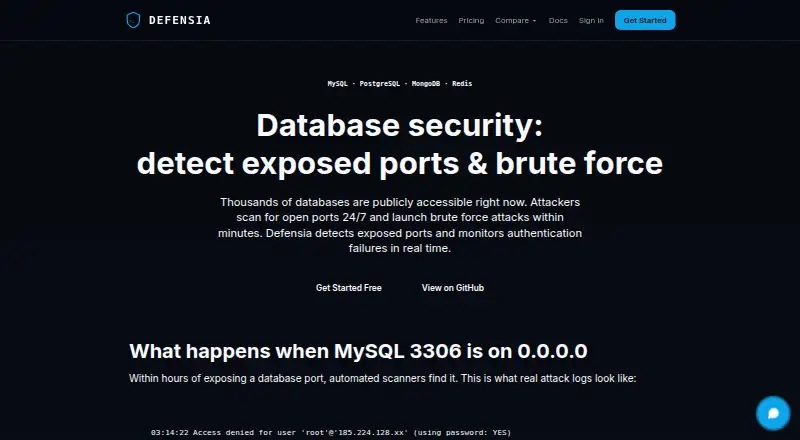
What Defensia Database Security is
Defensia Database Security detects exposed database ports and monitors authentication failures that may signal brute-force attempts. Its agent monitors authentication logs for MySQL/MariaDB, PostgreSQL, and MongoDB, and checks Redis port exposure. At startup, it checks ports 3306, 5432, 27017, and 6379 and adds a dashboard advisory when a port is bound to 0.0.0.0. Repeated authentication failures can trigger IP blocking through iptables or nftables. The agent installs as a systemd service and automatically detects MySQL, PostgreSQL, and MongoDB log files. It requires Linux kernel 4.x or newer, root or sudo access, and HTTPS internet access to the Defensia panel. Deployment options include Docker, Docker Swarm, and Kubernetes, with a Helm chart for Kubernetes. The dashboard shows attack timelines, blocked IPs, and port-exposure advisories. The free plan covers one server and monitors attacks without blocking them. Pro lists Slack, Discord, and webhook alerts. Free includes community support; Pro includes priority email support.
Good
- Monitors authentication logs for three database systems
- Can block IPs after repeated authentication failures
- Supports Docker, Swarm, and Kubernetes deployment
- Dashboard shows attack timelines and port advisories
Watch out
- Requires Linux kernel 4.x or newer and root or sudo
- Free plan is limited to one server
- Free plan monitors without blocking attacks
Who it suits
Defensia Database Security suits Linux operators who want database authentication monitoring and port-exposure alerts. The free plan is for one server and remains in monitor mode rather than blocking attacks.
Verdict
Defensia combines database login monitoring with port checks and optional blocking. The free plan is limited to a single monitored server; Pro adds blocking and alert integrations.
Plans and prices
From Defensia Database Security's own pricing page, checked 3 Oct 2026.
| Plan | Price | What it gives you |
|---|---|---|
| Free | Free | 1 server · 2,000 events/month · 3 days log retention · monitor mode only · Free forever. No credit card required. |
| Pro | €9 a month | Unlimited servers · unlimited events · 90 days log retention · 14-day trial, up to 3 servers · Billed monthly. Switch to annual and save 20%. |
The facts
Each one read from Defensia Database Security's own pages, with the date it was checked.
What it does
- Automatic blocking
- Repeated authentication failures can trigger IP blocking through iptables or nftables.checked 3 Oct 2026
- Dashboard and events
- The dashboard displays attack timelines, blocked IPs, and port-exposure advisories.checked 3 Oct 2026
- Database coverage
- It provides full authentication-log monitoring for MySQL/MariaDB, PostgreSQL, and MongoDB, plus Redis port-exposure detection.checked 3 Oct 2026
- Installation
- The agent installs as a systemd service and automatically detects MySQL, PostgreSQL, and MongoDB log files.checked 3 Oct 2026
- Port checks
- At startup, the agent checks ports 3306, 5432, 27017, and 6379 and creates a dashboard advisory if a port is bound to 0.0.0.0.checked 3 Oct 2026
- Privacy and data
- The privacy policy says account passwords are cryptographically hashed and that connected-server data includes hostnames, IP addresses, operating-system information, and security events.checked 3 Oct 2026
- Privacy compliance
- The privacy policy says Defensia is committed to handling personal information in compliance with GDPR and other applicable data-protection laws.checked 3 Oct 2026
- Pro integrations
- The Pro plan lists Slack, Discord, and webhook alerts.checked 3 Oct 2026
- Purpose
- Defensia detects exposed database ports and monitors database authentication failures for brute-force attacks.checked 3 Oct 2026
- Requirements
- The agent requires Linux kernel 4.x or newer, root or sudo access, and HTTPS internet access to the Defensia panel.checked 3 Oct 2026
- Support
- The Free plan includes community support, while Pro includes priority email support.checked 3 Oct 2026
- Supported deployment
- The product supports Docker, Docker Swarm, and Kubernetes deployment, including a Helm chart for Kubernetes.checked 3 Oct 2026
Money
- Free-plan limit
- The free plan allows one server and detects attacks in monitor mode without blocking them.checked 3 Oct 2026
The company
- Headquarters
- Barcelona, Spainchecked 28 Sep 2026
The full review of Defensia Database Security
Overview
Defensia Database Security pairs a Linux agent with a web dashboard to help teams spot exposed database ports and suspicious login failures. It suits operators who want database-specific monitoring on their own servers, with optional blocking on the paid plan. Its one-server free tier is useful for a limited deployment, but does not block attacks.
Key features
Authentication monitoring covers MySQL/MariaDB, PostgreSQL, and MongoDB, giving teams visibility into failed logins that may signal brute-force attempts. Redis receives port-exposure checks rather than authentication-log monitoring, so its coverage is narrower.
On startup, the agent checks ports 3306, 5432, 27017, and 6379. A port bound to 0.0.0.0 generates a dashboard advisory, a practical warning about exposure across network interfaces rather than a guarantee that the service is vulnerable. The dashboard also brings together attack timelines and blocked IPs.
Repeated authentication failures can trigger IP blocking through iptables or nftables. That response is reserved for Pro; Free remains in monitor mode. Installation as a systemd service and automatic detection of MySQL, PostgreSQL, and MongoDB log files reduce setup work, although the Linux and elevated-access requirements make this a server-operator tool, not a general desktop security app.
Deployment supports Docker, Docker Swarm, and Kubernetes, including a Helm chart. The agent requires Linux kernel 4.x or newer, root or sudo access, and HTTPS internet access to the Defensia panel. This hybrid design keeps an agent on the server while using a web panel for events. Remediation guidance is included, but agentless scanning is not.
Pricing
Free — €0.00 per free. Billed Free forever, with no credit card required. It covers one server, 2,000 events per month, three days of log retention, monitor mode only, and community support. That is a sensible way to monitor a small server, but the event ceiling, short retention, and lack of blocking limit its use for ongoing response or larger estates.
Pro — €9.00 per month. Billed monthly, with an option to switch to annual billing and save 20%. Pro adds unlimited servers and events, 90 days of log retention, blocking, Slack, Discord, and webhook alerts, plus priority email support. Its 14-day trial is limited to up to three servers. Pro is the better fit for teams that need response actions or longer event history; the monthly price buys substantially more operational capacity than Free, though annual billing terms beyond the stated saving are not given here.
Platforms
Defensia supports Linux, self-hosted deployments, and web access. Its Linux kernel and sudo/root requirements rule it out for teams that cannot install a privileged server agent.
Who it's for
Choose Defensia if you manage Linux-hosted MySQL, MariaDB, PostgreSQL, or MongoDB and want login-failure monitoring alongside checks for exposed default ports. It is especially relevant when a Kubernetes, Docker, or Docker Swarm deployment fits your environment. Look elsewhere if you need agentless scanning, Redis authentication monitoring, or blocking without moving beyond the single-server Free plan.
Defensia says account passwords are cryptographically hashed. Connected-server data includes hostnames, IP addresses, operating-system information, and security events; its privacy policy states a commitment to GDPR and other applicable data-protection laws. Those data flows are worth considering when deciding whether to connect production infrastructure to a web panel.
Pros and cons
- Pro: Combines database authentication monitoring with exposure checks, so operators can review two relevant risk signals in one dashboard.
- Pro: Pro supports IP blocking and common alert integrations, making it more useful for teams that need an active response path.
- Pro: Container and Kubernetes deployment options, including a Helm chart, suit varied self-hosted environments.
- Con: Free is capped at one server and 2,000 events per month, with only three days of retention and no blocking.
- Con: A privileged Linux agent is mandatory, which excludes agentless assessments and systems where root or sudo installation is not acceptable.
- Con: Redis is checked for exposed ports but is not among the databases with full authentication-log monitoring.
Alternatives
Database Vulnerability Scanners is the broader category to explore if you want to compare products oriented around database vulnerability scanning.
Choose Oracle Cloud Infrastructure Secret Management instead when managing secrets through its free web and API service is the priority; it is not presented as a database login-monitoring alternative.
Onam Database Security offers a freemium option for cloud-account posture: its free plan covers one cloud account, up to 500 resources, core critical and high CSPM rules, and CIS benchmark coverage. That makes it a better starting point for cloud security posture checks than Defensia's server-focused login and port monitoring.
DBX is a free web option for unlimited schema introspection, database topology and scoring, and finding counts and severity. Pick it when database structure analysis is more relevant than live authentication monitoring.
Omega DB Scanner Standalone is a free Windows application focused on Oracle database security scanning, including specified Oracle 10g, 11g, and 12c versions. It is the more relevant choice for that Oracle-and-Windows use case.
Trellix Data Loss Prevention covers enterprise data loss prevention across endpoints, email, web, networks, and storage, with on-premises or SaaS management; choose it when broad DLP is the requirement.
Banyan Cloud DSPM is another paid web-based option.
CIS-CAT Pro Assessor is a paid, non-trial option with Linux, macOS, Windows, API, and self-hosted platform coverage; consider it when that platform mix is the deciding factor.
Rapid7 Surface Command is a paid option with a free trial and asset discovery, inventory, and internal and external attack-surface visibility. It fits readers prioritizing broader asset context over database-specific login monitoring.
Verdict
Defensia is a focused choice for Linux operators who want database login monitoring and exposed-port advisories, with Pro adding blocking, integrations, and longer retention. The free plan can cover a single modest server, but teams needing response actions, more capacity, or agentless assessment should look elsewhere.
Getting started
- Visit https://defensia.cloud/database-security.
- Choose the Free plan or start the 14-day Pro trial, which covers up to three servers.
- Confirm the server runs Linux kernel 4.x or newer and that you have root or sudo access.
- Provide HTTPS internet access to the Defensia panel.
- Install the agent as a systemd service, or use Docker, Docker Swarm, or Kubernetes; Kubernetes has a Helm chart.
Limits worth knowing
The free plan covers one server, 2,000 events per month, and three days of log retention. It operates in monitor mode without blocking attacks. The 14-day Pro trial is limited to up to three servers.
Questions
Is there a free plan?
Yes. Free includes one server, 2,000 events per month, three days of log retention, and monitor mode only.
How much does Pro cost?
Pro is €9/mo, billed monthly. The plan notes that switching to annual billing saves 20%.
What does Pro add?
Pro includes unlimited servers, unlimited events, 90 days of log retention, Slack, Discord, and webhook alerts, plus priority email support.
Which databases does it cover?
It monitors authentication logs for MySQL/MariaDB, PostgreSQL, and MongoDB, and checks Redis port exposure.
What systems and deployment options does it support?
The agent requires Linux kernel 4.x or newer. Deployment options include Docker, Docker Swarm, and Kubernetes, including a Helm chart for Kubernetes.
Is a trial available?
Yes. The 14-day Pro trial is available for up to three servers.
Alternatives to Defensia Database Security
- 1

CIS-CAT Pro Assessor
Free planAPILinuxmacOSSelf-hosted7.7From $2,400 a year - 2
Microsoft Defender for Business
AndroidiOSAPImacOS7.5 - 3

DBX
Free planWeb7.2$19 one-time - 4

LevelBlue AppDetectivePRO
WebSelf-hostedWindows6.9 - 5

Onam Database Security
Free planWebAPISelf-hosted6.5From $22 a month - 6
DataSunrise
WebLinuxSelf-hostedWindows6.1