
DBX
DBX is a web-based security analysis tool for PostgreSQL and Supabase databases.
What DBX is
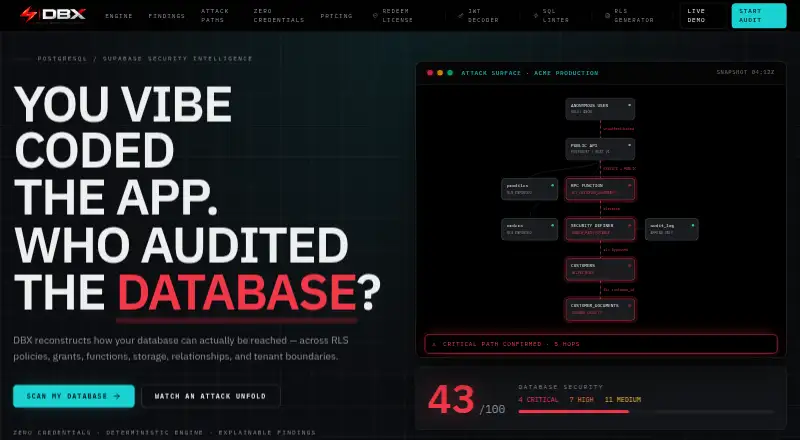
DBX is a web-based security analysis tool for PostgreSQL and Supabase databases. It examines how identities can reach database objects through RLS policies, grants, functions, storage, relationships, and tenant boundaries. DBX inspects live security objects and uses a deterministic rule engine and permission graph to assess practical access. It groups weaknesses into attack paths and reports severity, confidence, and evidence. Each deterministic finding includes a proposed migration tied to the object involved, with an expected security effect and compatibility risk. Its snapshot contains catalog metadata such as schemas, policies, grants, routines, and relationships, not database rows. DBX says the snapshot workflow needs no database password, persistent connection, agent, or production write access; its scanner is designed for a dedicated least-privilege role with catalog access. A language model explains verified findings and drafts remediation for human review. DBX does not test application code, network controls, or client authorization logic, and it makes no compliance certification claims. Free unlimited introspection is offered; Full Remediation is listed at $195, paid once.
Good
- Maps access through policies, grants, and relationships.
- Findings include severity, confidence, and evidence.
- Snapshots contain metadata, not database rows.
- No persistent connection or production write access required.
- Free plan offers unlimited introspection.
Watch out
- Does not test application code or network controls.
- Does not assess client authorization logic.
- Makes no compliance certification claims.
- Full Remediation is $195, paid once.
Who it suits
DBX suits developers and teams building PostgreSQL or Supabase applications, including multi-tenant systems and AI-generated SQL workflows. It is relevant to teams that want to inspect database permissions and review proposed remediation.
Verdict
DBX focuses on database-level access paths and connects findings to proposed migrations for human review. Its stated scope excludes application, network, and client authorization testing.
Plans and prices
From DBX's own pricing page, checked 15 Oct 2026.
| Plan | Price | What it gives you |
|---|---|---|
| Database Scan | Free | Unlimited schemas · topology and score · finding counts and severity · local browser analysis |
| Full Remediation | $19, paid once | 5 unique scans · exact vulnerability details · attack-path graphs · copy-paste SQL remediation · fix verification · Introductory Launch Price |
The facts
Each one read from DBX's own pages, with the date it was checked.
What it does
- Access model
- DBX states that it requires no database password, persistent connection, agent, or production write access for its snapshot workflow.checked 30 Sep 2026
- Analysis method
- DBX introspects live security objects and resolves what each identity can reach in practice.checked 30 Sep 2026
- Attack paths
- DBX links separate weaknesses into multi-hop attack paths with severity and confidence indicators.checked 15 Oct 2026
- Credential handling
- Submitted database credentials are sent to server-side functions over TLS, are not rendered back to the browser, and are not written to logs or analytics events.checked 30 Sep 2026
- Credential model
- The advertised scan workflow uses a read-only catalog snapshot rather than a persistent database connection or production write access.checked 15 Oct 2026
- Credential protection
- Credentials are sent to server-side functions over TLS, encrypted, and excluded from browser rendering, logs, analytics and AI prompts.checked 15 Oct 2026
- Data handling
- The security snapshot contains catalog metadata such as schemas, policies, grants, routines, and relationships, but never database rows.checked 30 Sep 2026
- Data scope
- Snapshots contain catalog metadata and exclude application rows.checked 15 Oct 2026
- Detection method
- A deterministic rule engine and permission graph determine findings; the language model only explains verified results and drafts remediation.checked 15 Oct 2026
- Findings
- DBX connects individual weaknesses into attack paths and reports severity and confidence with evidence.checked 30 Sep 2026
- Founder motivation
- The interview says DBXray originated from the question of who audited the database behind an otherwise finished application.checked 15 Oct 2026
- Independent developer profile
- Theodore Ochsen’s profile says he developed DBXray as a PostgreSQL and Supabase database-security analysis platform.checked 15 Oct 2026
- Independent technical description
- The same profile says DBXray examines database structure, RLS, policies, roles, grants, foreign keys and access patterns.checked 15 Oct 2026
- Independent workflow description
- Ochsen’s profile describes a read-only process in which users run an introspection query and provide the resulting snapshot for analysis.checked 15 Oct 2026
- Intended users
- DBX is positioned for developers and teams building PostgreSQL or Supabase applications, including multi-tenant systems and AI-generated SQL workflows.checked 30 Sep 2026
- Limitations
- DBX does not test application code, network controls, or client authorization logic and makes no compliance certification claims.checked 30 Sep 2026
- Limit: compliance
- The company says DBX does not certify databases as secure and makes no compliance-certification claims.checked 15 Oct 2026
- Limit: coverage
- DBX does not test application code, network controls or client-side authorization logic.checked 15 Oct 2026
- Linter claims
- The SQL-linter page labels the engine version 4.2.0-stable and claims 99.9% audit accuracy.checked 15 Oct 2026
- Local processing
- The homepage says snapshots, findings and remediation data are analyzed locally in the browser and are not retained.checked 15 Oct 2026
- Methodology
- A deterministic rule engine evaluates introspected facts and a permission graph, while a language model only explains verified findings and drafts remediation for human review.checked 30 Sep 2026
- Notable news
- A Signal//Tech founder interview published August 20, 2026 discusses DBXray as a response to database-access risks in rapidly built applications.checked 15 Oct 2026
The company
- Maker attribution
- Signal//Tech identifies Theodore Ochsen as founder of DaemonCore Enterprises and lists DBXray among its projects.checked 15 Oct 2026
- Maker role
- Ochsen’s independent profile lists him as founder and lead software engineer of DaemonCore Enterprises.checked 15 Oct 2026
The full review of DBX
DBX is a web-based analyzer for PostgreSQL and Supabase security configurations. It suits developers and teams managing complex permissions, especially multi-tenant databases or AI-generated SQL, who need a path from a database weakness to a proposed fix. The free tier is useful for broad introspection, while the paid tier is aimed at teams that need detailed attack paths and remediation material.
Overview
DBX reconstructs effective database reach rather than merely displaying individual grants or policies. It evaluates how identities can move through row-level security, functions, storage, relationships, tenant boundaries, and other PostgreSQL or Supabase objects. That focus makes it a strong choice when access depends on several interacting controls and a conventional object-by-object review could miss the combined effect.
Its scope is deliberately database-centric. DBX does not assess application code, network controls, or client-side authorization logic, and it makes no compliance-certification claims. Teams seeking a complete application and infrastructure security program therefore need additional tools.
Key features
The scanner introspects live security objects and resolves what each identity can actually reach. It then joins related weaknesses into attack paths and reports severity and confidence with supporting evidence. This relationship-based output is more useful for prioritization than a flat list of permissions, particularly in systems with multiple tenants or indirect access through routines and storage.
Every deterministic finding can include a proposed migration linked to the object that caused it. The recommendation states the expected security effect and compatibility risk, giving database owners a concrete starting point while preserving human review before deployment. A deterministic rule engine and permission graph perform the evaluation; a language model is restricted to explaining verified findings and drafting remediation, rather than deciding whether a vulnerability exists.
DBX's snapshot contains catalog metadata such as schemas, policies, grants, routines, and relationships, but not database rows. The workflow is described as agentless: no persistent connection, database password, agent, or production write access is required for the snapshot. A dedicated least-privilege role needs CONNECT, schema USAGE, and SELECT on catalog views. Credentials submitted for scanning are sent to server-side functions over TLS, are not returned to the browser, and are not written to logs or analytics events.
Pricing
Database Scan
The free plan costs nothing and is billed as Free Unlimited Introspection. It allows unlimited schema introspection, database topology and score views, and finding counts with severity. Analysis is local, so data never leaves the browser. This is a sensible starting point for developers who need recurring visibility across schemas, but it does not include the paid plan's exact vulnerability detail, attack-path graphs, remediation SQL, or fix verification.
Full Remediation
Full Remediation costs $195, paid once at the Introductory Launch Price. It includes five unique scans, exact vulnerability details, complete attack-path graphs, copy-paste SQL remediation, and the ability to verify fixes after remediation. The one-time structure fits a project or review cycle better than an ongoing subscription, while the five-scan allowance may be limiting for teams that expect to assess many databases or repeat scans frequently.
Platforms
DBX runs on the web and supports cloud databases. Its platform links include Supabase, PostgreSQL, Neon, AWS, GCP, Azure, Render, and DigitalOcean. That combination is practical for teams operating PostgreSQL-compatible services across different cloud providers, although the product remains focused on database access rather than provider-wide controls.
Who it's for
Choose DBX if you build PostgreSQL or Supabase applications and need to understand effective privilege across RLS, grants, routines, storage, and tenant boundaries. It is particularly relevant to multi-tenant teams and workflows that generate SQL with AI, where unintended permission paths can be difficult to spot manually. It is less suitable as a standalone choice for application penetration testing, network review, client authorization testing, or compliance certification.
Pros and cons
Pros
- Effective-access analysis: Resolving what identities can reach across interacting objects exposes risks that isolated grant reviews can miss.
- Attack-path context: Linking weaknesses and supplying severity, confidence, and evidence helps teams prioritize consequential paths.
- Actionable remediation: Object-specific migrations include security impact and compatibility risk, with copy-paste SQL in the paid plan.
- Least-privilege, agentless workflow: Catalog-only snapshots and stated avoidance of persistent connections, agents, and production writes reduce operational exposure.
- Generous free introspection: Unlimited schema introspection and local analysis provide meaningful visibility without a subscription.
Cons
- Narrow scope: Application code, network controls, and client authorization are outside the product, so it cannot serve as a complete security assessment.
- Paid scan cap: Full Remediation includes five unique scans, which may not suit large or continuously changing estates.
- Human deployment remains necessary: Proposed migrations require review and application by the team, especially where compatibility risk is material.
Alternatives
Database Vulnerability Scanners is the broader category to compare when you want options beyond DBX's PostgreSQL- and Supabase-focused approach.
Defensia Database Security is a better fit for Linux, self-hosted, or web deployments needing one monitored server, 2,000 events per month, and three days of retention on its free tier.
Qualys External Attack Surface Management suits teams seeking external asset-surface coverage, with a 30-day CSAM and EASM trial rather than DBX's database-path analysis.
Onam Database Security is preferable for cloud-account posture management, offering a free tier for one cloud account, up to 500 resources, and core critical/high CSPM rules.
Oracle Cloud Infrastructure Secret Management is the relevant choice when the requirement is tenancy-based secret storage and version management.
SQLTriage fits readers wanting a free, self-hosted or Windows tool with all features and no per-server fees or subscription.
Free SQL Server Compliance Benchmark Tool is aimed at SQL Server benchmarking, with more than 80 checks and PDF output.
Omega DB Scanner Standalone is a free Windows application for Oracle database scanning across listed 10g, 11g, and 12c versions.
Trellix Data Loss Prevention is the alternative for enterprise DLP spanning endpoints, email, web, networks, and storage.
Verdict
DBX is recommended for PostgreSQL and Supabase teams that need a defensible picture of effective permissions and a direct route to database-level remediation. Its strongest advantage is connecting verified access weaknesses to attack paths and object-specific migration proposals. Look elsewhere if your priority is application, network, client, compliance, or broad data-loss protection coverage, or if five paid scans cannot accommodate your review program.
Alternatives to DBX
- 1

CIS-CAT Pro Assessor
Free planAPILinuxmacOSSelf-hosted7.7From $2,400 a year - 2
Microsoft Defender for Business
AndroidiOSAPImacOS7.5 - 3

LevelBlue AppDetectivePRO
WebSelf-hostedWindows6.9 - 4

Defensia Database Security
Free planWebLinuxSelf-hosted6.7From €9 a month - 5

Onam Database Security
Free planWebAPISelf-hosted6.5From $22 a month - 6
DataSunrise
WebLinuxSelf-hostedWindows6.1