
DataChain
DataChain is a Python library and context layer for organizing unstructured data so researchers and AI agents can find and reuse data work.
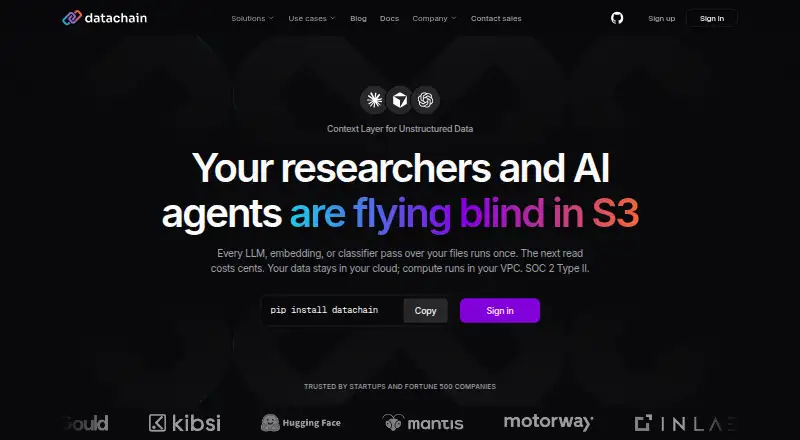
What DataChain is
DataChain is a Python library and context layer for organizing unstructured data so researchers and AI agents can find and reuse data work. It turns files from S3, Google Cloud Storage, Azure Blob Storage, local filesystems, and Hugging Face into typed, versioned datasets that can be queried. Its Dataset DB organizes file references with Pydantic schemas and versioning, while a Knowledge Base keeps summaries, statistics, lineage, and code. DataChain runs parallel Python pipelines locally or across distributed workers, with async I/O and automatic checkpoints. Its agent harness connects Claude Code, Cursor, and Codex through a local skill or Studio MCP. Studio adds job and dataset management, experiment tracking, a model registry, team collaboration, a REST API, and GitHub, GitLab, and Bitbucket connections. Compute can run in a customer VPC, and options include on-prem deployment, role-based access, audit logs, and SSO/SAML. The Open Source plan is free; Teams is $70 per contact. Enterprise pricing is custom.
Good
- Creates typed, versioned datasets from multiple storage sources
- Runs pipelines locally or across distributed workers
- Connects Claude Code, Cursor, and Codex
- Free Open Source plan for a single developer
- Offers on-prem deployment and role-based access
Watch out
- Teams is $70 per contact
- Teams billing is listed as coming soon
- Enterprise pricing is custom
Who it suits
It suits researchers and AI teams working with unstructured files who need queryable, versioned datasets or Python pipelines. Teams needing centralized management, collaboration, or controlled deployment can consider Studio and Enterprise options.
Verdict
DataChain combines file-based dataset organization, Python processing, and tools for agent workflows. Its free plan provides a way to start, while team and enterprise capabilities have separate pricing and deployment considerations.
Plans and prices
From DataChain's own pricing page, checked 7 Oct 2026.
| Plan | Price | What it gives you |
|---|---|---|
| Open Source | Free | Free · local compute · single developer · millions of records · S3, GCS, or Azure storage |
| Teams | Priced on request | Up to 5 users · local compute · billions of records · centralized Dataset DB · S3, GCS, or Azure storage · Coming soon |
| Enterprise | Priced on request | Teams with access control · BYOC centralized Dataset DB · BYOC CPU/GPU clusters · billions of records and distributed compute · Custom |
The facts
Each one read from DataChain's own pages, with the date it was checked.
What it does
- Additional storage
- Documentation lists local filesystems and Hugging Face alongside S3, Google Cloud Storage, and Azure Blob Storage as supported storage sources.checked 7 Oct 2026
- Agent integrations
- Its agent harness connects Claude Code, Cursor, and Codex through a local skill or Studio MCP.checked 7 Oct 2026
- Cloud storage
- The product works with Amazon S3, Google Cloud Storage, and Azure Blob Storage, and says original files stay in the customer’s cloud.checked 7 Oct 2026
- Dataset context
- The Knowledge Base stores summaries, statistics, lineage, and code, while the Dataset DB uses Pydantic schemas, versioning, and file references.checked 7 Oct 2026
- Deployment and control
- The product site says compute can run in the customer’s VPC, offers on-prem deployment, and supports role-based access, audit logs, and SSO/SAML.checked 7 Oct 2026
- Distributed processing
- DataChain can run parallel Python pipelines over files locally or across distributed workers, with async I/O and automatic checkpoints.checked 7 Oct 2026
- Git integrations
- Studio documentation lists connections to GitHub, GitLab, and Bitbucket, including support for self-hosted GitLab servers.checked 7 Oct 2026
- Open-source security
- For downloaded open-source tools, users manage their own credentials and security policies; anonymized usage logging can be disabled.checked 7 Oct 2026
- Purpose
- DataChain describes itself as a context layer for unstructured data that helps researchers and AI agents find and reuse data work.checked 7 Oct 2026
- Python library
- The product is a Python library that turns files in S3, GCS, and Azure into typed, versioned datasets that can be queried.checked 7 Oct 2026
- Security
- The company says it is SOC 2 Type 2 compliant and offers SOC 2 reports on request; its security page lists SOC 2 Type 2 (2026).checked 7 Oct 2026
- Studio features
- DataChain Studio documentation describes job tracking, dataset management, experiment tracking, model registry, team collaboration, and a REST API.checked 7 Oct 2026
- Support
- Customers may request security documents and compliance details by contacting [email protected].checked 7 Oct 2026
The company
- Company location
- DataChain, Inc. lists its address as 450 Townsend St #100, San Francisco, California 94107.checked 7 Oct 2026
Alternatives to DataChain
- 1

Roboflow
Free planAndroidiOSWebAPI8.3From $39 a month - 2

Weights & Biases
Free planAndroidiOSWebAPI8.3From $60 a month - 3

DagsHub
Free planWebAPILinuxmacOS7.9From $99 a month - 4
git-annex
Free planOpen sourceAndroidWebAPILinux7.7Free plan - 5

ClearML
Free planWebAPILinuxmacOS7.4From $15 a month - 6

Neon
Free planWebAPILinuxmacOS7.1$0.11 usage-based