
Control Plane
Control Plane virtualizes cloud infrastructure into an AI-native cloud for workloads deployed across infrastructure selected by the customer.
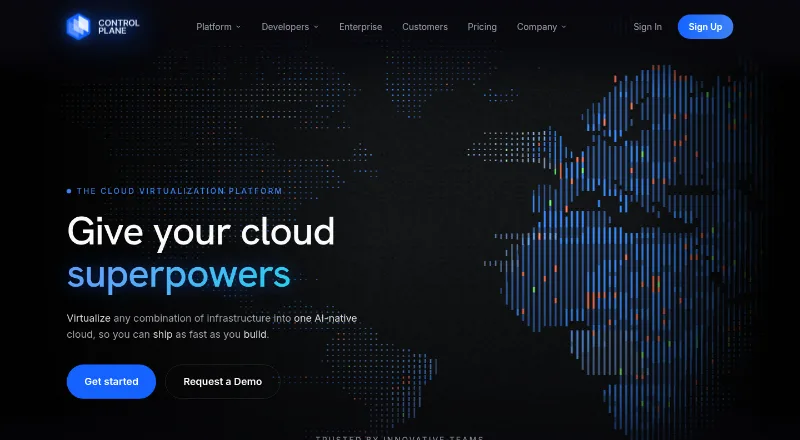
What Control Plane is
Control Plane virtualizes cloud infrastructure into an AI-native cloud for workloads deployed across infrastructure selected by the customer. It supports combinations of bare metal, Kubernetes, and regions from AWS, GCP, Azure, and OCI. Workload types include containers, virtual machines, and ephemeral isolated sandboxes. Universal Cloud Identity is designed to provide credential-free access to services across clouds without embedding credentials in workloads. Networking includes a service mesh, per-workload firewalls, and outbound-only Cloud Wormhole tunnels to private networks. The platform also lists infrastructure provisioning, governance policies, infrastructure as code, role-based access control, audit logs, and Kubernetes management. Named integrations include Terraform, Pulumi, Datadog, Logz.io, and Coralogix. Control Plane says its Capacity AI right-sizes resources and that most customers cut their cloud bill by 30–50%. Usage-based pricing is billed monthly, with listed CPU, memory, and general purpose SSD rates; the first 100 GB-months of observability storage and first 50M metrics samples are free. NVIDIA GPU compute is billed per second, subject to availability.
Good
- Supports AWS, GCP, Azure, and OCI regions
- Includes governance policies and audit logs
- First 100 GB-months of observability storage are free
- First 50M metrics samples are free
Watch out
- Pricing is usage-based
- NVIDIA GPU compute is subject to availability
Who it suits
Control Plane may suit development teams seeking to deploy workloads across infrastructure they choose. It is relevant for teams managing cloud identity, networking, governance, and Kubernetes across multiple providers.
Verdict
Control Plane combines multi-provider infrastructure options with workload, identity, and governance features. Review the usage-based rates and infrastructure requirements to determine whether its deployment model fits your team.
Plans and prices
From Control Plane's own pricing page, checked 29 Sep 2026.
| Plan | Price | What it gives you |
|---|---|---|
| Usage-based pricing | — | CPU $0.06205654 per millicore-month · memory $0.00706330 per megabyte-month · general purpose SSD $0.21224989 per GB-month · 100 GB-months observability storage free · first 50M metrics samples free · Billed monthly; no contracts, minimums, or lock-ins. |
The facts
Each one read from Control Plane's own pages, with the date it was checked.
What it does
- Cloud identity
- Universal Cloud Identity provides credential-free access to services across clouds without embedding credentials in workloads.checked 29 Sep 2026
- Compute
- It supports combinations of bare metal, Kubernetes, and regions from AWS, GCP, Azure, and OCI.checked 29 Sep 2026
- Integrations
- The platform names AWS, GCP, Azure, OCI, Terraform, Pulumi, and integrations including Datadog, Logz.io, and Coralogix.checked 29 Sep 2026
- Networking
- Built-in networking includes a service mesh, per-workload firewalls, and outbound-only Cloud Wormhole tunnels to private networks.checked 29 Sep 2026
- Pricing detail
- The pricing page lists pay-as-you-go NVIDIA GPU compute billed per second, subject to availability.checked 29 Sep 2026
- Product
- Control Plane virtualizes cloud infrastructure into an AI-native cloud for deploying workloads across infrastructure chosen by the customer.checked 29 Sep 2026
- Security
- The maker lists SOC 2 Type II, PCI DSS Level 1, HIPAA, and GDPR, and its compliance page describes encryption at rest and in transit.checked 29 Sep 2026
- Support
- The site lists [email protected] as its support contact.checked 29 Sep 2026
- Who it is for
- The company describes its mission as letting development teams use cloud infrastructure as though it were one cloud.checked 29 Sep 2026
- Workload types
- The platform describes container, virtual machine, and ephemeral isolated sandbox workloads.checked 29 Sep 2026
The company
- Company history
- The About page says Doron Grinstein left VMware in 2019 to build Control Plane.checked 29 Sep 2026
Money
- Cost optimization
- Control Plane says its Capacity AI right-sizes resources and that most customers cut their cloud bill by 30–50%.checked 29 Sep 2026
- Free usage
- The pricing page says the first 100 GB-months of observability storage and first 50M metrics samples are free.checked 29 Sep 2026
The full review of Control Plane
Overview
Control Plane turns customer-selected infrastructure into a unified environment for deploying containers, virtual machines, and isolated sandboxes. It suits development teams that want to deploy across providers while centralizing identity, networking, and governance. Its breadth is compelling, but usage-based charges and the need to provision infrastructure make it a considered choice rather than a turnkey free cloud.
Key features
Control Plane can combine bare metal and Kubernetes with regions from AWS, GCP, Azure, and OCI. That flexibility is useful for teams spanning providers or mixing infrastructure types; it also means the platform is not a substitute for having infrastructure to run workloads on.
Workloads can take the form of containers, virtual machines, or ephemeral isolated sandboxes. Universal Cloud Identity provides credential-free access to services across clouds, avoiding embedded credentials in workloads. Built-in networking includes a service mesh, per-workload firewalls, and outbound-only Cloud Wormhole tunnels to private networks. Together, these features address deployment, access, and connectivity in one platform, though the range is most relevant to teams managing workloads across a varied environment.
Infrastructure provisioning, infrastructure as code, Kubernetes management, role-based access control, governance policies, and audit logs round out the operational toolkit. Integrations include Terraform, Pulumi, Datadog, Logz.io, and Coralogix, alongside the named cloud providers. Capacity AI is intended to right-size resources; Control Plane says most customers reduce cloud bills by 30–50%, a company claim rather than a guaranteed outcome.
The maker lists SOC 2 Type II, PCI DSS Level 1, HIPAA, and GDPR, and describes encryption at rest and in transit. Those credentials matter to teams with compliance requirements, while actual fit still depends on their own deployment and governance needs.
Pricing
Control Plane uses usage-based pricing, billed monthly, with no contracts, minimums, or lock-ins. The listed rates are CPU $0.06205654 per millicore-month, memory $0.00706330 per megabyte-month, and general purpose SSD $0.21224989 per GB-month. There is no listed subscription price to compare against a fixed monthly budget, so teams should estimate consumption across their expected workloads.
The first 100 GB-months of observability storage and first 50M metrics samples are free. Pay-as-you-go NVIDIA GPU compute is billed per second and subject to availability. These free allowances soften the cost of observability, but they are caps, not an unlimited free plan; compute and storage beyond the included amounts can add to the bill. The pricing model is best suited to teams comfortable tracking variable infrastructure usage.
Platforms
Control Plane supports API, Linux, self-hosted, and web access. Its hybrid deployment model and infrastructure provisioning make it a fit for teams that need to connect platform management with infrastructure they choose, rather than a single fixed cloud environment.
Who it's for
Control Plane is aimed at development teams that want cloud infrastructure to behave like one cloud even when workloads span providers and infrastructure types. It is especially relevant when teams need cross-cloud identity, workload-level network controls, and governance in the same operating layer. It is less suitable for buyers seeking a fixed-price plan or a service that removes the need to bring and manage underlying infrastructure.
Pros and cons
- Pros: Combines bare metal, Kubernetes, and major cloud regions, giving teams latitude to place workloads across different infrastructure.
- Pros: Credential-free cloud identity, per-workload firewalls, and outbound-only tunnels address access and private-network connectivity without relying on embedded workload credentials.
- Pros: Infrastructure as code, governance policies, RBAC, audit logs, and Kubernetes management support operational control beyond deployment alone.
- Cons: Usage-based CPU, memory, and storage rates make total spend dependent on consumption rather than a predictable subscription price.
- Cons: The free observability allowances are limited, and GPU compute is subject to availability.
- Cons: Teams must choose and provision the underlying infrastructure, so it is not a complete replacement for cloud-provider resources.
Alternatives
For a broader comparison, browse Multi-Cloud Management Software.
Cloudify is worth considering when a no-time-limit free community plan is more important than Control Plane's usage-based approach; it requires Docker or VM setup and access to a cloud provider to run workloads.
Kubermatic Kubernetes Platform may suit teams seeking an open-source Apache-licensed community edition, with an enterprise edition also offered at consumption-based custom pricing.
Apache CloudStack is a free, open-source IaaS option for teams that prefer that model over Control Plane's paid usage-based service.
Jio CloudXP offers a modular paid platform with custom pricing; choose it when buying only the modules a business needs is the priority.
Xynvera is another paid API and web option to compare.
KubeSphere offers a free, open-source Community Edition for teams looking for a Kubernetes container platform.
OpenNebula provides a community edition with the complete core platform, public open-source releases, and no stated host limit, making it relevant when those terms matter more than Control Plane's cross-provider usage model.
ServiceNow Cloud Management is another paid, web-based alternative.
Verdict
Choose Control Plane if your development team needs a common operating layer for workloads across providers, with identity, networking, and governance built into the deployment model. Its strongest case is the combination of infrastructure choice and cross-cloud controls; its main drawback is that variable usage charges and customer-provisioned infrastructure demand careful cost and operations management.
Alternatives to Control Plane
- 1

Cloudify
Free planOpen sourceWebAPILinuxmacOS8.4From $395 a month - 2

KubeSphere
Free planOpen sourceWebAPILinuxSelf-hosted8.1From $65 a month - 3
Qstack
Free planOpen sourceWebAPILinuxSelf-hosted7.8From CN¥9,999 a year - 4

Apache CloudStack
Free planOpen sourceWebAPILinuxSelf-hosted7.4Free plan - 5
HPE Morpheus VM Essentials Software
WebLinuxSelf-hosted7.0From $600 a year - 6

Kubermatic Kubernetes Platform
Free planWebAPILinuxmacOS6.8Free plan