
conda
Conda is a cross-platform package and environment manager for software built in many programming languages.
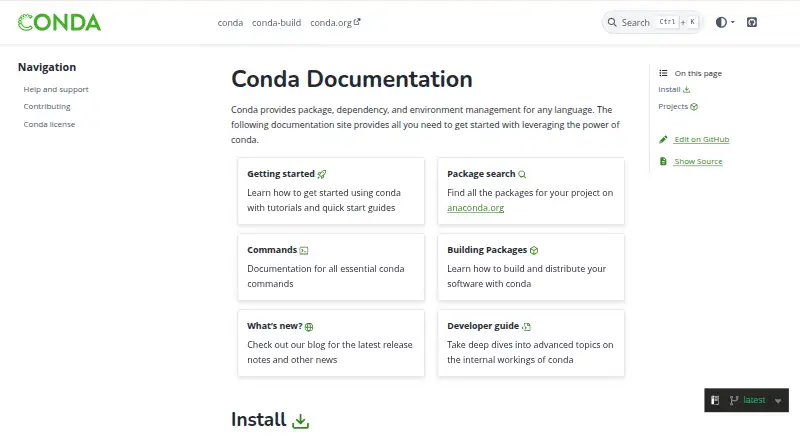
What conda is
Conda is a cross-platform package and environment manager for software built in many programming languages. It can search for, install, update, and remove packages, while keeping project dependencies in separate environments. Packages are obtained from configurable channels, which are locations for distributing software. Users can create environments from environment files and use lockfiles to reproduce resolved environments across Windows, macOS, and Linux when the necessary packages are available. Conda also supports dependency resolution, offline installation, and authenticated channels through plugins. Its command-line interface is BSD-licensed open-source software, and plugins can extend its behavior. It can be used alongside pip in an active environment, although the two systems have compatibility limits. The documentation recommends Miniconda or Miniforge as installation options, configured for different package repositories. Conda itself is free, and it handles .conda and .tar.bz2 package formats. The default channel may require a paid license; conda-forge is free to use.
Good
- Manages packages and isolated project environments
- Supports dependency resolution and lockfiles
- Can install packages offline
- Works on Windows, macOS, and Linux
- Open-source command-line interface
Watch out
- pip and conda packages have compatibility limits
- The default channel may require a paid license
Who it suits
Conda suits developers and technical users who need to manage packages and isolate dependencies across projects. It is useful for work involving multiple languages or environments that need to be recreated across supported operating systems.
Verdict
Conda brings package management and project environments together across several operating systems and languages. Users should account for channel licensing and the compatibility limits when mixing pip and conda packages.
The facts
Each one read from conda's own pages, with the date it was checked.
What it does
- Authentication
- Conda supports authenticated channels through authentication handler plugins, including token and HTTP basic authentication workflows.checked 30 Sep 2026
- Channel licensing limit
- The default channel may require a paid license, while the conda-forge channel is free for all to use.checked 30 Sep 2026
- Channels
- Conda downloads packages from channels, which are locations where packages are stored.checked 30 Sep 2026
- Community governance
- The conda Organization’s governance page describes a volunteer community with a Steering Council and project teams.checked 30 Sep 2026
- Community support
- The conda project points users to its documentation, Zulip chat, social channels, Stack Overflow, and bug reports or feature requests for help.checked 30 Sep 2026
- Dependency resolution
- Yeschecked 21 Sep 2026
- Environment portability
- Conda can create environments from environment files and supports lockfiles to recreate resolved environments across Windows, Linux, and macOS, depending on package availability.checked 30 Sep 2026
- Environments
- Conda lets users create and manage separate environments for projects.checked 30 Sep 2026
- Head office
- Anaconda’s contact page lists an Austin, Texas office at 901 East 6th Street, Austin, TX 78702, USA.checked 30 Sep 2026
- Installers
- The documentation recommends Miniconda or Miniforge to install conda, with Miniconda configured for the Anaconda Repository and Miniforge for conda-forge.checked 30 Sep 2026
- Integrations
- Conda can work with pip in an active conda environment, though the documentation notes unavoidable compatibility limits between pip and conda packages.checked 30 Sep 2026
- Lockfile support
- Yeschecked 21 Sep 2026
- Offline installation
- Yeschecked 21 Sep 2026
- Open source
- The conda command-line interface is BSD-licensed open-source software.checked 30 Sep 2026
- Package channels
- Conda downloads packages from channels, which are URLs to directories containing packages, and users can configure which channels it searches.checked 30 Sep 2026
- Package discovery
- The documentation directs users to Anaconda.org to find packages for projects.checked 30 Sep 2026
- Package formats
- Conda packages can contain system libraries, language modules, executable programs, and metadata, and use the .conda or .tar.bz2 file formats.checked 30 Sep 2026
- Packages
- Conda can search for, install, update, and remove packages in environments.checked 30 Sep 2026
- Package scope
- Conda can manage applications and libraries written in languages including C, C++, Java, Rust, and Go.checked 30 Sep 2026
- pip integration
- Conda documents using pip inside an active conda environment and notes that pip and conda package differences create compatibility limits.checked 30 Sep 2026
- Plugins
- Conda’s behavior can be extended through plugins.checked 30 Sep 2026
Money
- Free plan
- Yeschecked 21 Sep 2026
The company
- Maker relationship
- Anaconda says conda is its package, environment, and dependency manager and that Anaconda was founded in 2012.checked 30 Sep 2026
Where it runs
- Platforms
- The conda site lists Miniconda and Miniforge installers for Windows x86_64, macOS arm64 and x86_64, and Linux x86_64 and aarch64.checked 30 Sep 2026