Conan
Conan is a free, open-source package manager for C and C++ projects.
What Conan is
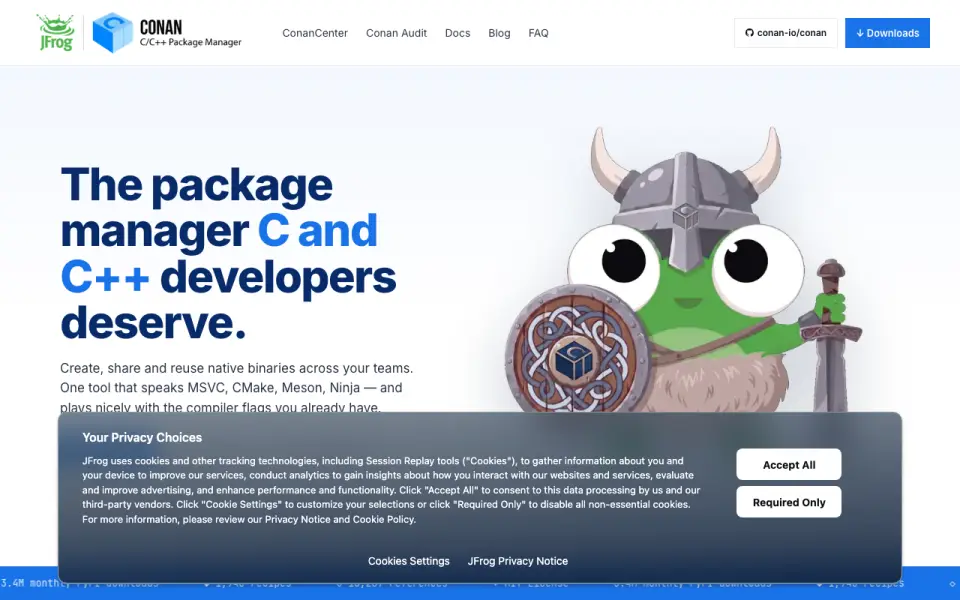
Conan is a free, open-source package manager for C and C++ projects. It handles dependencies and binary packages through Conan recipes, with dependency resolution, lockfiles, workspaces, private registry authentication, and offline installation. Package configurations can account for architectures, compilers, compiler versions, runtimes, and C++ standard libraries. If a matching binary is unavailable, Conan can build from source when needed. It targets desktop, server, mobile, embedded, and bare-metal systems, including Linux, Windows, macOS, Android, and iOS. Build integrations include CMake, MSBuild, Makefiles, Meson, and SCons; it also integrates with tools such as Docker, MinGW, WSL, and JFrog Artifactory. Teams can share and reuse native binaries. Artifactory Community Edition provides a self-hosted option for private packages, with a WebUI, authentication, permissions, CLI, and generic repositories. Conan is released under the MIT License. The project lists 3.4M monthly PyPI downloads, 1,948 recipes, and 10,287 references.
Good
- Supports dependency resolution, lockfiles, and workspaces.
- Can build unavailable binaries from source.
- Targets desktop, server, mobile, embedded, and bare metal.
- Integrates with several build systems and developer tools.
- Released under the MIT License.
Watch out
- The listed package formats are Conan recipes and binary packages.
- Artifactory Community Edition requires hosting on your own server.
Who it suits
Conan suits C and C++ developers managing dependencies and binaries across varied build environments. Teams that need to share native packages or host private packages can use its team-sharing and Artifactory options.
Verdict
Conan covers dependency and binary management across a broad range of target systems and build setups. Its free, open-source model and self-hosted private-package option suit teams prepared to manage their own package infrastructure.
Plans and prices
From Conan's own pricing page, checked 28 Sep 2026.
| Plan | Price | What it gives you |
|---|---|---|
| Conan | Free | Free and open source package manager. · C and C++ package management · Dependency and binary management · Local cache and remote repositories · Free and open source |
| Artifactory Community Edition | Free | Free server for hosting private packages on your own server. |
The facts
Each one read from Conan's own pages, with the date it was checked.
What it does
- Binary Configurations
- Supports different architectures, compilers, compiler versions, runtimes, and C++ standard libraries.checked 28 Sep 2026
- Build Integrations
- Integrates with CMake, MSBuild, Makefiles, Meson, SCons, and proprietary build systems.checked 28 Sep 2026
- Community Group
- The Conan 2.0 community includes more than 70 expert users and contributors.checked 28 Sep 2026
- Dependency resolution
- Yeschecked 22 Sep 2026
- Latest Conan Version
- The downloads page lists Conan 2.32.0.checked 28 Sep 2026
- License
- Conan is released under the MIT License.checked 28 Sep 2026
- Lockfile support
- Yeschecked 22 Sep 2026
- Maintainer Support
- Conan has full-time maintainers supporting many thousands of users.checked 28 Sep 2026
- Monthly Downloads
- The page reports 3.4M monthly PyPI downloads.checked 28 Sep 2026
- Offline installation
- Yeschecked 22 Sep 2026
- Operating Systems
- Works with Windows, Linux, OSX, FreeBSD, and other operating systems.checked 28 Sep 2026
- Package formats
- Conan recipes and binary packageschecked 22 Sep 2026
- Private Packages
- Artifactory CE lets developers host private packages on their own server.checked 28 Sep 2026
- Private registry auth
- Yeschecked 22 Sep 2026
- Recipes Count
- The page reports 1,948 recipes.checked 28 Sep 2026
- References Count
- The page reports 10,287 references.checked 28 Sep 2026
- Repository Features
- Artifactory CE includes WebUI, advanced auth, permissions, generic CLI, and generic repositories.checked 28 Sep 2026
- Source Fallback
- Unavailable binaries can be built from sources on demand.checked 28 Sep 2026
- Support Channels
- Installation support is available through Docs, Slack, and GitHub.checked 28 Sep 2026
- Tool Integrations
- Integrates with Docker, MinGW, WSL, and JFrog Artifactory.checked 28 Sep 2026
Money
- Free plan
- Yeschecked 22 Sep 2026
Where it runs
- Supported platforms
- Linux,Windows,macOS,Android,iOS,embedded and bare-metal targetschecked 22 Sep 2026
- Target Platforms
- Targets desktop, server, mobile, embedded, and bare metal platforms.checked 28 Sep 2026
The company
- Team Sharing
- Teams can create, share, and reuse native binaries across their organizations.checked 28 Sep 2026
The full review of Conan
Overview
Conan is a C and C++ package manager for projects whose dependencies and compiled binaries need to travel across varied build environments. It suits developers and teams managing native software beyond a single desktop platform. Its breadth is a strength, though teams wanting hosted private packages need to operate their own server.
Key features
Dependency and binary management
Conan recipes describe packages, and the manager resolves dependencies while handling binary packages. Lockfiles help preserve a selected dependency set; workspaces support coordinated project work. Local caching, remote repositories, and offline installation make it practical to work with packages even when a remote connection is unavailable. Private registry authentication is supported.
Binary configurations can account for architectures, compilers and compiler versions, runtimes, and C++ standard libraries. When a matching binary is unavailable, Conan can build from source on demand. That flexibility helps teams share and reuse native binaries across an organization, but it also makes Conan a more relevant choice for teams prepared to manage the range of configurations their projects require.
Build and repository integrations
Conan integrates with CMake, MSBuild, Makefiles, Meson, SCons, and proprietary build systems, alongside tools including Docker, MinGW, WSL, and JFrog Artifactory. This range can fit established build pipelines rather than requiring a project to adopt one build system. For private packages, Artifactory Community Edition can be hosted on a team's own server and includes a WebUI, advanced authentication, permissions, a generic CLI, and generic repositories; self-hosting means the infrastructure remains the team's responsibility.
Conan is MIT-licensed. The page reports 3.4M monthly PyPI downloads, 1,948 recipes, and 10,287 references. Its community includes more than 70 expert users and contributors, and full-time maintainers support many thousands of users. Installation support is available through documentation, Slack, and GitHub; the downloads page lists version 2.32.0.
Pricing
Conan
Conan is free and open source. The package manager includes C and C++ dependency and binary management, a local cache, and remote repositories. It is the natural fit for individuals and teams seeking package management without a software fee; the trade-off for private package hosting is that the free Artifactory Community Edition is a server the team runs itself.
Artifactory Community Edition
Artifactory Community Edition is a free server for hosting private packages on your own server. Its repository and access-management features suit teams that need private package infrastructure and can maintain it; teams seeking a hosted service should consider another option.
Platforms
Conan targets desktop, server, mobile, embedded, and bare-metal systems, including Linux, Windows, macOS, Android, and iOS. It also works with FreeBSD and other operating systems. This makes it a strong fit for cross-platform native development, particularly where embedded or bare-metal targets matter.
Who it's for
Conan is best suited to C and C++ developers and organizations that need dependency and binary management across multiple operating systems, build systems, or hardware targets. Its build integrations and configurable binaries are useful where a project must account for different compilers, runtimes, and standard libraries. It is less compelling for teams that do not need native package management or that want private packages without operating their own server.
Pros and cons
- Pros: Broad operating-system and target coverage, including embedded and bare-metal systems, supports projects beyond conventional desktop builds.
- Pros: Binary configurations and on-demand source builds help accommodate differing toolchains and avoid depending on a single prebuilt configuration.
- Pros: Multiple build-system integrations, offline installation, lockfiles, and workspaces cover practical needs across development workflows.
- Cons: Private package hosting through Artifactory Community Edition is self-hosted, so teams must take responsibility for the server.
- Cons: Its focus on C and C++ recipes and native binaries makes it a less direct fit for teams seeking a general-purpose registry for other package ecosystems.
Alternatives
Choose npm instead for public package publishing and use through its free plan, particularly for a Linux, macOS, or Windows workflow centered on public packages. Choose NuGet for a free package-management option with support across API, Linux, macOS, web, and Windows environments.
Inedo ProGet is an alternative for teams considering a freemium package-management service with a free edition offering unlimited feeds for private packages and Docker, alongside limited security and compliance features. R is another free software environment option. Hex offers a freemium package registry with an open-source plan for public packages.
Maven Central is a freemium option for community open-source publishing with monthly file-count, release-size, and release-count limits. PyPI offers a free community-organization plan and a paid company-organization plan at 5.00 USD. RubyGems.org is a free, MIT-licensed alternative. Browse Package Registries or Package Managers for more options.
Verdict
Choose Conan if you manage C or C++ dependencies and binaries across diverse toolchains or targets: its broad integrations, configuration support, and free open-source model make it a capable fit. Look elsewhere if you need a different package ecosystem or private-package hosting without maintaining your own server.