
Coin Wallet
Coin Wallet is a self-custodial multicurrency wallet for buying, storing, sending, receiving, and swapping cryptocurrency.
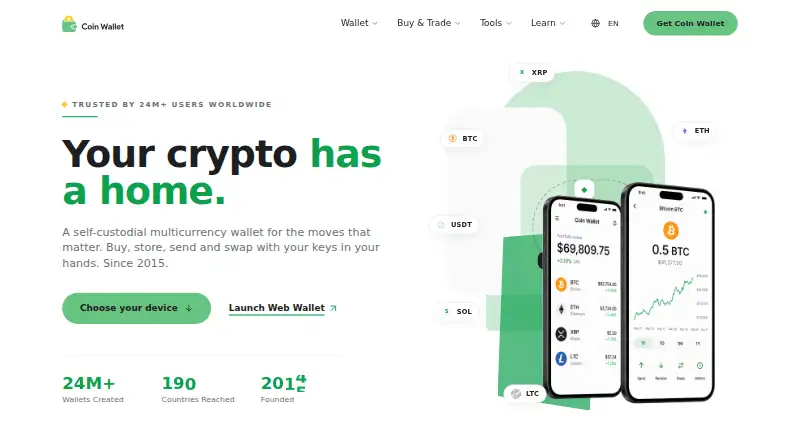
What Coin Wallet is
Coin Wallet is a self-custodial multicurrency wallet for buying, storing, sending, receiving, and swapping cryptocurrency. It supports assets across networks including Bitcoin, Ethereum, Solana, and TRON, and is available on web, iOS, Android, macOS, Windows, and Linux. Private keys are generated and stored on the user's device; Coinspace LLC says it does not take custody of funds. Listed security features include AES-256 device encryption, PIN or biometric login, and FIDO-certified security keys for sensitive actions. Supported keys include FIDO U2F or FIDO2/WebAuthn devices such as YubiKey and Google Titan. The wallet says it requires no registration, supports Tor and VPN routing, and has publicly hosted client code on GitHub. Users can swap supported currencies without an account after reviewing the estimated amount and network fee. Coin Wallet says it charges no deposit fees, but transaction fees vary by cryptocurrency and may include network fees and additional charges. Virtual crypto debit cards are available in version 6.30.0 and up, depending on location, with KYC required during issuance.
Good
- Private keys stay on the user's device
- Supports multiple cryptocurrency networks
- Available on six platform types
- No registration required
- Supports Tor and VPN routing
Watch out
- Transaction fees vary by cryptocurrency
- Additional transaction charges may apply
- Virtual cards depend on location and require KYC
Who it suits
It suits people who want a self-custodial wallet across desktop, mobile, and web platforms. It may also fit users who want account-free swaps and optional security-key support.
Verdict
Coin Wallet combines device-held keys with broad platform availability and account-free swaps. Review transaction fees and local card availability before relying on those options.
Plans and prices
From Coin Wallet's own pricing page, checked 8 Oct 2026.
| Plan | Price | What it gives you |
|---|---|---|
| Coin Wallet | Free | No subscription price stated; transaction fees may apply |
The facts
Each one read from Coin Wallet's own pages, with the date it was checked.
The company
- Company history
- Coinspace LLC says it has built self-custodial crypto software since 2015.checked 8 Oct 2026
- Founded
- 2015checked 28 Sep 2026
What it does
- Fees
- Coin Wallet says it does not charge deposit fees; transaction fees vary by cryptocurrency and may include network fees and additional charges.checked 8 Oct 2026
- Hardware key compatibility
- The wallet supports FIDO U2F or FIDO2/WebAuthn certified security keys, including YubiKey and Google Titan.checked 8 Oct 2026
- Open source
- Coin Wallet says its client code is publicly hosted on GitHub.checked 8 Oct 2026
- Privacy
- The features page says the wallet requires no registration and supports Tor and VPN routing.checked 8 Oct 2026
- Product
- Coin Wallet is a self-custodial multicurrency wallet for buying, storing, sending, receiving, and swapping cryptocurrency.checked 8 Oct 2026
- Security
- The product page lists AES-256 device encryption, PIN or biometric login, and FIDO-certified security keys for sensitive actions.checked 8 Oct 2026
- Support
- Coin Wallet's support portal provides FAQ articles on installation, security, purchases, transactions, and other wallet topics.checked 8 Oct 2026
- Supported assets
- The wallet supports cryptocurrencies and tokens across networks including Bitcoin, Ethereum, Solana, TRON, and others.checked 8 Oct 2026
- Swaps
- Users can swap supported cryptocurrencies without creating an account, after reviewing the estimated amount and network fee.checked 8 Oct 2026
- Virtual cards
- Virtual crypto debit cards are available in Coin Wallet v6.30.0 and up, with availability depending on location and KYC required during issuance.checked 8 Oct 2026
- Wallet control
- Private keys are generated and stored on the user's device, and Coinspace LLC says it does not take custody of funds.checked 8 Oct 2026
Where it runs
- Platforms
- Coin Wallet offers web, iOS, Android, Windows, macOS, and Linux versions.checked 8 Oct 2026
The full review of Coin Wallet
Coin Wallet is a self-custodial wallet for managing crypto across mobile, desktop and web. It is best suited to people who want to control their own keys and make account-free swaps. Its wide platform reach is a strength, but it is not a conventional payment account and transaction costs can vary.
Overview
Private keys are generated and kept on the user's device, while Coinspace LLC says it does not take custody of funds. That arrangement gives users direct control, but also places key management with them; readers seeking an account provider to hold funds should look elsewhere. Peer transfers are supported, and the wallet covers cryptocurrencies and tokens across networks including Bitcoin, Ethereum, Solana and TRON.
Coinspace LLC says it has built self-custodial crypto software since 2015. Coin Wallet's client code is publicly hosted on GitHub, a useful point for readers who value publicly accessible code, though it does not change the responsibility of self-custody.
Key features
The wallet brings buying, storing, sending, receiving and swapping into one product. Swaps do not require an account, and users can review an estimated amount and network fee before confirming. This suits occasional exchanges without a separate swap account, but the estimate is not a fixed price: transaction fees vary by cryptocurrency and may include network fees and additional charges. Coin Wallet says it does not charge deposit fees.
Security options include AES-256 device encryption, PIN or biometric login, and FIDO-certified security keys for sensitive actions. Compatible keys include YubiKey and Google Titan, with support for FIDO U2F and FIDO2/WebAuthn. These options offer additional ways to protect access and sensitive actions, while leaving custody of the keys on the device. The wallet also requires no registration and supports Tor and VPN routing, which will appeal to users who prefer not to create an account.
Virtual crypto debit cards are available in version 6.30.0 and later, but issuance depends on location and requires KYC. This makes the card a conditional extra rather than a dependable reason to choose the wallet. A support portal provides FAQ articles on installation, security, purchases and transactions.
Pricing
Coin Wallet is free: the Coin Wallet plan is free, with no subscription price stated. There is no free trial because the product has a free plan rather than a trial offer. The lack of a subscription cost makes it accessible for occasional use, but it does not mean every transaction is free. Coin Wallet says it charges no deposit fees; transaction fees vary by cryptocurrency and may include network fees and additional charges. Users should review the estimated amount and network fee before swaps.
Platforms
Coin Wallet is available on Web, iOS, Android, macOS, Windows and Linux. That breadth is useful for people who want to access a wallet across phones and computers. Availability on multiple platforms does not change the self-custodial responsibility for private keys.
Who it's for
Coin Wallet is a strong fit for crypto users who prioritize self-custody, want to manage several supported networks, and value swaps that do not require account creation. The combination of device-held keys, broad platform support and optional security-key compatibility gives those users flexibility. It is a weaker fit for anyone who wants predictable transaction pricing, a conventional payment account, or a virtual card without location and KYC conditions.
Pros and cons
Pros
- Private keys stay on the user's device, with no custody of funds by Coinspace LLC.
- Account-free swaps show an estimated amount and network fee before confirmation.
- Available across six platforms, including web, mobile and desktop systems.
- Device encryption, biometric or PIN login, and compatible FIDO security keys provide multiple security options.
Cons
- Users bear the responsibility of controlling their own keys.
- Transaction costs vary by cryptocurrency and may include network fees and additional charges.
- Virtual card issuance is limited by location and requires KYC.
Alternatives
Guarda Wallet is another free wallet with a similar breadth across web, desktop and mobile, plus a browser extension. Its plan is free, with no platform fee, while network fees and possible third-party provider fees apply; choose it if browser-extension support matters to you.
Wise is a freemium personal account and transfer service rather than a self-custodial crypto wallet. Its personal account and transfers have no subscription plan and account registration is free, with charges based on use; choose it for account-based transfers instead of crypto custody.
Google Pay offers online checkout, in-store tap to pay and an API for businesses on a free plan. Pick it for payment checkout and tap-to-pay use rather than managing crypto keys.
Monese is a freemium account option, with a free Pay as you go plan for occasional use and a £2.95 a month Everyday plan. It is a better direction for readers seeking a basic account and bank transfers rather than a crypto wallet.
Solar Wallet is a free Stellar wallet for Android, iOS, Linux, macOS and Windows; its code is published under the GPL license for public auditing. Choose it if a Stellar-focused wallet and GPL-licensed public code better match your needs.
Apple Pay is free and makes sense for readers seeking Apple Pay purchases, with no Apple fees for purchases though a card issuer may apply usual charges or fees.
Armory is a free Bitcoin wallet with cold storage and multi-signature support; consider it if those Bitcoin-specific capabilities are your priority.
easypaisa provides a free mobile account on Android, iOS, API and web, with transaction limits varying by account level. It is an account-based option rather than a self-custodial crypto wallet.
Browse the Digital Wallet Apps list for more options.
Verdict
Choose Coin Wallet if you want self-custody, account-free swaps and access across mobile, desktop and web in a free wallet. Its defining advantage is that keys remain on your device, supported by several login and security-key options. Look elsewhere if you need a conventional payment account, assured card availability or more predictable transaction costs.
Getting started
- Visit https://coin.space/.
- Choose the web wallet or a supported platform: iOS, Android, macOS, Windows, or Linux.
- Use the wallet without registration.
- Review the estimated amount and network fee before swapping supported cryptocurrencies.
Questions
How much does Coin Wallet cost?
The Coin Wallet plan is free at no cost. Coin Wallet says it charges no deposit fees, but transaction fees may apply.
Which platforms does it support?
Coin Wallet is available on web, iOS, Android, macOS, Windows, and Linux.
Does Coin Wallet hold users' funds?
Private keys are generated and stored on the user's device. Coinspace LLC says it does not take custody of funds.
Is Coin Wallet open source?
Coin Wallet says its client code is publicly hosted on GitHub.
Can I use it without registering?
The wallet requires no registration, and supported cryptocurrency swaps can be made without an account.
Are virtual crypto debit cards available everywhere?
Cards are available in Coin Wallet v6.30.0 and up, depending on location. KYC is required during issuance.
Alternatives to Coin Wallet
- 1
Monzo
Free planAndroidiOSWebAPI8.1From £3 a month - 2

Mercado Pago
Free planAndroidiOSWebAPI8.0$1.49 one-time - 3

PayPal Invoicing
Free planAndroidiOSWeb7.8Free plan - 4
Revolut Business
AndroidiOSWebAPI7.7From £10 a month - 5
Cash App Taxes
Free planAndroidiOSWebAPI7.6Free plan - 6
Guarda Wallet
Free planAndroidiOSWebAPI7.6Free plan