CloudSploit
CloudSploit is a free, open-source project for finding possible misconfigurations and security risks in cloud infrastructure accounts.
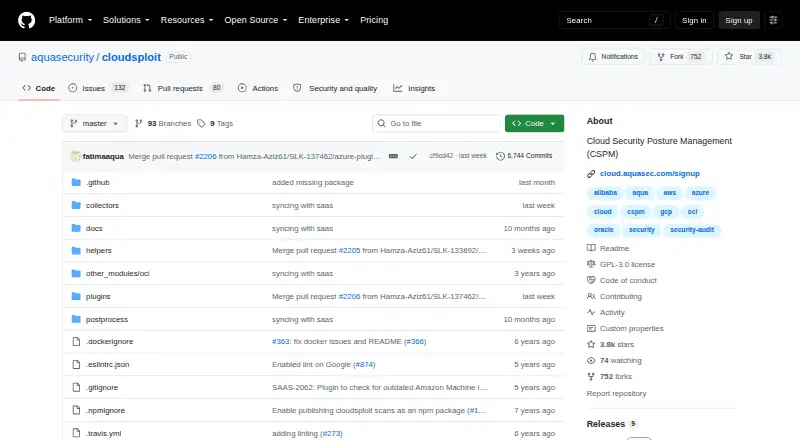
What CloudSploit is
CloudSploit is a free, open-source project for finding possible misconfigurations and security risks in cloud infrastructure accounts. It uses read-only access to collect account metadata through cloud APIs, then examines that information for potential security issues. Supported account types include Amazon Web Services, Microsoft Azure, Google Cloud Platform, Oracle Cloud Infrastructure, and GitHub, providing multi-cloud coverage and cloud asset inventory. The project documents a self-hosted version and a commercial edition hosted at Aqua Wave. The self-hosted edition runs on Linux and can be used through web and self-hosted deployments. Setup uses NodeJS with npm, and Docker build and run instructions are also provided. Its command-line interface maps findings to HIPAA, PCI, and CIS Level 1 and Level 2 requirements. Results can appear in the console or be exported as CSV, JSON, or JUnit XML. A non-zero exit code for non-passing results supports CI/CD workflows. AWS GovCloud and AWS China options are included. CloudSploit is released under GPL-3.0. Its listed capabilities also include automated remediation and Kubernetes security.
Good
- Free self-hosted open-source edition
- Supports five named cloud account types
- HIPAA, PCI, and CIS mappings
- CSV, JSON, JUnit XML, or console output
- Docker setup instructions available
- Non-zero status can support CI/CD checks
Watch out
- Requires read-only cloud-account permission
- Image scanning is not included
- Runtime protection and admission control are absent
- Managed Kubernetes is listed as none
Who it suits
CloudSploit suits teams that need self-hosted, multi-cloud checks across AWS, Azure, Google Cloud, Oracle Cloud, or GitHub accounts. It is also relevant to organizations aligning scans with HIPAA, PCI, or CIS mappings and feeding results into CI/CD systems.
Verdict
Pick CloudSploit for a free, self-hosted way to inspect several cloud accounts and produce compliance-oriented results. Look elsewhere if you need image scanning, runtime protection, admission control, identity security, posture management, or managed Kubernetes.
Plans and prices
From CloudSploit's own pricing page, checked 7 Oct 2026.
| Plan | Price | What it gives you |
|---|---|---|
| Open-source CloudSploit | Free | Self-hosted open-source version |
| Hosted at Aqua Wave | Priced on request | Commercial hosted version; pricing not stated |
The facts
Each one read from CloudSploit's own pages, with the date it was checked.
What it does
- Access required
- CloudSploit requires read-only permission to the cloud account it scans.checked 7 Oct 2026
- AWS regions
- The CLI includes AWS GovCloud and AWS China options.checked 7 Oct 2026
- CI/CD use
- The CLI can exit with a non-zero status when it finds non-passing results, which the README identifies as useful for CI/CD systems.checked 7 Oct 2026
- Cloud providers
- The project lists AWS, Microsoft Azure, Google Cloud Platform, Oracle Cloud Infrastructure, and GitHub as supported accounts.checked 7 Oct 2026
- Deployment
- The project documents a self-hosted open-source version and a commercial version hosted at Aqua Wave.checked 7 Oct 2026
- Docker
- The README provides Docker build and run commands for CloudSploit.checked 7 Oct 2026
- Installation
- The README instructs users to install NodeJS and run npm install for setup.checked 7 Oct 2026
- License
- The GitHub repository lists the project under the GPL-3.0 license.checked 7 Oct 2026
- Output formats
- Results can be written as CSV, JSON, or JUnit XML, or printed to the console.checked 7 Oct 2026
- Purpose
- CloudSploit is an open-source project for detecting potential misconfigurations and security risks in cloud infrastructure accounts.checked 7 Oct 2026
- Scanning process
- It collects account metadata through cloud infrastructure APIs, then scans the collected data for potential misconfigurations, risks, and other security issues.checked 7 Oct 2026
Where it runs
- Compliance mappings
- The CLI supports HIPAA, PCI, and CIS Level 1 and Level 2 compliance mappings.checked 7 Oct 2026
The company
- Founded
- 2015checked 28 Sep 2026
- Headquarters
- Boston, Massachusetts, United States and Ramat Gan, Israelchecked 28 Sep 2026
The full review of CloudSploit
CloudSploit is an open-source scanner for finding cloud-account misconfigurations and security risks across multiple providers. It best suits engineering and security teams comfortable operating a self-hosted CLI and needing repeatable compliance checks. The bottom line is straightforward: it delivers broad account inspection at no software cost, but it is not a complete cloud or workload protection suite.
Overview
CloudSploit collects account metadata through cloud-infrastructure APIs and evaluates that data for potential misconfigurations, risks, and other security issues. It supports AWS, Microsoft Azure, Google Cloud Platform, Oracle Cloud Infrastructure, and GitHub accounts, making it a practical choice when one scanner must cover a mixed estate. The scanner requests read-only permissions, which limits the access granted to the tool; teams still need a separate process to investigate and fix findings, even though automated remediation is included among its capabilities.
The project began in 2015 and is published under the GPL-3.0 license. Aqua Wave also hosts a commercial version, while the documented community edition is self-hosted.
Key features
Compliance-oriented checks map to HIPAA, PCI, and CIS Level 1 and Level 2 benchmarks. That mapping gives regulated teams a defined way to organize results rather than treating every finding as an undifferentiated alert. Output can be printed to the console or written as CSV, JSON, or JUnit XML, so results can feed reports and other engineering systems.
For automation, the CLI can return a non-zero status when checks do not pass. That makes it suitable for CI/CD gates that should flag configuration drift before deployment. AWS GovCloud and AWS China options are useful for teams operating in those regional environments. Cloud asset inventory and Kubernetes security broaden its coverage beyond a narrow account checklist, and multi-cloud support avoids maintaining a different scanner for each provider.
Installation requires NodeJS followed by npm install. Docker build and run commands are documented as an alternative, which helps teams standardize execution in a container. This remains an operator-managed tool: the self-hosted model places setup, scheduling, storage, and follow-up work with your team.
Pricing
Open-source CloudSploit — free: The self-hosted open-source version includes the scanner without a software charge. It fits teams with the skills and infrastructure to run a CLI, manage read-only credentials, and process findings themselves. The trade-off is operational ownership rather than a managed service.
Hosted at Aqua Wave — custom pricing: This is the commercial hosted version.
Platforms
CloudSploit runs on Linux, is self-hosted, and provides a web presence through the hosted offering. Its documented setup is command-line and container friendly rather than a native desktop application.
Who it's for
Choose CloudSploit when you need one free scanner for AWS, Azure, Google Cloud, Oracle Cloud Infrastructure, and GitHub accounts, with compliance mappings and CI/CD-friendly output. It is particularly suited to teams that can operate NodeJS or Docker tooling and want read-only inspection across several accounts.
Look elsewhere if your requirement is image scanning, runtime protection, admission control, identity security, posture management, or managed Kubernetes. Those omissions make CloudSploit a focused configuration and inventory scanner, not an end-to-end cloud security platform.
Pros and cons
Pros
- Broad provider coverage: AWS, Azure, Google Cloud, Oracle Cloud Infrastructure, and GitHub accounts can be inspected through one project.
- Useful compliance output: HIPAA, PCI, and CIS Level 1 and Level 2 mappings give checks a recognizable control structure.
- Automation-ready formats: CSV, JSON, JUnit XML, console output, and non-zero failure status support reporting and CI/CD workflows.
- Low-permission scanning: Read-only access reduces the privileges required by the scanner.
- Free self-hosted edition: The open-source version costs nothing and can run with NodeJS or Docker.
Cons
- Self-hosting workload: Installation, execution, and finding management remain your responsibility.
- Narrow security scope: There is no image scanning, runtime protection, admission control, identity security, or posture management.
- Limited managed option clarity: The Aqua Wave hosted version uses custom pricing, with no published price or terms.
Alternatives
For Kubernetes policy checks, Fairwinds Polaris is a free, self-hosted open-source policy engine aimed at small teams. Kubescape is another free self-hosted option, offering a CLI and Kubernetes operator under Apache 2.0.
Monokle provides a free open-source desktop application, while Kyverno is a free Apache-licensed project for teams choosing that policy approach. KSPM Pro has a free web plan limited to one Kubernetes cluster with real-time scans.
For runtime-focused Kubernetes security, consider free open-source KubeArmor, Tetragon, or Falco. Browse Cloud Security Posture Management Software, Security Configuration Management Software, Kubernetes Security Software, Container Security Software, Infrastructure Testing Tools, and LLM Evaluation Tools when your selection needs extend beyond CloudSploit's account-scanning focus.
Verdict
Pick CloudSploit if you want a free, self-hosted way to inspect several cloud accounts, maintain an asset inventory, and produce compliance-oriented results for automation. Its main reason to choose it is multi-cloud breadth with machine-readable output and read-only access. Look elsewhere when you need runtime or workload defenses, identity and posture management, admission control, image scanning, or a managed Kubernetes security service.
Getting started
- Open the CloudSploit GitHub website
- Install NodeJS
- Run npm install
- Build and run the provided Docker commands instead, if preferred
- Grant CloudSploit read-only permission to the cloud account
- Run the command-line scans and choose console, CSV, JSON, or JUnit XML output
Limits worth knowing
The free Open-source CloudSploit plan is the self-hosted edition at no cost. The listed scope excludes image scanning, posture management, runtime protection, admission control, and identity security, while managed Kubernetes is listed as none.
Questions
Is CloudSploit free?
The Open-source CloudSploit plan is listed as free and is self-hosted. A commercial hosted version is available at Aqua Wave.
Which cloud accounts does it support?
Supported accounts include AWS, Microsoft Azure, Google Cloud Platform, Oracle Cloud Infrastructure, and GitHub.
What access does scanning require?
CloudSploit requires read-only permission to the cloud account it scans.
Which compliance mappings are available?
The CLI supports HIPAA, PCI, and CIS Level 1 and Level 2 mappings.
How can results be exported?
Results can be printed to the console or written as CSV, JSON, or JUnit XML.
Can it run in CI/CD?
The CLI can return a non-zero status when it finds non-passing results, which supports CI/CD use.
Alternatives to CloudSploit
- 1

Aikido CSPM
Free planWebAPILinuxmacOS7.9From $300 a month - 2

Mondoo CSPM
Free planOpen sourceWebAPIExtensionLinux7.7Free plan - 3
Microsoft Defender for Business
AndroidiOSAPImacOS7.5 - 4

Sysdig Secure
WebAPILinuxmacOS7.2From $20 a month - 5

Powerpipe
Free planWebLinuxmacOSSelf-hosted7.1Free plan - 6

Oracle Cloud Infrastructure Secret Management
Free planWebAPI7.0Free plan