Cloudpods
Cloudpods is open-source software for managing enterprise IaaS resources and different cloud infrastructures from one place.
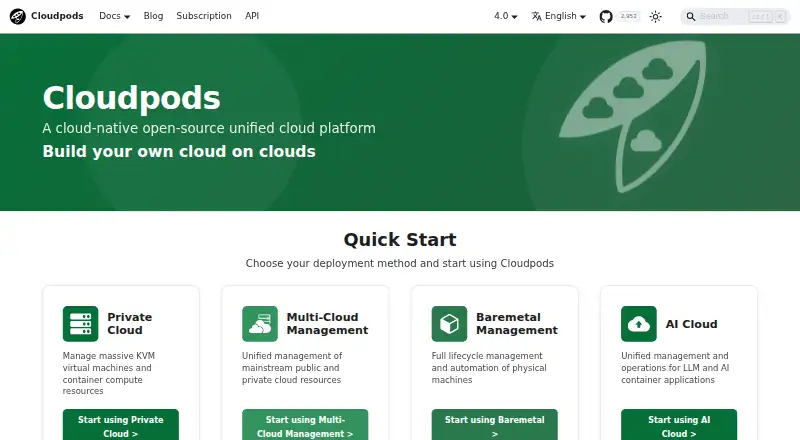
What Cloudpods is
Cloudpods is open-source software for managing enterprise IaaS resources and different cloud infrastructures from one place. Its unified management platform connects public and private resources through cloud accounts. The built-in private cloud is based on KVM and manages virtual machines, storage, networks, GPU cards, and bare metal. Documented connections include Alibaba Cloud, Azure, Tencent Cloud, AWS, Huawei Cloud, UCloud, Google Cloud, VMware, ZStack, DStack, and OpenStack. Cloudpods supports self-built Kubernetes clusters and management of existing clusters, including synced AWS EKS, Alibaba Cloud ACK, Azure AKS, and Tencent Cloud AKS clusters. Its AI Cloud manages LLM inference and AI container applications with GPU scheduling, model libraries, templates, and images. Documented AI applications include Ollama, Dify, OpenClaw, HermesAgent, and ComfyUI. Access tools include multi-tenant IAM, multi-cloud SSO, the climc command-line tool, and REST APIs. Deployment options include private-cloud installation with ocboot and multi-cloud deployment through Docker Compose or Kubernetes with Helm. Open-source features are free; paid enterprise editions have listed annual prices or tailored pricing.
Good
- Manages public and private cloud resources together.
- Built-in KVM private cloud includes GPU and bare-metal management.
- Supports documented integrations across multiple cloud platforms.
- Provides multi-tenant IAM, SSO, CLI, and REST APIs.
- Open-source community edition is free.
Watch out
- Ollama inference and ComfyUI require a GPU.
- Basic enterprise editions have annual per-resource or per-socket prices.
- Advanced Enterprise pricing depends on resources or customized modules.
Who it suits
Cloudpods suits organizations managing enterprise IaaS across private and public clouds, including teams working with Kubernetes or AI workloads. Its self-hosted deployment options and APIs may suit teams that need to operate and integrate their own cloud management platform.
Verdict
Cloudpods brings private-cloud, multi-cloud, Kubernetes, and AI management capabilities into one platform. Its open-source edition is free, while enterprise editions use per-resource, per-socket, or tailored pricing.
Plans and prices
From Cloudpods's own pricing page, checked 15 Oct 2026.
| Plan | Price | What it gives you |
|---|---|---|
| Open Source Community Edition | Free | Cloudpods open-source features · GitHub Issues and technical group support |
| Basic Enterprise Edition — cloud management | CN¥999 a year | 5×8 remote support · 7×24 emergency response · annual license per 10 billable cloud resources |
| Basic Enterprise Edition — private cloud | CN¥1,999 a year | 5×8 remote support · 7×24 emergency response · annual license per host CPU socket |
| Advanced Enterprise Edition | Priced on request | Pricing depends on resource quantity, CPU sockets or customized modules · 5×8 remote support · 7×24 emergency response |
The facts
Each one read from Cloudpods's own pages, with the date it was checked.
What it does
- Access and APIs
- Cloudpods provides multi-tenant IAM, multi-cloud SSO, a command-line tool called climc, and REST APIs and models.checked 29 Sep 2026
- AI features
- AI Cloud manages LLM inference and AI container applications, with GPU scheduling, model libraries, templates, and images.checked 29 Sep 2026
- AI inference
- AI Cloud can deploy Ollama, vLLM and SGLang inference services with GPU scheduling, model mounting and service-address allocation.checked 15 Oct 2026
- AI integrations
- The AI Cloud documentation lists Ollama, Dify, OpenClaw, HermesAgent, and ComfyUI as supported applications or inference services.checked 29 Sep 2026
- API surface
- Cloudpods exposes APIs through separate backend services, with internal Kubernetes endpoints and public NodePort endpoints.checked 15 Oct 2026
- Bare metal
- Cloudpods manages bare-metal resources and supports operating-system installation workflows.checked 15 Oct 2026
- Deployment
- The documentation describes private-cloud deployment with ocboot and multi-cloud deployment through Docker Compose or Kubernetes with Helm.checked 29 Sep 2026
- Documentation depth
- The repository links separate getting-started, user, operations, development, API, Swagger, release-note and changelog documentation.checked 15 Oct 2026
- Identity and access
- The platform provides multi-cloud single sign-on, RBAC and IAM.checked 15 Oct 2026
- Install prerequisite
- The installer requires Ansible version 2.11.12 or later-compatible packages and Git.checked 15 Oct 2026
- Integrations
- Documented cloud platforms include Alibaba Cloud, Azure, Tencent Cloud, AWS, Huawei Cloud, UCloud, Google Cloud, VMware, ZStack, DStack, and OpenStack.checked 29 Sep 2026
- Kubernetes
- The feature set includes Kubernetes cluster management alongside database and infrastructure resources.checked 15 Oct 2026
- License
- The main Cloudpods repository is released under the Apache License 2.0.checked 15 Oct 2026
- Limit: deployment complexity
- The installer requires a clean operating system without preinstalled Kubernetes or Docker because it builds its own Kubernetes cluster and warns of conflicts otherwise.checked 15 Oct 2026
- Limit: open issues
- The public issue tracker shows 176 open issues, including reports about CPU display, ARM startup, container-port mapping, Ceph permissions and failed installations.checked 15 Oct 2026
- MCP integration
- An MCP server connects Cloudpods to clients such as Cursor and Cline through SSE or stdio.checked 15 Oct 2026
- MCP tools
- The MCP server documents 15 read and write tools for images, networks, regions, servers, storage, VPCs and monitoring.checked 15 Oct 2026
- Model library
- The model library manages model sources, versions and caches and supports reuse across instances and offline distribution.checked 15 Oct 2026
- Monitoring
- Monitoring and operations functions are included in the documented feature list.checked 15 Oct 2026
- Multi-cloud
- The platform manages public and private cloud resources through cloud accounts and presents them in a unified management platform.checked 29 Sep 2026
Where it runs
- AI applications
- AI Cloud supports containerized applications including OpenClaw, Dify, ComfyUI and Hermes Agent.checked 15 Oct 2026
- Limit: platform coverage
- The project’s own Ubuntu 22.04 support issue describes earlier deployment support as centered on CentOS 7, Debian 10 and Kylin, showing that OS compatibility has required separate adaptation work.checked 15 Oct 2026
The company
- Company headquarters
- The yunionio GitHub organization lists Beijing, China as its location.checked 15 Oct 2026
- Company identity
- Cloudpods is developed by Beijing YunionCloud Technology Co., Ltd., whose commercial YunionCloud product began development in 2017 and whose Cloudpods code was open-sourced on GitHub in 2019.checked 15 Oct 2026
The full review of Cloudpods
Cloudpods is an open-source control plane for teams operating private infrastructure, public clouds, Kubernetes clusters, and AI workloads together. It is best suited to platform engineers who can run self-hosted management software and want one governance layer across varied estates. The trade-off is operational responsibility and enterprise pricing that rises with resources or host sockets.
Overview
Cloudpods combines a KVM-based private cloud with connectors for public and hosted environments. It can administer virtual machines, storage, networks, GPU cards, and bare metal, then present those assets alongside external cloud accounts in a common interface. Multi-tenant IAM, policy governance, approval controls, scheduled automation, multi-cloud SSO, the climc command-line client, and REST APIs make it suitable for an internal platform rather than a simple inventory screen.
Deployment is self-managed: private-cloud installations use ocboot, while multi-cloud deployments can run through Docker Compose or Kubernetes with Helm. That gives infrastructure teams control over placement and architecture, but requires them to own installation and ongoing operations.
Key features
Heterogeneous cloud management
Cloud accounts unify Alibaba Cloud, Azure, Tencent Cloud, AWS, Huawei Cloud, UCloud, Google Cloud, VMware, ZStack, DStack, and OpenStack resources. This is a strong fit for organisations consolidating several providers or mixing on-premises capacity with public services. Teams running one cloud only may gain less from the broad connector set.
Kubernetes and AI Cloud
Cloudpods can create self-built Kubernetes clusters and manage existing ones, including synchronised AWS EKS, Alibaba Cloud ACK, Azure AKS, and Tencent Cloud AKS clusters. Its AI Cloud layer adds GPU scheduling, model libraries, templates, images, LLM inference, and AI container applications. Ollama, Dify, OpenClaw, HermesAgent, and ComfyUI are documented integrations. GPU planning matters: Ollama inference and ComfyUI require a GPU, while Dify, OpenClaw, and HermesAgent do not, so not every AI workflow needs accelerator hardware.
Access and security
HTTPS protects component traffic, Keystone authorises inter-service REST calls, and administrators can use MFA, password controls, and network policies. These controls, together with tenant isolation and approvals, make Cloudpods more appropriate for governed enterprise environments than an unmanaged collection of provider consoles.
Pricing
Open Source Community Edition
The community edition costs nothing. Open-source features are free, with free GitHub Issues and technical chat support. It is the logical starting point for teams comfortable supporting their own deployment, but paid remote support and enterprise features are not included.
Basic Enterprise Edition — cloud management
This plan costs CN¥999 a year, billed ¥999 per ten cloud resources per year. It suits a modest multi-cloud estate that needs commercial coverage; the per-10-resource meter means costs increase as connected resources grow.
Basic Enterprise Edition — private cloud
Private-cloud licensing is CN¥1,999 a year, billed ¥1999 per host CPU socket per year. It fits KVM-based installations where socket count is a clearer planning unit than virtual-machine count. Larger hosts or expansion directly increase the annual bill.
Advanced Enterprise Edition
Advanced Enterprise uses custom pricing based on resource quantity, server CPU sockets, or tailored modules. Choose it when standard editions do not cover required enterprise capabilities; buyers must obtain a quote before budgeting.
Platforms
Cloudpods provides API, Linux, web, and self-hosted access. Its deployment options are designed for infrastructure teams that want to keep the control plane in their own environment.
Who it's for
Cloudpods is a strong choice for platform teams managing mixed private and public infrastructure, multiple Kubernetes distributions, or GPU-backed AI services under shared IAM and policy controls. It also suits organisations that need approvals and scheduled automation across tenants. It is less suitable for small teams seeking a hosted, hands-off console, or for estates with no need to combine providers and on-premises resources.
Pros and cons
Pros
- Broad infrastructure coverage: KVM private cloud, major public providers, VMware, OpenStack-family platforms, Kubernetes, and bare metal share one management layer.
- Useful platform controls: Multi-tenant IAM, SSO, MFA, approvals, policies, automation, CLI, and REST APIs support repeatable operations.
- Open-source entry point: The community edition is free and can be deployed without a commercial license.
- AI workload tooling: GPU scheduling and model/application building blocks address inference and containerised AI operations.
Cons
- Self-hosting burden: ocboot, Docker Compose, or Helm deployments leave installation and maintenance with the customer.
- Resource-based licensing: Paid editions charge per ten cloud resources or per host CPU socket, making growth a direct cost driver.
- Uneven AI hardware needs: Ollama and ComfyUI require GPUs, which can add infrastructure cost before those integrations are usable.
- Advanced pricing is bespoke: The top tier cannot be budgeted from a published rate.
Alternatives
Choose Kubermatic Kubernetes Platform when Kubernetes lifecycle management is the priority and an Apache-licensed community edition is sufficient. Apache CloudStack is a simpler open-source IaaS-focused alternative for teams that do not need Cloudpods' wider provider and AI scope. Pick Rundeck for runbook automation rather than unified cloud and cluster management. Cloudify suits users wanting a Docker- or VM-based community deployment tied to a cloud provider. Juju is an open-source orchestration engine when application orchestration is the central requirement. Cycloid is preferable to teams wanting a SaaS free tier with up to five users, one workspace, RBAC, SSO, and MFA. Azion Content Delivery targets edge workloads and offers a free hobby tier, not an enterprise IaaS control plane. Clouder is aimed at mobile DNS, workers, pages, and monitoring access rather than infrastructure orchestration.
For a broader category comparison, see Cloud Automation Software.
Verdict
Choose Cloudpods if you need one self-hosted control plane for heterogeneous clouds, KVM infrastructure, Kubernetes, and AI operations, with governance and APIs built in. Its main reason to look elsewhere is the operational overhead of running it yourself and the way paid licensing scales with resources or CPU sockets.
Alternatives to Cloudpods
- 1

Cloudify
Free planOpen sourceWebAPILinuxmacOS8.4From $395 a month - 2
Rundeck
Free planOpen sourceWebAPILinuxmacOS8.1From $125 a month - 3

Apache CloudStack
Free planOpen sourceWebAPILinuxSelf-hosted7.4Free plan - 4
HPE Morpheus VM Essentials Software
WebLinuxSelf-hosted7.0From $600 a year - 5

Cycloid
Free planWebAPILinuxSelf-hosted6.9From $45 a month - 6
Juju
Free planAPILinuxmacOSSelf-hosted6.9Free plan