
Cloudforet
Cloudforet is a free, open-source platform for managing public and private clouds from a centralized, self-hosted deployment.
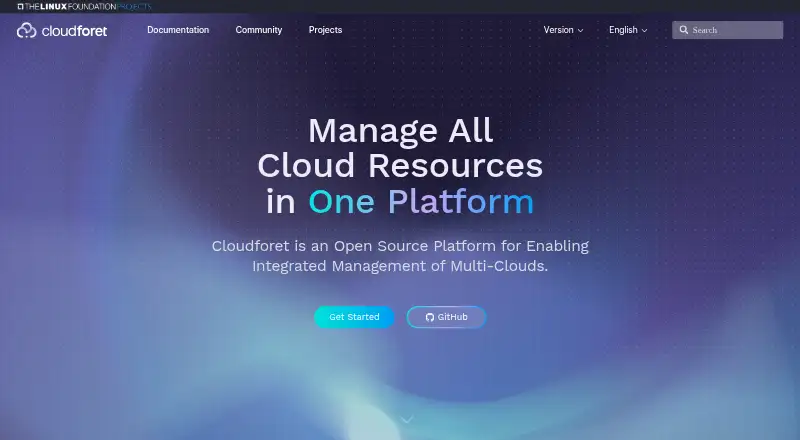
What Cloudforet is
Cloudforet is a free, open-source platform for managing public and private clouds from a centralized, self-hosted deployment. Its inventory collector plugins gather assets and scan resources across connected cloud accounts. The platform covers infrastructure as code, batch remote commands, and an application catalog for software such as databases and middleware. Cost tools include billing analysis, resource optimization, and budget management; incident features include real-time notifications and post-mortems. Projects and project groups organize resources, while role-based access control manages user access. Cloud service plugins are listed for AWS, Microsoft Azure, and Google Cloud; its stated cloud coverage also includes Oracle Cloud Infrastructure and Alibaba Cloud. Monitoring and notification connections include CloudWatch, Azure Monitor, Google Cloud monitoring, Zabbix, Grafana, Slack, Telegram, and email. Users can authenticate with local credentials or external identity options such as Google OAuth2, Active Directory, and Keycloak. Cloudforet also describes security vulnerability analysis, open APIs, and a plugin architecture for extending the platform.
Good
- Open-source platform with a free plan
- Inventory scans assets across connected accounts
- Includes billing analysis and budget management
- Supports several cloud and monitoring integrations
- Offers role-based access control
Watch out
- Self-hosted deployment is required
- Minikube installation guide is marked not for production
- Community support is through GitHub Discussions
Who it suits
Cloudforet suits businesses managing public and private clouds that want centralized resource management, monitoring, and automation. It is aimed at users comfortable with self-hosted deployment and a developer-oriented installation guide.
Verdict
Cloudforet brings inventory, cost management, automation, and incident features into a self-hosted multi-cloud platform. Its installation guidance is developer-focused and explicitly not for production, so deployment fit matters.
Plans and prices
From Cloudforet's own pricing page, checked 30 Sep 2026.
| Plan | Price | What it gives you |
|---|---|---|
| Cloudforet | Free | Open-source platform · self-hosted deployment |
| Custom quote | Priced on request | pricing available upon request |
The facts
Each one read from Cloudforet's own pages, with the date it was checked.
What it does
- Access control
- The homepage says projects and project groups organize resources and RBAC controls user access.checked 30 Sep 2026
- Alert Manager
- Alert Manager consolidates events from multiple monitoring systems and supports rules, webhooks, maintenance windows, notifications and escalation policies.checked 15 Oct 2026
- API
- Developer documentation covers versioned gRPC APIs, protobuf specifications and API/SDK guidance.checked 15 Oct 2026
- API and extensibility
- The homepage says Cloudforet provides open APIs and a plugin architecture that lets users build and share plugins.checked 30 Sep 2026
- API reference
- The public API reference documents Board, Config, Cost Analysis, Dashboard, Identity, Inventory, Monitoring, Notification, Plugin, Repository, Secret and Statistics services.checked 15 Oct 2026
- Architecture
- Cloudforet uses loosely coupled microservices with Kubernetes, gRPC, Helm, Prometheus and Istio.checked 15 Oct 2026
- Asset inventory
- It collects and categorizes resources from connected cloud accounts and makes them searchable in a central dashboard.checked 15 Oct 2026
- Authentication
- Cloudforet supports local ID and password authentication and lists Google OAuth2, Active Directory, and Keycloak as external identity options.checked 30 Sep 2026
- Capterra pricing status
- Capterra lists pricing as contact vendor, with no free trial and no free version in its catalog entry.checked 15 Oct 2026
- CLI
- The cfctl command-line client supports service discovery, environment switching, token authentication and table, YAML, JSON and CSV output; binaries are documented for macOS, Linux, Windows and Docker.checked 15 Oct 2026
- Cloud integrations
- Official collectors exist for AWS, Microsoft Azure and Google Cloud.checked 15 Oct 2026
- Cloud orchestration
- The overview lists infrastructure as code, batch remote commands, and an application catalog for software such as databases and middleware.checked 30 Sep 2026
- Dashboards
- Users can build dashboards from widgets with configurable variables, date ranges and display options.checked 15 Oct 2026
- Deployment
- The installation guide describes deployment with Minikube and says it is a developer guide, not for production.checked 30 Sep 2026
- Documentation depth
- Docs cover user administration, projects, dashboards, inventory, costs, alerting, IAM, architecture, microservices, plugins, APIs, CI/CD and contribution workflows.checked 15 Oct 2026
- Identity integrations
- Authentication options include local credentials, Google OAuth2, Active Directory and Keycloak.checked 15 Oct 2026
- Incident management
- The platform sends real-time incident notifications and supports post-mortem workflows.checked 15 Oct 2026
- Incidents and alerts
- The homepage describes real-time incident notifications and post-mortem features.checked 30 Sep 2026
- Installation requirements
- The developer quick-start requires at least 2 CPU cores, 8 GB RAM, 30 GB disk, Docker, Kubernetes 1.21 or newer, kubectl and Helm 3.11 or newer.checked 15 Oct 2026
The company
- Company founding and size
- Crunchbase lists MegazoneCloud as founded in 2018 with 1,001–5,000 employees.checked 15 Oct 2026
- Company funding
- Crunchbase records nine funding rounds and 23 investors for MegazoneCloud, including Neowiz Partners and Glenwood PE.checked 15 Oct 2026
- Company legal identity
- Crunchbase identifies the maker as MegazoneCloud Co., Ltd., a private company headquartered in Seoul, South Korea.checked 15 Oct 2026
Money
- Cost Explorer
- Cost Explorer cleans account billing data, supports period analysis and can notify users about budget usage.checked 15 Oct 2026
- Cost management
- Billing analysis, resource optimization and budget controls are included.checked 15 Oct 2026
The full review of Cloudforet
Cloudforet is an open-source platform for managing resources across public and private clouds. It best suits teams that want inventory, cost oversight and operational automation in one self-hosted system. Its breadth is a strong draw, but its developer-oriented installation guide makes deployment fit an important part of the decision.
Overview
Cloudforet brings cloud inventory, governance, cost management and operations into a shared platform. Collector plugins scan connected accounts for assets, while projects and project groups organize resources and role-based access control governs who can reach them. This centralized approach is useful for teams working across providers, but self-hosting also means the organization owns deployment and operation.
The platform covers hybrid cloud environments and supports AWS, Microsoft Azure, Google Cloud, Oracle Cloud Infrastructure and Alibaba Cloud. Its open APIs and plugin architecture leave room to extend integrations, though adapting or maintaining plugins calls for technical ownership.
Key features
Inventory, cost and governance
Resource collectors provide a shared view of cloud assets across connected accounts. Billing analysis, resource optimization and budget management help teams examine and control cloud spending, while policy governance supports oversight. These functions are most useful when teams need centralized visibility across multiple clouds rather than isolated provider dashboards.
Automation and service catalog
Cloudforet combines infrastructure as code, batch remote commands and an application catalog for software such as databases and middleware. That range can connect provisioning with routine operations and self-service requests. Teams seeking only a focused infrastructure-as-code tool may find the broader platform unnecessary.
Monitoring, incidents and security
Integrations include AWS CloudWatch, Azure Monitor, Google Cloud monitoring, Zabbix and Grafana, alongside Slack, Telegram and email notification plugins. Cloudforet also offers real-time incident notifications and post-mortem features, and describes automatic detection and analysis of cloud security vulnerabilities. The integration breadth can bring operational signals together, but it does not remove the work of configuring and running the platform.
Access and identity
Local ID and password authentication is supported, with Google OAuth2, Active Directory and Keycloak among the external identity options. Combined with project-level organization and RBAC, these controls suit teams that need to manage access across a shared cloud operation.
Pricing
Cloudforet is open source and its Cloudforet plan costs nothing for an open-source platform with self-hosted deployment. There is no free trial; the free plan is the product's open-source offering rather than a time-limited evaluation. No paid tier or seat or usage quota is part of this plan, so teams should weigh the software cost against the responsibility of operating it themselves.
Platforms
Cloudforet is available through API, Linux, macOS, web, Windows and self-hosted deployment. Its installation guide uses Minikube and is explicitly a developer guide rather than a production guide. Verified developer setup environments are Ubuntu 22.04, macOS with Apple Silicon M1 or M2, and Windows. That makes experimentation accessible across common development environments, but teams should not treat those instructions as production deployment guidance.
Who it's for
Cloudforet is a strong fit for businesses managing public and private clouds that want centralized inventory, monitoring and automation, especially when cost management and governance belong in the same workflow. It is less suitable for teams that need a clearly production-oriented deployment path or do not want to take on self-hosted operations. Community support is through GitHub Discussions, and the project uses the Apache license.
Pros and cons
- Pros: Combines resource scanning, billing analysis, optimization and budget management, so teams can connect inventory with cost oversight.
- Pros: Supports five named cloud providers and a broad set of monitoring and notification integrations, giving hybrid-cloud teams room to consolidate operations.
- Pros: Open APIs, plugin architecture, policy governance and provisioning automation offer technical teams ways to adapt workflows.
- Cons: The installation guide is for developers and not production, leaving production deployment fit as a significant consideration.
- Cons: Self-hosting puts deployment and ongoing operation on the organization, which may outweigh the benefits for teams seeking a managed service.
Alternatives
Cloud Management Software is a useful category view for comparing products in this area.
- Terraform is worth considering when infrastructure as code is the priority and its free plan's caps of 500 managed resources, one concurrent remote run and one concurrent agent run are acceptable.
- Cloudify may suit teams seeking a free community option with no time limit, provided they can handle its Docker or VM setup and have access to a cloud provider to run workloads.
- Pulumi is an alternative for teams that prefer its free plan, which includes one user and unlimited projects, stacks, environments, updates and history, plus up to 500 workflow minutes.
- Cycloid offers a free SaaS plan for up to five users and one workspace, with blueprints, forms, orchestration, RBAC, SSO and MFA; consider it when that hosted setup is a better fit than self-hosting.
- Platform9 Private Cloud Director offers a free, full-featured Community Edition without a time limit for a single workload region; it may suit teams focused on that scope.
- VMware Workstation Pro is a free option for running virtual machines on supported Windows or Linux hosts rather than managing multi-cloud operations.
- Apache CloudStack is another open-source IaaS cloud software option for teams whose need is centered on that category.
- Canonical OpenStack is an alternative open-source option based on upstream OpenStack code.
Verdict
Choose Cloudforet if your team needs one self-hosted platform for multi-cloud inventory, cost management, governance and automation, and has the technical capacity to operate it. Its integrated scope and open extension model are the main reasons to choose it; teams that need production deployment guidance or prefer a managed service should look elsewhere.
Getting started
- Visit https://cloudforet.io/.
- Choose the self-hosted deployment route.
- Use the Minikube installation guide for a developer setup.
- Use a verified setup environment: Ubuntu 22.04, macOS with Apple Silicon M1 or M2, or Windows.
Questions
Is Cloudforet free?
Yes. The listed Cloudforet plan is free, and the platform is open source.
Which cloud providers does it cover?
Its listed coverage includes AWS, Microsoft Azure, Google Cloud, Oracle Cloud Infrastructure, and Alibaba Cloud.
Can Cloudforet be self-hosted?
Yes. The listed deployment model is self-hosted.
What authentication options does it support?
It supports local ID and password authentication, and lists Google OAuth2, Active Directory, and Keycloak as external identity options.
What is the installation guide for?
The Minikube guide is for developers and is not intended for production.
Alternatives to Cloudforet
- 1

Cloudify
Free planOpen sourceWebAPILinuxmacOS8.4From $395 a month - 2

Terraform
Free planWebAPILinuxmacOS8.0Free plan - 3

Canonical OpenStack
Free planOpen sourceWebAPILinuxSelf-hosted7.7$75,000 one-time - 4

Apache CloudStack
Free planOpen sourceWebAPILinuxSelf-hosted7.4Free plan - 5

Pulumi
Free planWebAPILinuxmacOS7.4From $40 a month - 6
HPE Morpheus VM Essentials Software
WebLinuxSelf-hosted7.0From $600 a year