
Canonical OpenStack
Canonical OpenStack is a self-hosted cloud platform for organizations running applications in their own data centers.
What Canonical OpenStack is
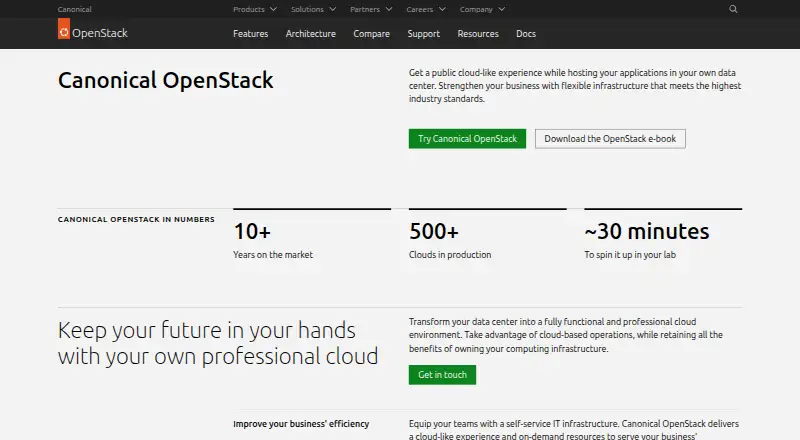
Canonical OpenStack is a self-hosted cloud platform for organizations running applications in their own data centers. It gives teams self-service access to computing resources on demand, with automation spanning bare-metal provisioning through applications using MAAS and Juju. Canonical describes it as 100% open source and based on upstream OpenStack code. Its architecture uses Kubernetes, OCI images and snaps to separate OpenStack from the underlying Ubuntu OS. Canonical Ceph is included by default and supports up to 128 TB of data per node. The stack also includes an expandable Kubernetes layer, observability, Landscape system management and MAAS bare-metal automation. Listed workloads include HPC and AI/ML, telco NFVI, sovereign clouds, local or regional public clouds and edge infrastructure. Organizations can deploy it themselves or have Canonical design, build, test and validate the cloud. The software has no license or subscription cost; commercial support and consulting are separate. Support includes 24/7 phone and ticket coverage, with a stated one-hour response for Severity 1 issues. On-demand Kubernetes is currently in beta.
Good
- Automates operations from bare metal through applications.
- Canonical Ceph is included by default.
- Offers self-deployment or Canonical-led cloud buildout.
- Commercial support includes 24/7 coverage.
Watch out
- Commercial support and consulting cost separately.
- On-demand Kubernetes is currently in beta.
- Getting-started tutorial requires a dedicated physical machine.
Who it suits
Canonical OpenStack suits organizations that need self-hosted infrastructure and on-demand computing in their own data centers. Its listed workloads include HPC and AI/ML, telco NFVI, sovereign clouds and edge infrastructure.
Verdict
Canonical OpenStack offers self-hosted infrastructure with automation and multiple deployment options. Organizations should note that commercial services are separate and on-demand Kubernetes remains in beta.
Plans and prices
From Canonical OpenStack's own pricing page, checked 3 Oct 2026.
| Plan | Price | What it gives you |
|---|---|---|
| Canonical OpenStack | Free | No hidden license or subscription cost; commercial support and consulting are separate |
| Private Cloud Build | $75,000, paid once | Cloud deployment · additional features and integrations via add-ons · fixed price |
| Private Cloud Build Plus | — | Cloud deployment · additional features and integrations via add-ons · fixed price |
The facts
Each one read from Canonical OpenStack's own pages, with the date it was checked.
What it does
- API compatibility
- Canonical states that its upstream OpenStack foundation guarantees API compatibility.checked 15 Oct 2026
- Architecture
- Its cloud-native architecture is based on Kubernetes, OCI images and snaps, which Canonical says decouples OpenStack from the underlying Ubuntu OS.checked 3 Oct 2026
- Automation
- It automates cloud operations from bare metal provisioning through applications, using MAAS and Juju across the stack.checked 3 Oct 2026
- Bare-metal automation
- Canonical MAAS provides bare-metal provisioning and is included in Canonical consulting packages for OpenStack.checked 15 Oct 2026
- Ceph storage
- Canonical Ceph is included by default and supports up to 128 TB of data per node without additional cost.checked 15 Oct 2026
- CLI
- The OpenStack client command line interface supports bulk operations and administrative automation.checked 15 Oct 2026
- Cloud-native architecture
- Sunbeam isolates OpenStack components and decouples them from the underlying operating system.checked 15 Oct 2026
- Compliance
- Canonical support includes CIS and DISA-STIG hardening profiles and conformance for sectors such as telecom, government and financial services.checked 15 Oct 2026
- Deployment model
- The platform supports single-node clouds and multi-node clouds for greater capacity and resilience.checked 15 Oct 2026
- Deployment options
- Customers can deploy Canonical OpenStack themselves or have Canonical design, build, test and validate the cloud for them.checked 3 Oct 2026
- Documentation depth
- Official documentation includes tutorials, step-by-step how-to guides, technical reference material and conceptual explanations.checked 15 Oct 2026
- Extensibility
- Deployment and operation use Juju charms, Rocks OCI images and Snaps as extensible artifacts.checked 15 Oct 2026
- Getting started
- Canonical's learning tutorial uses one dedicated physical machine with at least 4 amd64 cores, 16 GiB RAM, 100 GiB SSD storage and Ubuntu Desktop 24.04 LTS.checked 3 Oct 2026
- GPU and acceleration
- The platform supports GPU virtualization and other acceleration technologies for HPC and AI/ML workloads.checked 15 Oct 2026
- Integrations
- The product includes an expandable Kubernetes layer, an integrated observability stack, Landscape system management and MAAS bare metal automation.checked 3 Oct 2026
- Kubernetes layer
- Canonical OpenStack can provide an expandable Kubernetes layer that users provision from the dashboard.checked 15 Oct 2026
- Licence
- OpenStack software is fully open source and existing OpenStack software uses the Apache License 2.0.checked 15 Oct 2026
- Limit: complexity
- G2 reviewers report that setup and operation can be daunting or complex for inexperienced Linux and cloud users.checked 15 Oct 2026
- Limit: customization and migration
- TrustRadius reviewers request more VM configuration choices, stronger privilege controls and better VMware migration tooling.checked 15 Oct 2026
- Limit: storage and networking choices
- The reference design supports Ceph storage and OVN networking as the only supported options, with third-party storage integrations described as forthcoming.checked 15 Oct 2026
- Limit: support
- G2 reviewers repeatedly mention limited or absent dedicated vendor support unless commercial services are purchased.checked 15 Oct 2026
- Limit: upgrades and HA
- Reviewers report challenging upgrades, a need for better high availability and incomplete GUI coverage compared with the CLI.checked 15 Oct 2026
The company
- Maker headquarters
- Canonical lists its headquarters in London, England.checked 15 Oct 2026
- Maker legal name
- The maker identifies itself as Canonical Ltd.checked 15 Oct 2026
Alternatives to Canonical OpenStack
- 1

Cloudify
Free planOpen sourceWebAPILinuxmacOS8.4From $395 a month - 2

Terraform
Free planWebAPILinuxmacOS8.0Free plan - 3

Cloudforet
Free planOpen sourceWebAPILinuxmacOS7.5Free plan - 4

Apache CloudStack
Free planOpen sourceWebAPILinuxSelf-hosted7.4Free plan - 5

Pulumi
Free planWebAPILinuxmacOS7.4From $40 a month - 6
HPE Morpheus VM Essentials Software
WebLinuxSelf-hosted7.0From $600 a year