Cisco Panoptica
Cisco Panoptica is a cloud-native security solution for identifying, prioritizing, and remediating risks across multi-cloud environments.
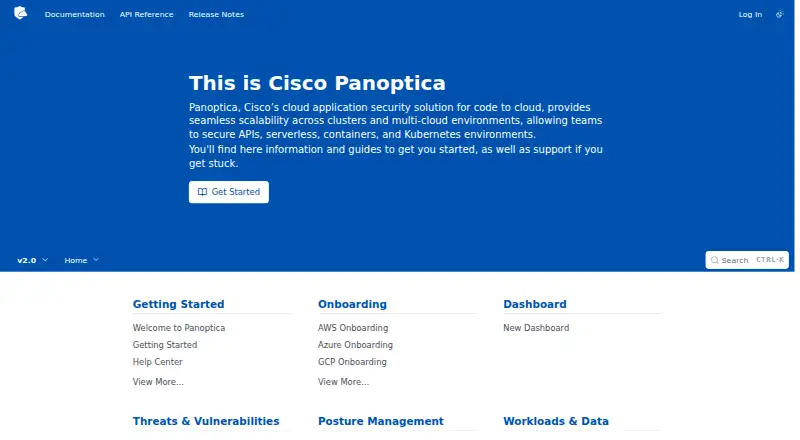
What Cisco Panoptica is
Cisco Panoptica is a cloud-native security solution for identifying, prioritizing, and remediating risks across multi-cloud environments. It covers Kubernetes workloads, APIs, serverless functions, virtual machines, and infrastructure-as-code repositories. Its graph-based attack path analysis connects security findings, vulnerabilities, and identity risks to show potential paths and remediation options. Workload scans review CVEs by asset or Docker image, prioritizing them using environment security and network topology. Panoptica catalogs internal, external, and third-party APIs, assesses their risks, and detects sensitive data in API traffic. Code Security checks connected repositories for infrastructure misconfigurations, secrets, and code vulnerabilities. Supported source control providers include GitHub, GitLab, Azure DevOps, and Bitbucket; Jira tickets can be created from several security modules. Deployments include AWS, Azure, GCP, and Kubernetes, with Kubernetes available in public cloud or on-premise settings. Cloud integrations are agentless and use a secure read-only role. Panoptica offers a free tier, and is aimed at developers and engineers securing applications from development through runtime.
Good
- Covers workloads, APIs, serverless, VMs, and IaC repositories.
- Graph analysis relates findings, vulnerabilities, and identity risks.
- Agentless cloud integrations use a secure read-only role.
- Free tier is listed.
Watch out
- Repository scans run daily only when new commits exist.
- Manual rescan is needed for other repository scans.
Who it suits
Panoptica suits developers and engineers responsible for cloud-native security across development and runtime. It may also fit teams that need to assess API, workload, and repository risks across multiple cloud environments.
Verdict
Cisco Panoptica brings workload, API, and code security capabilities together with attack path analysis. Its free tier and breadth of listed coverage make it worth considering for cloud-native teams.
Plans and prices
From Cisco Panoptica's own pricing page, checked 8 Oct 2026.
| Plan | Price | What it gives you |
|---|---|---|
| Free tier | Free | Free tier stated by Cisco; a 2023 Cisco brochure says up to 10 nodes · 1 cluster · unlimited pods |
The facts
Each one read from Cisco Panoptica's own pages, with the date it was checked.
What it does
- Agentless onboarding
- The Help Center says cloud integrations use a secure read-only role and are agentless.checked 8 Oct 2026
- API security
- Panoptica catalogs internal, externally exposed, and third-party APIs, assesses risks, and detects sensitive data in API traffic.checked 8 Oct 2026
- Attack path analysis
- Its graph-based attack path analysis combines security findings, vulnerabilities, and identity risks to show attack paths and remediation options.checked 8 Oct 2026
- Cloud deployment
- The Help Center lists AWS, Azure, GCP, and Kubernetes deployments, with Kubernetes available in public cloud or on-premise environments.checked 8 Oct 2026
- Code scanning
- Code Security detects IaC misconfigurations, secrets, and code vulnerabilities in connected repositories.checked 8 Oct 2026
- Compliance
- The Help Center says its compliance frameworks cover GDPR, SOC 2, HIPAA, CIS, PCI, and more.checked 8 Oct 2026
- Coverage
- The documentation describes coverage for Kubernetes workloads, APIs, serverless functions, virtual machines, and infrastructure-as-code repositories.checked 8 Oct 2026
- Intended users
- Cisco describes Panoptica as helping developers and engineers provide cloud-native security from application development through runtime.checked 8 Oct 2026
- Product purpose
- Panoptica is Cisco’s cloud native application security solution for identifying, prioritizing, and remediating risks and misconfigurations in multi-cloud environments.checked 8 Oct 2026
- Repository scan cadence
- Integrated repositories are scanned once a day when there have been new commits, and users can also initiate a manual rescan.checked 8 Oct 2026
- Security controls
- For proof-of-concept tenants, the platform security FAQ says data is encrypted, tenant access can be restricted by IP allowlist or mTLS, and tenant data is deleted when the tenant closes.checked 8 Oct 2026
- Source control integrations
- The docs list GitHub, GitLab including self-managed repositories, Azure DevOps, and Bitbucket as supported source control providers.checked 8 Oct 2026
- Task integrations
- Panoptica can create Jira tickets from its Attack Path Analysis, Vulnerability Management, Security Posture, Root Cause Analysis, and Code Security modules.checked 8 Oct 2026
- Vulnerability management
- Workload scanning reviews CVEs grouped by assets or Docker images and prioritizes them using environment security and network topology.checked 8 Oct 2026
The full review of Cisco Panoptica
Cisco Panoptica is a cloud-native application security platform for development and security teams managing applications across cloud and hybrid environments. Its broad coverage and attack-path analysis make it a strong fit for teams that need to connect risks across workloads, APIs, and code; teams focused on API security alone may prefer a narrower tool.
Overview
Panoptica is designed to identify, prioritize, and remediate risks and misconfigurations from development through runtime. It covers Kubernetes workloads, APIs, serverless functions, virtual machines, and infrastructure-as-code repositories, giving teams a way to address several layers of cloud-native security in one platform.
Its graph-based attack-path analysis combines security findings, vulnerabilities, and identity risks to show potential attack paths and remediation options. That context can help security and engineering teams prioritize connected risks instead of treating every finding as equally urgent.
Key features
Cloud and workload security
Cloud integrations are agentless and use a secure read-only role, reducing onboarding friction and limiting the access granted to integrations. Panoptica supports AWS, Azure, GCP, and Kubernetes deployments; Kubernetes can run in public cloud or on-premise environments. Workload scanning reviews CVEs by asset or Docker image and prioritizes them using environment security and network topology, which gives teams more context for remediation than a raw vulnerability list.
API and code security
API security catalogs internal, externally exposed, and third-party APIs, assesses their risks, and detects sensitive data in API traffic. API discovery, posture management, and specification governance make this a meaningful part of the platform, not merely an add-on to workload scanning.
Code Security detects infrastructure-as-code misconfigurations, secrets, and code vulnerabilities in connected repositories. GitHub, GitLab—including self-managed repositories—Azure DevOps, and Bitbucket are supported. Repositories are scanned once daily when new commits arrive, with manual rescans also available. That cadence supports routine checks, but teams needing scans after every change will find it limiting.
Workflow and compliance
Panoptica can create Jira tickets from its Attack Path Analysis, Vulnerability Management, Security Posture, Root Cause Analysis, and Code Security modules, helping teams carry security findings into an existing issue workflow. Its compliance frameworks cover GDPR, SOC 2, HIPAA, CIS, PCI, and more.
For proof-of-concept tenants, data is encrypted, access can be restricted by IP allowlist or mTLS, and tenant data is deleted when the tenant closes. These controls help address evaluation-stage security needs.
Pricing
Free tier: free. Cisco describes the tier as covering up to 10 nodes, 1 cluster, and unlimited pods. That makes it practical for a small proof of concept or a limited Kubernetes environment, but the node and cluster caps constrain its use as a broad production deployment. No paid plan price is established.
Platforms
Panoptica supports API, Linux, self-hosted, and web environments. Its hybrid deployment model and support for public-cloud and on-premise Kubernetes give teams options across mixed infrastructure.
Who it's for
Panoptica is best suited to developers, engineers, and security teams responsible for cloud-native applications across multiple environments. It is especially relevant when the same team needs workload vulnerability management, API visibility, code scanning, and a way to prioritize related risks. A team looking only for a focused API scanner may not need its wider application-security scope.
Pros and cons
- Broad coverage: Workloads, APIs, serverless functions, virtual machines, and infrastructure-as-code fit under one security platform.
- Contextual prioritization: Attack-path analysis connects vulnerabilities, findings, and identity risks to remediation options.
- Agentless cloud onboarding: Read-only integrations avoid installing agents and reduce required cloud permissions.
- Useful integrations: Multiple source control providers and Jira ticket creation support established engineering workflows.
- Free-tier limits: The 10-node and 1-cluster caps make the no-cost tier a constrained starting point rather than an unrestricted deployment.
- Daily repository cadence: Automatic scans run once a day after new commits, which may be too slow for teams expecting frequent code feedback.
Alternatives
For a broader comparison, browse API Security Software.
- 42Crunch API Security Platform is worth considering for teams that want OpenAPI audits, vulnerability scans, and automatic fixes in a free plan, with a free trial also available.
- Wallarm API Security may fit teams prioritizing request-based API protection: its free tier allows up to 500,000 requests per month and three users, but excludes vulnerability assessment and API Abuse Prevention.
- APISec Platform is an option for teams seeking free public API testing and basic test simulations, with a free trial and no-credit-card free plan.
- F5 BIG-IP APM is a paid alternative with a free trial and perpetual-license availability across virtual, hardware, or hybrid environments.
- Haltdos offers a free Community WAF limited to one website and one security profile, and may suit teams seeking a narrowly scoped WAF entry point.
- Onam Security API Security has a free plan capped at one cloud account, 500 resources, and 30-day finding history; it suits teams whose needs fit those bounds.
- APIPosture offers a self-hosted Community Edition with local analysis and eight authorization rules, a fit for teams that specifically want local API posture analysis.
- Akto API Security Platform is another API security option.
Verdict
Choose Cisco Panoptica if your team needs one platform to connect cloud workload, API, and code risks, with attack-path analysis to help prioritize remediation. Its free tier offers a practical way to start, but the node and cluster caps and once-daily repository scans make it less suitable for larger environments or teams that need faster code-scanning feedback.
Getting started
- Open the Panoptica documentation website
- Choose a supported AWS, Azure, GCP, or Kubernetes deployment
- Connect cloud accounts with a secure read-only role
- Link GitHub, GitLab, Azure DevOps, or Bitbucket repositories
- Configure Jira ticket creation from supported security modules
- Use the free tier, stated as free
Limits worth knowing
The free tier is stated at up to 10 nodes, one cluster, and unlimited pods. Integrated repositories are scanned once daily when new commits are present, although a manual rescan is available.
Questions
Is Cisco Panoptica free?
Yes. The listed pricing model is free, with a Free tier listed as free.
Which environments does Panoptica support?
It supports AWS, Azure, GCP, and Kubernetes. Kubernetes can be deployed in public cloud or on-premise environments.
Which source-control providers integrate?
The listed providers are GitHub, GitLab including self-managed repositories, Azure DevOps, and Bitbucket.
Can Panoptica detect API data risks?
Yes. It catalogs internal, externally exposed, and third-party APIs, assesses risks, and detects sensitive data in API traffic.
Does Panoptica offer compliance coverage?
Its listed frameworks include GDPR, SOC 2, HIPAA, CIS, PCI, and more.
Alternatives to Cisco Panoptica
- 1
42Crunch API Security Platform
Free planWebAPIExtensionLinux7.9From $9 a month - 2

APIPosture
Free planOpen sourceLinuxmacOSSelf-hostedWindows7.8From $9 a month - 3

Onam Security API Security
Free planWebAPILinuxmacOS7.8From $22 a month - 4

APISec Platform
Free planWebAPIExtensionLinux7.5From $690 a month - 5

DataDome API Protection
AndroidiOSWebAPI6.8From $3,830 a month - 6
Haltdos
Free planWebAPILinuxSelf-hosted6.8From $30 a month