
APISec Platform
APISec Platform is an AI-based application security platform for validating exploits against APIs and applications.
What APISec Platform is
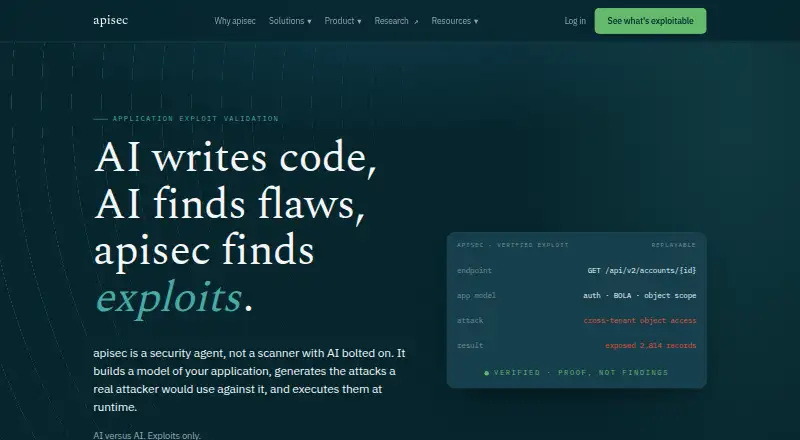
APISec Platform is an AI-based application security platform for validating exploits against APIs and applications. It discovers applications, builds a dynamic model of how they work, and runs attacker-like tests at runtime. The model can capture endpoints, parameters, authentication flows, roles, permissions, object ownership, and business logic without requiring documentation or developer interviews. Testing covers business logic, data access, roles and permissions, configuration, infrastructure, and controls such as injection and token handling. For validated exploits, APISec returns a request sequence, data reached, blast radius, replay, and suggested resolution. It says it discovers APIs across infrastructure, source, gateways, ingress and authentication paths, web apps, Postman, SwaggerHub, Insomnia, and CI/CD, including agents, MCP servers, and LLM call sites. Public APIs run against its cloud; private and on-premises APIs can use a Kubernetes or Docker container, and cloud deployments can run in a customer’s GCP, Azure, or AWS environment. The free plan covers public API testing and basic simulations. Standard costs $690 a month per 100 endpoints; Pro costs $2,750 a month per 100 endpoints. Private API testing and on-premises pricing can be custom.
Good
- Models application roles, permissions, and business logic dynamically.
- Returns replay details and suggested resolutions for validated exploits.
- Discovers APIs across listed tools and infrastructure.
- Offers a free plan for public API testing.
- Can run private APIs in customer cloud environments.
Watch out
- Standard is $690 a month per 100 endpoints.
- Pro is $2,750 a month per 100 endpoints.
- On-premises and private API testing have custom pricing.
Who it suits
It suits teams that need runtime validation of API and application exploits, including testing business logic and permissions. Teams should check deployment requirements and endpoint-based pricing, particularly for private or on-premises testing.
Verdict
APISec combines API discovery, dynamic modeling, and exploit validation, with results intended to help teams reproduce and address findings. Its per-endpoint pricing and deployment choices merit review before adoption.
Plans and prices
From APISec Platform's own pricing page, checked 15 Oct 2026.
| Plan | Price | What it gives you |
|---|---|---|
| Free | Free | Public API testing · Basic test simulations · Community support · Dashboard access · $0 forever |
| Standard | $690 a month | Continuous automated validation · Business-logic attacks · Continuous API testing · Team collaboration · Dedicated support · $690/mo · per 100 endpoints or $8,275/yr |
| Pro | $2,750 a month | Standard features · CI/CD and ticketing integrations · Custom attack simulations · Advanced reporting and SLAs · White-glove onboarding · Premium support · $2,750/mo · per 100 endpoints or $33,075/yr |
| Bug Bounty | Priced on request | Certified expert reports · Manual and ad-hoc deep dives · Private and public API testing · Authentication support · Custom pricing |
The facts
Each one read from APISec Platform's own pages, with the date it was checked.
What it does
- API-first
- The FAQ says nearly every aspect of the product is exposed as an API for custom automations and integrations.checked 29 Sep 2026
- API formats
- API registration accepts OpenAPI, Swagger, Postman, and RAML documents from a URL or uploaded file.checked 15 Oct 2026
- Attack coverage
- The platform tests business logic, data access, roles and permissions, application configuration, infrastructure, and security controls such as injection and token handling.checked 29 Sep 2026
- Automated attack generation
- The documentation says APISec generates thousands of test cases tailored to each API architecture.checked 15 Oct 2026
- Behavioral learning
- APISec learns roles, tokens, object ownership, and allowed or disallowed behavior to test business logic and authorization.checked 15 Oct 2026
- Data-use terms
- The terms state that APISec will not sell, rent, or lease service data and reserve the company’s intellectual-property rights in the service.checked 15 Oct 2026
- Deployment
- Public APIs run against APISec’s public cloud; private and on-premises APIs can use an APISec Kubernetes or Docker container, and cloud deployments can run in the customer’s GCP, Azure, or AWS environment.checked 29 Sep 2026
- Developer examples
- The public examples repository provides Python and shell workflows to register applications, manage instances, trigger scans, and use personal-access-token authentication in CI/CD.checked 15 Oct 2026
- Discovery
- The platform discovers APIs across source code, gateways, ingress, authentication paths, web applications, Postman, SwaggerHub, Insomnia, CI/CD, agents, MCP servers, and LLM call sites.checked 15 Oct 2026
- Documentation depth
- The documentation includes API registration, CLI endpoint addition, API calls, dashboards, categories, integrations, and configuration procedures with curl examples.checked 15 Oct 2026
- Exploit proof
- The platform returns validated exploits with the request sequence, data reached, blast radius, replay, and suggested resolution.checked 29 Sep 2026
- Exploit validation
- Results include evidence of what was exploitable, replay information, and remediation context rather than only potential findings.checked 15 Oct 2026
- Funding
- Dealroom records a July 2018 $2.0 million seed investment from Canaan and describes the company as a San Francisco cloud API-security provider.checked 15 Oct 2026
- GitHub integration
- GitHub can receive vulnerability issues and can store or restore APISec playbooks through personal-access-token or SSH credentials.checked 15 Oct 2026
- Integrations
- Configuration supports report, issue-tracker, notification, playbook-backup, and single-sign-on integrations.checked 15 Oct 2026
- Integrations and discovery
- APISec says it discovers APIs across infrastructure, source, gateways, ingress and auth paths, web apps, Postman, SwaggerHub, Insomnia, and CI/CD, including agents, MCP servers, and LLM call sites.checked 29 Sep 2026
- Jira integration
- The Jira connector can create vulnerability tickets after APISec validates findings and can transition tickets when later scans confirm fixes.checked 15 Oct 2026
- Limit: customization and complexity
- Gartner reviewers cite limited customization, clutter when many scan results appear, heavy setup for smaller teams, and remediation guidance that may lack step-by-step detail.checked 15 Oct 2026
Where it runs
- Application model
- Its application model captures endpoints, parameters, authentication flows, roles, permissions, object ownership, and business logic dynamically without requiring documentation or developer interviews.checked 29 Sep 2026
- Browser extension
- APIsec BOLT passively captures browser API traffic locally, detects authentication details, generates OpenAPI specifications, and can onboard captured applications for scans.checked 15 Oct 2026
The company
- Company
- APISec says it was created in 2018 and identifies the company as APIsec, Inc.checked 29 Sep 2026
- Company identity
- The legal entity is APIsec Inc., headquartered at One Sansome Street, Suite 3500, San Francisco, California.checked 15 Oct 2026
- Company profile
- LinkedIn lists APIsec as privately held, founded in 2018, headquartered in San Francisco, and employing 11–50 people.checked 15 Oct 2026
- Founded
- 2018checked 28 Sep 2026
The full review of APISec Platform
Overview
APISec Platform is an API security service that discovers applications, builds a live model of their behavior, and validates attacks at runtime. It is best suited to teams securing APIs with complex permissions or business rules. Its strongest draw is evidence-backed exploit validation, though per-endpoint costs and deployment requirements deserve careful consideration.
Key features
APISec builds a dynamic map of endpoints, parameters, authentication flows, roles, permissions, object ownership, and business logic without relying on documentation or developer interviews. That can help teams investigate APIs whose specifications are incomplete, but buyers seeking only schema checks may find this broader runtime approach unnecessary.
Its tests cover business logic, data access, authorization, configuration, infrastructure, and controls including injection and token handling. Findings include the request sequence, data reached, potential blast radius, replay, and a suggested resolution. That context gives engineers a practical way to reproduce and assess a problem rather than treating every alert as equally actionable.
Discovery can draw from infrastructure, source, gateways, ingress and authentication paths, web apps, Postman, SwaggerHub, Insomnia, and CI/CD, as well as agents, MCP servers, and LLM call sites. Supported API formats include OpenAPI Specification, Swagger, Postman, and RAML. Nearly every aspect of the product is exposed through an API, which suits teams building custom automation.
Public APIs run through APISec’s cloud. Private and on-premises APIs can use a Kubernetes or Docker container, while cloud deployments can run in a customer’s GCP, Azure, or AWS environment. Hosted agents can also validate private APIs. This range supports varied infrastructure, but the right setup depends on where the APIs live and the deployment model the team can operate.
The open-source APISec Surface discovery tool runs locally and says it sends nothing off the user’s machine. Its package includes local discovery tools, GitHub Actions, and a browser extension; AI Surface and MCP audit use MIT licenses, while the Bolt Browser Extension uses Apache 2.0.
Pricing
The Free plan costs nothing, billed $0 forever, requires no credit card, and includes public API testing, basic test simulations, community support, and dashboard access. It is a low-commitment way to explore the product, but it does not include the continuous validation and business-logic attacks named in Standard.
Standard costs $690 a month, billed $690/mo per 100 endpoints or $8,275/yr. It adds continuous automated validation, business-logic attacks such as BOLA and RBAC, team collaboration, and dedicated support. This is the entry paid option for teams that need ongoing API testing; its per-100-endpoint increments make the endpoint count central to budgeting.
Pro costs $2,750 a month, billed $2,750/mo per 100 endpoints or $33,075/yr. It includes Standard plus full CI/CD and ticketing integrations, custom attack simulations, advanced reporting and SLAs, white-glove onboarding, and premium support. It fits teams that need those integrations and service commitments, but is a substantial step up from Standard.
Bug Bounty has custom pricing and offers certified expert reports, manual and ad-hoc deep dives, private and public API testing, and authentication support for periodic assurance. On-premises and private API testing also use custom pricing. A free trial is offered; the Free plan itself is billed at $0 forever.
Platforms
APISec supports API, extension, Linux, self-hosted, and web environments. Its public-cloud and customer-cloud deployment choices make it relevant to teams with mixed infrastructure, while self-hosting is an option for private or on-premises APIs.
Who it's for
APISec is a strong fit for security and engineering teams that need to discover APIs across multiple sources, test authorization and business logic, and reproduce validated exploits. It is less compelling for teams that only need lightweight schema-driven testing or cannot justify endpoint-based paid pricing.
Pros and cons
- Pros: Dynamic modeling covers roles, ownership, and business logic without depending on documentation, useful for complex or poorly documented APIs.
- Pros: Validated exploits include replayable requests and impact context, helping teams prioritize and investigate findings.
- Pros: Local discovery and customer-cloud or container deployment options support different privacy and infrastructure needs.
- Cons: Paid plans are priced per 100 endpoints, so costs scale with the API footprint.
- Cons: Private and on-premises testing can require custom pricing, complicating cost planning.
- Cons: The Free plan is limited to public API testing and basic simulations, so it is not a substitute for continuous paid validation.
Alternatives
For a broader directory comparison, browse API Security Testing Software and API Security Software.
42Crunch API Security Platform is worth considering if an AI coding plugin, OpenAPI audit, vulnerability scans, and automatic fixes are a closer match.
VulnAPI is a free open-source option for educational and testing use when a no-cost tool is the priority.
AquilaX API Security Scanner may suit teams prioritizing secrets scanning, PII detection, compliance auditing, and unlimited scans on its Free plan.
Pynt offers a free Starter plan capped at 10 API endpoints, making it an option for a small initial testing scope.
Schemathesis is a free open-source choice for generating tests from OpenAPI and GraphQL schemas.
Beagle Security has a Free plan with one lite test per month, surface-scan reports, and SSL and domain-expiry monitoring.
ZeroThreat may work for a limited initial scan: its Free plan gives five sign-up scan credits valid for 15 days, then one scan credit per month and one target per account.
Bright Security DAST is an alternative to consider if a demo-led evaluation is preferred.
Verdict
Choose APISec if your team needs broad API discovery and reproducible validation of business-logic and authorization flaws, especially across complex or private environments. The detailed exploit evidence is its clearest advantage; teams with smaller endpoint footprints, schema-only needs, or tight budgets should compare simpler or free options first.
Getting started
- Visit https://www.apisec.ai/.
- Choose the Free plan for public API testing and basic simulations, or select a paid plan.
- Use the public cloud for public APIs, or choose container deployment for private or on-premises APIs.
- For cloud deployment, run it in your GCP, Azure, or AWS environment.
Limits worth knowing
The Free plan provides public API testing and basic test simulations. Standard and Pro pricing is per 100 endpoints, while private and on-premises testing has custom pricing.
Questions
Is there a free plan?
Yes. Free costs $0 forever, requires no credit card, and includes public API testing, basic test simulations, and community support.
How much do the paid plans cost?
Standard is $690/mo per 100 endpoints. Pro is $2,750/mo per 100 endpoints.
Can it test private APIs?
Yes. Private and on-premises APIs can use an APISec Kubernetes or Docker container, and hosted agents can validate private APIs.
Which deployment options are available?
Public APIs run against APISec’s public cloud. Cloud deployments can also run in a customer’s GCP, Azure, or AWS environment.
What integrations or API access does it offer?
The FAQ says nearly every aspect of the product is exposed as an API for custom automations and integrations. Pro includes full CI/CD and ticketing integrations.
Who makes APISec Platform?
The company identifies itself as APIsec, Inc. and says it was created in 2018.
Alternatives to APISec Platform
- 1
42Crunch API Security Platform
Free planWebAPIExtensionLinux7.9From $9 a month - 2
WuppieFuzz
Free planOpen sourceAPILinuxmacOSSelf-hosted7.3Free plan - 3

Beagle Security
Free planWebAPI6.9From $99 a month - 4
StackHawk HawkScan
WebAPILinuxmacOS6.8From $10 a month - 5
AquilaX API Security Scanner
Free planWebAPIExtensionSelf-hosted6.7From $19 a month - 6

Parasoft SOAtest
AndroidiOSAPILinux6.7