
Pynt
Pynt tests API security by examining API traffic and creating simulated attacks to find vulnerabilities.
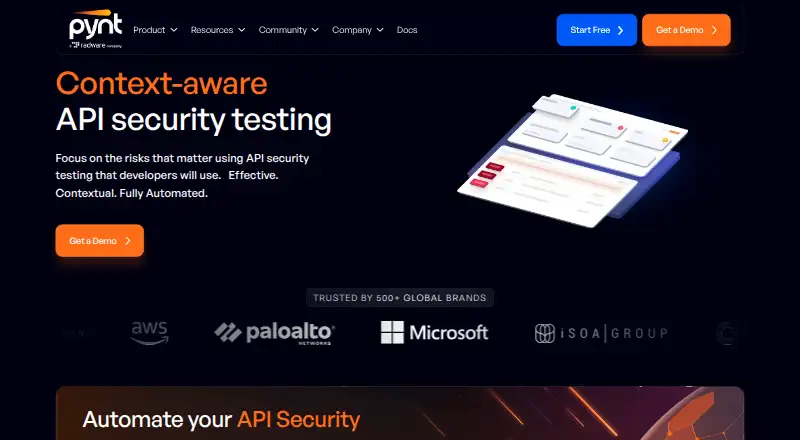
What Pynt is
Pynt tests API security by examining API traffic and creating simulated attacks to find vulnerabilities. It uses application and API context—including structure, sessions, parameters, users, and roles—to shape its testing. Listed coverage includes OWASP Top 10 risks for APIs, web applications, and LLMs, along with business-logic scenarios and custom attacks. Findings can include vulnerability evidence, fix suggestions, risk scores, and CWE associations. A CLI supports CI/CD automation, and results are produced in JSON. Pynt can analyze testing assets, Burp XML, HAR recordings, and live traffic sources such as eBPF and ALB mirroring. Listed integrations include Postman, Newman, Python, Rest Assured, Burp, Go, Jest, ReadyAPI, Insomnia, GitHub Actions, GitLab, Jenkins, Azure DevOps, Jira, and Kubernetes. The free Starter plan is limited to 10 API endpoints. Business cloud scans are available through a free trial. Local use requires Docker and Python 3.9 or later, and Postman integration requires the desktop app rather than the web interface.
Good
- Findings can include evidence and suggested fixes.
- CLI supports CI/CD automation with JSON results.
- Accepts OpenAPI, Postman collections, HAR, and Burp XML.
- Starter plan is free.
Watch out
- Starter testing is limited to 10 API endpoints.
- Local use requires Docker and Python 3.9 or later.
- Postman integration requires the desktop app.
Who it suits
Pynt suits teams that want to include API security checks in CI/CD or test APIs using traffic and application context. The Starter plan may suit users testing up to 10 endpoints.
Verdict
Pynt combines contextual API testing with CI/CD workflows and evidence-backed findings. Check the Starter endpoint cap and local requirements against your setup.
Plans and prices
From Pynt's own pricing page, checked 30 Sep 2026.
| Plan | Price | What it gives you |
|---|---|---|
| Starter | Free | Limited API security testing · up to 10 API endpoints |
| Business | Priced on request | Full API security testing · cloud scan available under a free trial |
The facts
Each one read from Pynt's own pages, with the date it was checked.
What it does
- Contextual testing
- Pynt uses application and API context, including structure, sessions, parameters, users, and roles, to shape its security testing.checked 30 Sep 2026
- Findings and fixes
- Pynt provides vulnerability evidence, fix suggestions, risk scoring, and CWE associations.checked 30 Sep 2026
- Integrations
- Listed integrations include Postman, Newman, Python, Rest Assured, Burp, Go, Jest, ReadyAPI, Insomnia, GitHub Actions, GitLab, Jenkins, Azure DevOps, Jira, and Kubernetes.checked 30 Sep 2026
- Local requirements
- The documentation says local use requires Docker and Python 3.9 or later, and Postman integration requires the desktop app rather than the web interface.checked 30 Sep 2026
- Purpose
- Pynt tests APIs by analyzing API traffic and generating simulated attacks to identify vulnerabilities.checked 30 Sep 2026
- Security coverage
- Pynt lists coverage for OWASP Top 10 risks for APIs, web applications, and LLMs, as well as business-logic scenarios and homegrown attacks.checked 30 Sep 2026
- Security program
- Pynt directs customers to its Security Hub for information about its security program and standards, but the opened page does not specify particular certifications.checked 30 Sep 2026
- Starter limit
- The documentation says Starter plan API security testing is limited to 10 endpoints.checked 30 Sep 2026
- Support
- Pynt's integration documentation directs users needing help to Pynt Community Support.checked 30 Sep 2026
- Traffic sources
- Pynt says it can analyze testing assets, Burp XML, HAR recordings, and live traffic sources including eBPF and ALB mirroring.checked 30 Sep 2026
- Workflow
- Pynt supports CI/CD automation through a CLI and produces results in JSON.checked 30 Sep 2026
The company
- Headquarters
- 108 W. 13th Street, Wilmington, Delaware 19801, United Stateschecked 23 Sep 2026
Money
- Postman plans
- Pynt's Postman documentation says local scans are included in the free Starter plan and cloud scans are available through the Business plan under a free trial.checked 30 Sep 2026
The full review of Pynt
Overview
Pynt is an API security testing tool that analyzes API traffic and simulates attacks to uncover vulnerabilities. It is best suited to teams that want security checks grounded in application context and connected to development workflows. Its contextual testing and evidence-backed findings are compelling, but the Starter plan’s 10-endpoint ceiling may quickly become restrictive.
Key features
Pynt uses API structure, sessions, parameters, users, and roles to shape tests. That context can help teams probe how an API behaves under realistic conditions rather than rely only on its schema. Its stated coverage spans OWASP Top 10 risks for APIs, web applications, and LLMs, along with business-logic scenarios and custom attacks.
Findings include vulnerability evidence, suggested fixes, risk scores, and CWE associations, giving developers concrete material for triage and remediation. API discovery and authentication, authorization, input-validation, and business-logic testing are supported. For teams that need repeatable checks in delivery pipelines, Pynt offers CLI-based CI/CD automation and JSON results.
Inputs can include testing assets, Postman collections, HAR recordings, Burp XML, and live traffic sources such as eBPF and ALB mirroring. Listed integrations range from Postman, Newman, Burp, Insomnia, Python, Go, Rest Assured, Jest, and ReadyAPI to GitHub Actions, GitLab, Jenkins, Azure DevOps, Jira, and Kubernetes. This breadth makes it relevant to varied workflows, though the local setup has prerequisites: Docker and Python 3.9 or later. Postman integration requires the desktop app, not the web interface.
Pricing
Pynt uses a freemium model with a free trial. Starter costs nothing and provides limited API security testing for up to 10 API endpoints. That makes it a reasonable starting point for a small API or an initial evaluation, but the endpoint cap may rule it out for broader inventories.
Business has custom pricing and includes full API security testing. Cloud scans are available under a free trial; local scans are included in Starter. Teams that need cloud scanning or more than the Starter scope should consider Business, while those content with local scans and the endpoint limit can begin free. No seat quota or trial length is stated.
Platforms
Pynt supports API, Linux, self-hosted, and web environments, with hybrid deployment. Its mix of local requirements, traffic-based inputs, and cloud scanning gives teams more than one way to fit testing into their setup, but local use calls for Docker and Python 3.9 or later.
Who it's for
Pynt is a strong fit for API teams that want security testing informed by real application context, actionable evidence, and CI/CD automation. It is less suitable for teams seeking a broad Starter allowance or a local setup without Docker and Python. Postman users should also be prepared to use the desktop app for integration.
Pros and cons
- Pros: Context from sessions, roles, and parameters can make testing more representative of how an API is used.
- Pros: Evidence, fix suggestions, risk scores, and CWE associations make findings more actionable for remediation.
- Pros: CLI automation, JSON output, and a broad set of integrations support pipeline-based workflows.
- Cons: Starter testing is capped at 10 API endpoints, limiting its reach for larger API estates.
- Cons: Local use requires Docker and Python 3.9 or later; Postman integration also requires its desktop app.
- Cons: Business has custom pricing, so teams needing full API security testing must seek a quote.
Alternatives
For a wider range of API security software, browse API Security Testing Software. Choose Levo.ai if you want a freemium option spanning SaaS, on-prem, hybrid, or air-gapped deployments, with support scoped to your needs. Schemathesis is a free, open-source choice for generating tests from OpenAPI and GraphQL schemas.
APISec Platform may suit teams looking for a free public-API testing tier with basic simulations and community support. 42Crunch API Security Platform offers a free tier with an AI coding plugin, OpenAPI audit, vulnerability scans, and automatic fixes. Akto API Security Platform is another freemium API, Linux, self-hosted, and web option, with usage-based pricing.
AquilaX API Security Scanner may be a better fit when secrets scanning, PII detection, compliance auditing, unlimited scans, and CI/CD and IDE integrations are priorities. Operator offers a self-serve first scan covering one domain. ZeroThreat starts with five free scan credits on sign-up, valid for 15 days, then one scan credit per month for one target per account.
Verdict
Choose Pynt if your team wants context-aware API security testing with findings that support remediation and checks that can run in CI/CD. Its most important drawback is the Starter limit of 10 endpoints; teams with larger needs should weigh Business at custom pricing, while teams seeking a schema-focused free tool may prefer Schemathesis.
Alternatives to Pynt
- 1
42Crunch API Security Platform
Free planWebAPIExtensionLinux7.9From $9 a month - 2

APISec Platform
Free planWebAPIExtensionLinux7.5From $690 a month - 3
WuppieFuzz
Free planOpen sourceAPILinuxmacOSSelf-hosted7.3Free plan - 4

Beagle Security
Free planWebAPI6.9From $99 a month - 5
StackHawk HawkScan
WebAPILinuxmacOS6.8From $10 a month - 6
AquilaX API Security Scanner
Free planWebAPIExtensionSelf-hosted6.7From $19 a month