Cetus
Cetus is open-source C middleware that proxies MySQL access between applications and backend servers.
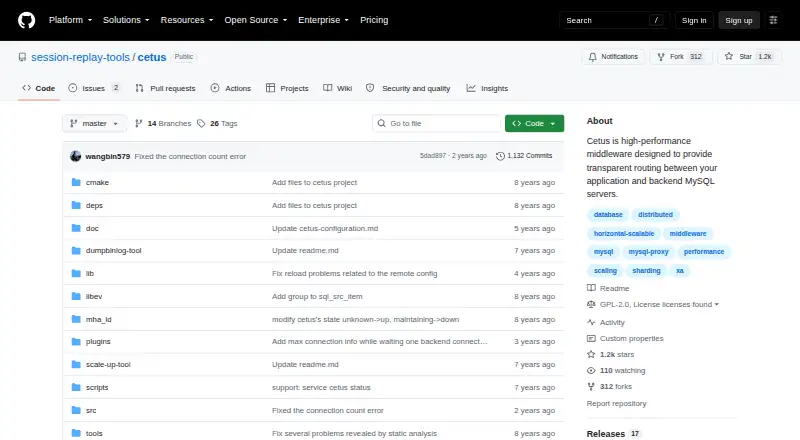
What Cetus is
Cetus is open-source C middleware that proxies MySQL access between applications and backend servers. It runs on Linux as a self-hosted deployment and provides separate read-write splitting and sharding editions. The read-write edition handles SQL read-write splitting and enhanced SQL routing. The sharding edition adds data sharding, distributed transaction processing, and bulk inserts. Both editions support transparent backend connection pooling and prepared statements. Cetus includes status monitoring and an admin port for viewing or changing backend status and configuration parameters. The quick-start guide recommends MySQL 5.7.16 or later and describes command-line or service-based startup. Management access through the admin port is documented with Python pymysql and MySQLdb. The project uses the GPL-2.0 license. Constraints include no multi-tenant use or cross-shard joins; sharding supports at most 64 databases and lacks dynamic expansion.
Good
- Open source under GPL-2.0
- Read-write splitting and SQL routing
- Sharding with distributed transactions
- Backend connection pooling
- Admin port and status monitoring
Watch out
- Linux and self-hosted only
- No multi-tenant use
- No cross-shard joins
- Sharding supports at most 64 databases
Who it suits
Cetus suits Linux teams that can operate self-hosted MySQL middleware. It is aimed at deployments needing query routing, read-write separation, or sharding.
Verdict
Cetus provides MySQL proxying with distinct routing and sharding editions. Its deployment constraints and conflicting TLS documentation should be reviewed before adoption.
The facts
Each one read from Cetus's own pages, with the date it was checked.
What it does
- Connection handling
- Both versions support transparent backend connection pooling and prepared statements.checked 10 Oct 2026
- Connections
- Cetus supports transparent backend connection pooling and prepared statements in its read-write splitting edition.checked 11 Oct 2026
- Database compatibility
- The quick-start guide recommends MySQL 5.7.16 or later and describes using MySQL client connections to Cetus.checked 10 Oct 2026
- Deployment
- Cetus runs only on Linux, and its installation guide describes compiling and installing it from source.checked 11 Oct 2026
- Editions
- The project offers read-write splitting and database sharding editions.checked 11 Oct 2026
- Integration
- The quick-start guide says the admin port can be accessed using Python pymysql and MySQLdb modules.checked 11 Oct 2026
- License
- The repository identifies Cetus as GPL-2.0 licensed.checked 10 Oct 2026
- Management
- Cetus exposes an admin port for viewing and changing backend status and configuration parameters.checked 11 Oct 2026
- Management integrations
- The quick-start guide documents connecting to the management port with Python pymysql and MySQLdb modules.checked 10 Oct 2026
- Monitoring
- Cetus supports status monitoring and provides an admin port for viewing and changing backend status and configuration parameters.checked 10 Oct 2026
- Purpose
- Cetus is C middleware that acts as a MySQL database access proxy, allowing applications to connect through it for database-layer horizontal scaling and high availability.checked 11 Oct 2026
- Read-write routing
- The read-write splitting edition supports SQL read-write splitting and enhanced SQL routing.checked 11 Oct 2026
- Security
- The repository lists security management and client-side SSL/TLS support as features, while its usage constraints page says TLS is unsupported; the pages therefore give conflicting TLS information.checked 11 Oct 2026
- Sharding
- The sharding edition supports data sharding, distributed transaction processing, and bulk inserts.checked 11 Oct 2026
- Sharding limits
- The sharding edition does not support dynamic expansion or cross-database joins and supports at most 64 databases.checked 11 Oct 2026
- Support
- The repository directs users to open an issue for bugs or feature requests and asks them to search existing issues first.checked 11 Oct 2026
- TLS support
- The README lists client-side SSL/TLS support, while the constraints guide says TLS is unsupported.checked 10 Oct 2026
- Usage limits
- The usage constraints page says Cetus does not support multi-tenant use, batch SQL execution, or client Ctrl+C query termination.checked 11 Oct 2026
Alternatives to Cetus
- 1
OceanBase Database
Free planOpen sourceWebAPILinuxmacOS8.2$2.38 usage-based - 2

MySQL
Free planAPILinuxmacOSSelf-hosted7.9Free plan - 3
Supavisor
Free planOpen sourceAPILinuxSelf-hosted7.6From $25 a month - 4
Avidemux
Free planOpen sourceWebLinuxmacOSWindows7.3Free plan - 5
TiCDC
Free planOpen sourceAPILinuxmacOSSelf-hosted7.2Free plan - 6

Amazon RDS
Free planWebAPISelf-hosted7.1Free plan