Cass
Cass is an AI mental-health assistant that offers wellness chatbot support through text messaging and Facebook Messenger.
What Cass is
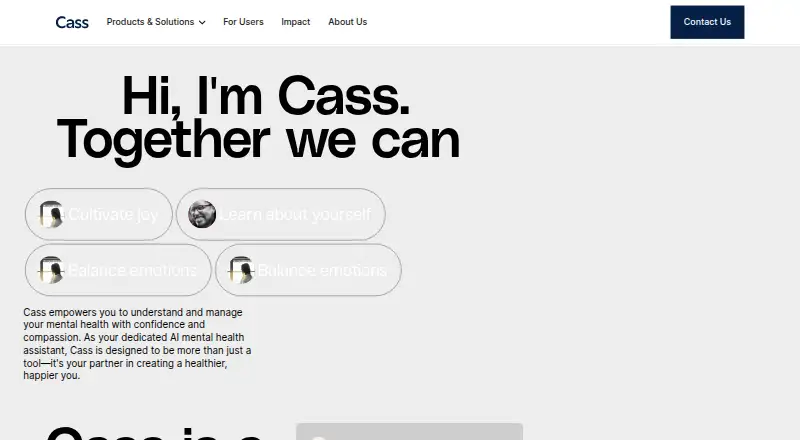
Cass is an AI mental-health assistant that offers wellness chatbot support through text messaging and Facebook Messenger. Users can access it by SMS or Messenger without downloading an app or creating an account. Its coaching includes personalized conversations, recommendations, resources, surveys, self-guided exercises, follow-ups, goal setting, and referrals. Cass can administer self-assessments such as GAD-7 and PHQ-9, and its knowledge engine covers 800 topics and more than 3 million variations.
Cass flags crisis situations, follows severity-verification protocols, and engages a crisis professional within 20 seconds. The service states that it is not a crisis-response service or a replacement for professional therapy. It is available in seven languages, including English and Spanish, and can connect users on demand to a network of 5,000 coaches across all 50 states. Cass states that it is HIPAA-compliant and SOC 2 certified, but HIPAA coverage applies on its network, not to SMS, Facebook Messenger, or WhatsApp communications except Signal. A free plan is listed; paid options include $0.05 a year per employee at scale and $5 a month per active user.
Good
- Access by SMS without an app or account
- Offers exercises, follow-ups, and goal setting
- Can connect users to a coach on demand
- Available in seven languages
Watch out
- Not a crisis-response service
- Not a replacement for professional therapy
- HIPAA coverage does not extend to most listed messaging channels
Who it suits
Cass may suit individuals seeking wellness coaching and organizations serving employees, members, or patients. It is not a substitute for professional therapy or a crisis-response service.
Verdict
Cass offers low-friction access to coaching, assessments, and referrals, with a route to human support. Readers should note its stated limits around crisis response, therapy, and messaging-channel coverage.
Plans and prices
From Cass's own pricing page, checked 1 Oct 2026.
| Plan | Price | What it gives you |
|---|---|---|
| At-scale employee | $0.05 a year | per-employee pricing at scale · per employee per year |
| Active user | $5 a month | active user pricing · 24/7 access · per person |
The facts
Each one read from Cass's own pages, with the date it was checked.
What it does
- Analytics
- Cass provides an insights dashboard with reporting and integration of information into a database or EHR.checked 30 Sep 2026
- Assessments
- Cass can administer self-assessments such as GAD-7 and PHQ-9.checked 30 Sep 2026
- Availability
- Cass provides emotional support and check-ins 24/7.checked 1 Oct 2026
- Channels
- Cass delivers coaching through text messaging and Facebook Messenger.checked 30 Sep 2026
- Clinical evidence
- Cass says it is clinically shown to help manage conditions including anxiety and depression, with research from Duke, Stanford, and Northwestern.checked 1 Oct 2026
- Coaching features
- Cass provides personalized conversations, recommendations, resources, surveys, self-guided exercises, follow-ups, goal setting, and resource referrals.checked 30 Sep 2026
- Coach network
- Cass connects users to 5,000 coaches available in all 50 states.checked 1 Oct 2026
- Crisis triage
- Cass flags crises, begins de-escalation, and engages a crisis professional within 20 seconds.checked 1 Oct 2026
- Data deletion
- Cass says users can request data deletion at any point and that unnecessary protected health information is securely deleted immediately.checked 1 Oct 2026
- Deployment
- Cass requires no app download, account creation, or waitlist for text messaging access.checked 1 Oct 2026
- Encryption
- Cass encrypts data with at least 256-bit asymmetric or 4096-bit symmetric keys and secures transit with TLS 1.2 and 1.3.checked 1 Oct 2026
- HIPAA limitation
- Cass says HIPAA compliance applies on its network, while SMS, Facebook Messenger, and WhatsApp communications are not covered except Signal.checked 30 Sep 2026
- Insights
- Cass provides an insights dashboard and can integrate information with a database or EHR.checked 1 Oct 2026
- Integrations
- Cass can be embedded in Google Home, Instagram, Facebook Messenger, WhatsApp, websites, portals, and other communication channels.checked 1 Oct 2026
- Knowledge engine
- Cass's knowledge engine covers 800 topics and more than 3 million variations.checked 30 Sep 2026
- Languages
- Cass is currently available in seven languages, including English and Spanish.checked 1 Oct 2026
- No-download access
- Users can text Cass through SMS or Facebook Messenger without downloading an app or creating an account.checked 30 Sep 2026
- Product limitation
- Cass's sample conversation states that the service is not a crisis-response service.checked 30 Sep 2026
- Purpose
- Cass is an AI mental health assistant that provides behavioral health coaching through text messaging.checked 1 Oct 2026
- Security
- Cass states that it is HIPAA-compliant and SOC 2 certified.checked 1 Oct 2026
- Target users
- Cass serves individuals as well as health plans, healthcare providers, employers, and communities.checked 1 Oct 2026
- Therapy limitation
- Cass states that it is not a replacement for professional therapy.checked 1 Oct 2026
The full review of Cass
Cass is an AI mental-health assistant for people who want coaching and self-guided support through familiar messaging channels. It is strongest as a low-friction route to assessments, exercises, and human referrals—not as a substitute for therapy or crisis care.
Overview
Cass offers round-the-clock wellness chatbot support, with personalized conversations, recommendations, follow-ups, and referrals. Users can start by text or Facebook Messenger without downloading an app or creating an account, which makes access straightforward for people who do not want another app or sign-up process.
Its scope is broader than a chatbot alone: it can administer GAD-7 and PHQ-9 self-assessments, set goals, deliver surveys and exercises, and connect users on demand to a network of 5,000 coaches across all 50 states. Cass says its knowledge engine spans 800 topics and more than 3 million variations. That breadth supports varied conversations, though the product itself says it is not a crisis-response service or a replacement for professional therapy.
Key features
Coaching and assessments
Cass combines conversational coaching with self-guided exercises, goal setting, resources, and follow-up. GAD-7 and PHQ-9 assessments give users a structured way to reflect on symptoms; they should not be mistaken for diagnosis. The option to refer users to a coach is a meaningful bridge to human support when automated guidance is not enough.
Access, integrations, and privacy
Alongside SMS and Facebook Messenger, Cass can be embedded in Google Home, Instagram, WhatsApp, websites, portals, and other communication channels. It supports seven languages, including English and Spanish, and provides an insights dashboard with reporting and the ability to integrate information into a database or EHR. These features make it relevant to organizations as well as individuals.
Cass says it is HIPAA-compliant and SOC 2 certified, encrypts data with at least 256-bit asymmetric or 4096-bit symmetric keys, and secures transit with TLS 1.2 and 1.3. It also says users can request deletion of their data at any point. The HIPAA boundary matters: Cass says its compliance applies on its own network, while SMS, Facebook Messenger, and WhatsApp communications are not covered, except Signal.
Crisis limits
Cass says it flags crisis situations, verifies severity, and engages a crisis professional within 20 seconds. That escalation is a useful safeguard, but it does not make Cass a crisis service; people in immediate danger should seek emergency help rather than rely on the chatbot.
Pricing
Cass has a free plan, but its published plan prices are also aimed at organizational deployment. The At-scale employee plan costs $0.05 a year, billed per employee per year at scale. It suits employers pricing access across a workforce, but the per-employee-at-scale terms make it a poor basis for assuming a small deployment will cost the same.
The Active user plan costs $5 a month, billed per person, with 24/7 access. It is the clearer fit when an organization wants to pay for active users rather than all employees. No seat minimum, usage quota, trial, or renewal term is established for either plan. Individual access is free, but the free plan's caps are not established.
Platforms
Cass is listed for web access and also reaches users through text messaging and Facebook Messenger without an app download or account. Its integrations extend to Google Home, Instagram, WhatsApp, websites, and portals. Messaging-channel access comes with the privacy caveat that SMS, Facebook Messenger, and WhatsApp are outside Cass's stated HIPAA coverage, except Signal.
Who it's for
Cass is a good fit for individuals seeking accessible wellness coaching, self-assessments, and exercises, especially those who prefer messaging to installing an app. Its coach network and organizational reporting also suit health plans, providers, employers, and communities planning broader access. It is not the right choice for someone seeking therapy, a diagnosis, or crisis response from an app.
Pros and cons
- Pro: SMS access without an app, account, or waitlist lowers barriers to getting started.
- Pro: Assessments, exercises, follow-ups, and referrals combine self-guided support with a path to human coaching.
- Pro: Seven languages and integrations with organizational systems support wider deployment.
- Con: HIPAA coverage does not extend to several prominent messaging channels, including SMS and Facebook Messenger.
- Con: Cass is not a substitute for therapy or crisis response, limiting its role for people who need clinical care or urgent intervention.
- Con: The employee plan's scale-based pricing and the active-user charge require organizations to match the plan to their deployment model.
Alternatives
For a broader comparison, see AI Mental Health Chatbots. Choose Noa by Anshap if you want core features at no cost across Android, iOS, and web, without paywalls or hidden fees. Thrive AI suits Android or iOS users who want a free chatbot, blogs, and self-assessments, with AI-guided exercises excluded from its free plan.
Dr. Riya by Mindtalk is another free option across Android, iOS, and web; it does not provide diagnosis, prescribing, or therapy. Elomia is an alternative for users considering an individual subscription, with monthly pricing that varies by option. For CBT materials, CBT without a Therapist: Helpy offers a free thought journal, exercise library, and first course modules, while limiting AI chat replies.
Clare may suit users who prefer calls and messages during set daily hours; its free access runs 9 am–5 pm in the user's local time. Alongside is a paid alternative for people open to a paid service. Mentis offers tracking, articles, journaling, CBT activities, and a limited AI plan on its free tier for Android and iOS users.
Verdict
Choose Cass if you want messaging-first wellness coaching, structured self-assessments, and a route to human coaches without installing an app. Its breadth and access options are compelling for individuals and organizations, but its therapy and crisis limits—and the privacy boundary around common messaging channels—are reasons to look elsewhere when clinical care, urgent support, or covered communications are priorities.
Alternatives to Cass
- 1

Mithra by MannSetu
Free planAndroidiOSWebmacOS8.0From ₹50 a year - 2

CBT without a Therapist: Helpy
Free planAndroidiOSWebmacOS7.9$29 one-time - 3

Clare
Free planAndroidiOSWebAPI7.9Free plan - 4
Mentis
Free planAndroidiOS7.6From ₹749 a year - 5
Thrive AI
Free planAndroidiOS7.0From C$4.99 a month - 6
ZenIA
Free planAndroid6.8Free plan