Canonical Chaos Engineering Platform
Canonical Chaos Engineering Platform deploys chaos engineering infrastructure and runs experiments to check whether systems recover from faults.
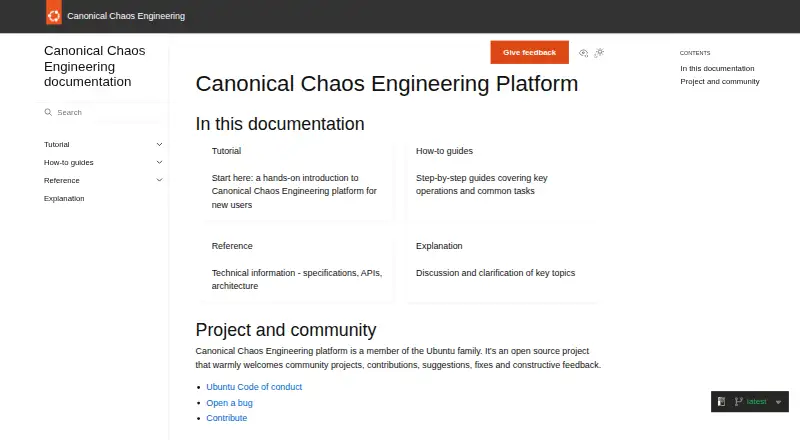
What Canonical Chaos Engineering Platform is
Canonical Chaos Engineering Platform deploys chaos engineering infrastructure and runs experiments to check whether systems recover from faults. It is an open source project that welcomes community contributions and feedback. The documented setup uses Terraform and Juju to deploy on Kubernetes, and its tutorial demonstrates deleting a pod and using a resilience probe to check workload recovery. The example control plane includes Litmus Auth, Litmus Backend, Litmus ChaosCenter, and MongoDB; the tutorial connects Litmus infrastructure to that control plane and uses a self-signed-certificates charm as the system under test. Users access Litmus ChaosCenter in a browser at the deployed unit’s IP address and port 8185. The documentation describes TLS for internal and external connections and recommends trusted CA certificates for production. It also warns that an upstream bug prevents the Litmus control plane from communicating with MongoDB over TLS, leaving that traffic unencrypted. The current focus is Kubernetes chaos testing, not charmed VM cloud testing. Charmed Litmus currently wraps only the control plane; charming the execution plane is future work. Setup guidance calls for 8 GB RAM, 50 GB free disk space, a snapd-compatible operating system, and a Linux shell.
Good
- Open source and welcomes community contributions.
- Tutorial demonstrates pod deletion and recovery probing.
- Experiment scheduling is listed as supported.
- Documentation describes TLS for internal and external connections.
Watch out
- Focuses on Kubernetes, not charmed VM cloud testing.
- MongoDB traffic from the control plane remains unencrypted.
- Execution-plane charm work is still future work.
- Setup calls for 8 GB RAM and 50 GB free disk.
Who it suits
This platform may suit teams running Kubernetes workloads who want to test recovery from injected faults. It is intended for users comfortable with a self-hosted deployment using Terraform, Juju, and Kubernetes.
Verdict
The platform provides a documented Kubernetes path for running fault-recovery experiments. Its MongoDB TLS gap and limited execution-plane scope matter when assessing deployment fit.
The facts
Each one read from Canonical Chaos Engineering Platform's own pages, with the date it was checked.
What it does
- Components
- The tutorial’s example control plane includes Litmus Auth, Litmus Backend, Litmus ChaosCenter, and MongoDB.checked 9 Oct 2001
- Credential limitation
- Litmus does not clear MongoDB tables on teardown, so a forgotten changed admin password requires manually deleting those tables or redeploying the MongoDB charm to reset.checked 9 Oct 2001
- Deployment
- The getting-started tutorial deploys the platform using Terraform and Juju on Kubernetes.checked 9 Oct 2001
- Deployment prerequisites
- The tutorial lists 8 GB RAM, 50 GB free disk space, an Ubuntu or snapd-compatible environment, and a Linux shell for its commands.checked 9 Oct 2001
- Experiments
- The tutorial demonstrates a pod-deletion experiment with a resilience probe to check whether a workload recovers.checked 9 Oct 2001
- Integrations
- The tutorial integrates Litmus infrastructure with the control plane and uses a self-signed-certificates charm as its example system under test.checked 9 Oct 2001
- Interface
- The tutorial accesses Litmus ChaosCenter through a browser at the deployed unit's IP address and port 8185.checked 9 Oct 2001
- Kubernetes scope
- The platform currently focuses on chaos testing in Kubernetes environments and does not currently target Charmed VM cloud chaos testing.checked 9 Oct 2001
- Open source
- Canonical describes the platform as an open source project that welcomes community contributions and feedback.checked 9 Oct 2001
- Password limitation
- Litmus retains user settings in MongoDB after teardown, and the documentation says a forgotten changed admin password may require manually deleting database tables or redeploying MongoDB to reset.checked 9 Oct 2001
- Purpose
- The platform deploys chaos engineering infrastructure and runs experiments to check whether a system under test recovers from faults.checked 9 Oct 2001
- Scope limitation
- The platform currently focuses on Kubernetes chaos testing and does not cover charmed VM cloud chaos testing.checked 9 Oct 2001
- Security limitation
- The documentation says an upstream bug prevents the Litmus control plane from communicating with MongoDB over TLS, leaving that traffic unencrypted.checked 9 Oct 2001
- Setup requirements
- The getting-started tutorial specifies a machine with 8 GB RAM, 50 GB free disk space, and Ubuntu or another operating system that supports snapd.checked 9 Oct 2001
- Support and community
- The project documentation directs users to its GitHub issue trackers for known issues, bugs, and feature requests.checked 9 Oct 2001
- TLS
- The documentation describes TLS integration for internal service interactions and external client connections, and recommends trusted CA certificates for production deployments.checked 9 Oct 2001
- TLS guidance
- Canonical's TLS how-to recommends certificates signed by a trusted CA and safely stored, for example with a Vault charm, for production deployments.checked 9 Oct 2001
- TLS limitation
- The documentation says the Litmus control plane cannot currently communicate with MongoDB over TLS, so that traffic remains unencrypted even when MongoDB has a TLS certificates relation.checked 9 Oct 2001
Money
- Execution plane
- The Charmed Litmus project currently wraps only the control plane; the documentation says charming the execution plane is future work.checked 9 Oct 2001
- Execution plane limitation
- The documentation says Charmed Litmus currently wraps only the control plane; charming the execution plane is described as future work.checked 9 Oct 2001
The company
- Founded
- 2004checked 28 Sep 2001
Alternatives to Canonical Chaos Engineering Platform
- 1

FaultMesh
Free planWebAPISelf-hosted7.2From $49 a month - 2

Gremlin
WebAPILinuxSelf-hosted7.2From $3,750 a month - 3

Reliably
Free planWebLinuxmacOSSelf-hosted7.1From £40 a month - 4
Krkn
Free planWebAPILinuxSelf-hosted6.7Free plan - 5

Chaos Mesh
Free planWebAPISelf-hosted6.5Free plan - 6
Toxiproxy
Free planAPILinuxmacOSSelf-hosted6.5Free plan