Bugfender
Bugfender remotely gathers application logs, errors, and crashes from devices to help teams investigate bugs and support users.
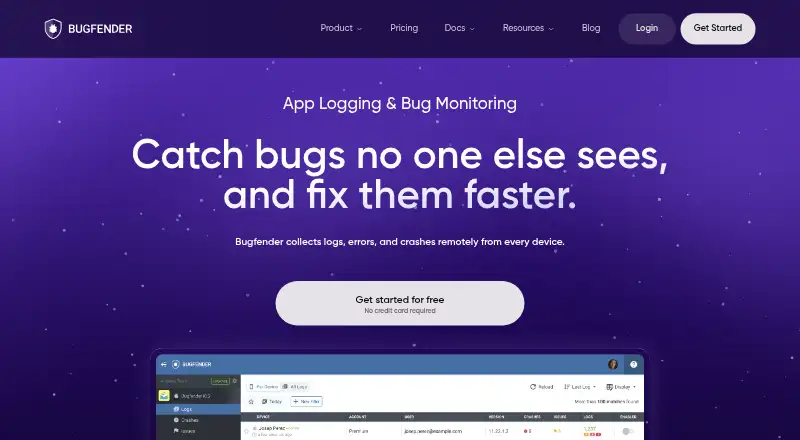
What Bugfender is
Bugfender remotely gathers application logs, errors, and crashes from devices to help teams investigate bugs and support users. Its dashboard organizes device logs, including activity that does not lead to a crash, and presents crash reports alongside them. Android and iOS developers can provide a custom in-app screen for user issue reports. The mobile-focused SDK is described as compact, low-memory, battery-efficient, and able to work offline. Documented SDKs cover Android, iOS, web frameworks, game engines, and other platforms, including Flutter, React Native, Unity, and Cordova. Listed integrations include GitHub, Bitbucket, GitLab, Slack, Jira, Zendesk, and Intercom. A free plan includes up to 100,000 log lines per day, 24-hour retention, and a 2,000-device limit. Bugfender says logs are encrypted in transit and at rest, and states GDPR compliance and ISO 27001 certification. The company was founded in 2014 and has a central office in Barcelona.
Good
- Captures application activity even when no crash occurs.
- Crash reports appear alongside device logs.
- Android and iOS apps can include custom issue-reporting screens.
- Free plan includes 100,000 daily log lines and 2,000 devices.
- Logs are encrypted in transit and at rest.
Watch out
- Free-plan logs are retained for 24 hours.
- API access is listed only for Pro and Premium.
- Plans other than Premium have no SLA.
Who it suits
Bugfender suits mobile and software teams that need device-level logs, crash reporting, or in-app user feedback. Its documented SDKs and integrations cover a range of development frameworks and team services.
Verdict
Bugfender combines remote logging, crash reporting, and user feedback, with a free plan for smaller logging needs. Check its retention and device limits against your requirements before choosing a plan.
Plans and prices
From Bugfender's own pricing page, checked 15 Oct 2026.
| Plan | Price | What it gives you |
|---|---|---|
| Free | Free | 100K daily log lines · 24-hour retention · 2,000 devices · unlimited team members · unlimited apps · daily summary email |
| Team | $39 a month | 10M monthly log lines · 7-day retention · unlimited devices · crash reporting · user feedback · GDPR DPA · basic permissions · from $39/month |
| Pro | $89 a month | 10M monthly log lines · 30-day retention · fine-grained permissions · S3 archiving · API access · webhooks · customizable usage budget · from $89/month |
| Premium | $449 a month | custom volume · 30-day retention · priority support · 99.95% dashboard SLA · SAML SSO · purchase-order billing · bank transfer · from $449/month |
| On-Premises | $3,600 a month | Docker images · Docker Compose or Helm deployment · administration manual · update installation and monitoring · support · $3,600/month for up to 50 developer seats; $36/month per additional seat |
| On-Premises License | $3,600 a month | Self-hosted license · Docker images · sample Docker Compose or Helm configuration · administration manual · support and software updates · $3,600.00/month for up to 50 developer seats; $36.00/month per additional seat. |
The facts
Each one read from Bugfender's own pages, with the date it was checked.
What it does
- API
- Bugfender exposes an API for programmatic log queries and custom integrations.checked 15 Oct 2026
- Authentication security
- Account protection includes TOTP, FIDO U2F security keys, SMS fallback and audit logging.checked 15 Oct 2026
- Compliance
- Bugfender states GDPR compliance, ISO 27001 certification and EU ISO-certified data centers.checked 15 Oct 2026
- Crash reporting
- Crash reports are shown with surrounding logs and issue context for forensic investigation.checked 15 Oct 2026
- Documentation depth
- The help center contains sections for getting started, supported development platforms, logging frameworks, advanced usage, troubleshooting, security, billing and on-premises deployments.checked 15 Oct 2026
- Founder and funding facts
- Bugfender’s press kit names Jordi Gimenez, Aleix Ventayol and Stefan Klumpp as founders, says it has taken no external investment, and records a €100,000 Impact EU grant in 2015.checked 15 Oct 2026
- Historical business limitation
- A Failory interview reported that the free version was mainly for testing while important capabilities required payment, creating competitive pressure if large platforms offered similar free tooling.checked 15 Oct 2026
- Hybrid documentation
- Documentation provides setup guides and sample repositories for React Native, Flutter, Unity, Ionic, .NET MAUI, Cordova and Xamarin.checked 15 Oct 2026
- Independent praise
- EuropeanStack highlights continuous device-level logging, EU hosting, lightweight SDKs and fast integration for mobile teams.checked 15 Oct 2026
- Independent scope limit
- EuropeanStack describes Bugfender as specialized remote logging rather than a full APM product, lacking transaction tracing, performance dashboards and release-health tracking.checked 15 Oct 2026
- Integrations
- Official integrations include GitHub, Bitbucket, GitLab, Zapier, Slack, Trello, Basecamp, Jira, Zendesk, Intercom and Freshdesk.checked 15 Oct 2026
- Limit: G2 pricing
- A reviewer says pricing jumps sharply between log-volume tiers and lacks an intermediate option.checked 15 Oct 2026
- Limit: Software Advice interface
- Reviews criticize limited log exploration, slow or clunky web screens, limited SDK customization and unclear usage throttling.checked 15 Oct 2026
- Mobile SDK
- Bugfender describes its mobile-first SDK as low-memory, battery-efficient, compact, and able to work offline.checked 3 Oct 2026
- Notable news
- Bugfender announced a new monthly pricing model on October 1, 2025, emphasizing usage-based flexibility and predictable budgeting.checked 15 Oct 2026
The company
- Company
- Bugfender says it was founded in 2014 and has a central office in Barcelona.checked 3 Oct 2026
- Company location
- The press kit says Bugfender has a central office in Barcelona with a distributed international team.checked 15 Oct 2026
- Founded
- 2014checked 28 Sep 2026
- Headquarters
- Barcelona, Spain (central office)checked 28 Sep 2026
- LinkedIn company facts
- LinkedIn lists Bugfender as privately held, headquartered in Baiersbronn, founded in 2015 and employing 2–10 people.checked 15 Oct 2026
Where it runs
- Device-centric investigation
- The dashboard organizes data around individual devices or users so engineers can inspect one customer’s history.checked 15 Oct 2026
- In-app feedback
- Android and iOS developers can provide a ready-made or customized feedback screen that sends user reports and session logs.checked 15 Oct 2026
- Limit: GetApp search
- Reviewers report that searching and filtering logs is less powerful than needed.checked 15 Oct 2026
Money
- Free plan limit
- The free plan includes up to 100,000 log lines each day retained for 24 hours, with a 2,000-device limit.checked 3 Oct 2026
The full review of Bugfender
Bugfender is a mobile-focused diagnostics service that gathers logs, crashes, errors, and user reports from deployed apps. It suits Android, iOS, and cross-platform teams that need device-level context without reproducing every problem locally. The main buying decision is how much retention, governance, and operational support your team needs.
Overview
Bugfender places application activity in a dashboard arranged by device. Remote logging captures events even when an app keeps running, while crash reporting puts failures and related issues beside those logs. This combination is more useful than crash-only monitoring when a bug is intermittent or depends on a particular handset state.
Android and iOS developers can add a custom in-app feedback screen, giving users a direct route to report trouble. The mobile SDK is designed to stay compact, limit memory and battery use, and continue collecting data offline before it can transmit. Bugfender was founded in 2014 and has its central office in Barcelona.
Key features
Diagnostics and feedback
Device-organized logs let support and engineering teams examine what happened before an issue was reported. Crash reports retain that context instead of separating failure data from ordinary activity. Network request tracing adds another diagnostic signal for apps where connectivity is part of the problem.
The SDK supports Android, iOS, JavaScript, Angular, React, jQuery, VueJS, Svelte, Flutter, React Native, Ionic, .NET MAUI, Unity, Xamarin, and Cordova. That breadth makes Bugfender practical for mixed mobile stacks, rather than only native Android or iOS projects.
Workflow and security
Connections to GitHub, Bitbucket, GitLab, Zapier, Slack, Jira, Zendesk, Intercom, and other services can turn a finding into an issue or support workflow. The API, available on Pro and Premium, is the route for programmatic queries and custom integrations. Logs are encrypted in transit and at rest, with TLS 1.3 and TLS 1.2 supported for network communications. Bugfender states that it is GDPR compliant and ISO 27001 certified; On-Premises or Private Instance editions address PCI or HIPAA-oriented workloads and data-locality requirements.
Pricing
Bugfender uses a freemium structure. Annual plans are advertised as saving 30% on the monthly starting prices.
| Plan | Price | What you get |
|---|---|---|
| Free | free | 100,000 log lines per day, 24-hour retention, 2,000 devices, unlimited team members and apps, and a daily summary email. |
| Team | $39 a month | 10 million monthly log lines, seven-day retention, unlimited devices, crash reporting, user feedback, GDPR DPA, basic permissions, and a fixed pay-as-you-go budget. |
| Pro | $89 a month | 10 million monthly log lines, 30-day retention, fine-grained permissions, S3 log archiving, API access, webhooks, and a customizable pay-as-you-go budget. |
| Premium | $449 a month | 30-day retention, priority support, a 99.95% monthly dashboard uptime SLA, SAML SSO, purchase-order billing, and bank transfer; volume is custom. |
| On-Premises License | $3,600 a month | Self-hosted Docker deployment, sample Docker Compose or Helm configuration, administration manual, support, and software updates for up to 50 developer seats; additional seats cost $36 a month each. |
Free is useful for prototypes or small teams that can investigate quickly, but a one-day window makes long-running support cases difficult. Team removes the device cap and adds core reporting and feedback, making it the sensible production entry point; it still limits history to seven days and lacks an SLA. Pro is the better fit for regulated or larger engineering workflows that need 30-day history, archives, granular permissions, and automation. Premium justifies its higher cost when uptime commitments, SSO, priority assistance, or formal purchasing processes matter. On-Premises is for organizations that must operate the service in their own environment, not for teams seeking the lowest software bill.
Platforms
Bugfender provides Android, iOS, web, API, and self-hosted options. Its SDK coverage spans the mobile and web frameworks listed above, including Unity and Xamarin for app projects built outside standard native stacks.
Who it's for
Choose Bugfender if your team supports distributed mobile users and needs logs, crashes, network traces, and feedback in one device-oriented workflow. It is particularly well matched to cross-platform development and organizations that need GDPR-oriented controls or a self-hosted edition. It is less suitable when you require long retention at the lowest tier, or when a crash-only tool already covers your narrow use case.
Pros and cons
Pros
- Remote logs preserve non-crash activity, giving investigations more context than crash reports alone.
- The mobile SDK is designed for low memory and battery use and can work offline.
- Broad SDK coverage and issue-tracking integrations suit mixed app estates.
- Free includes unlimited team members and apps, plus a 2,000-device allowance.
- Pro and Premium add API access, while Premium supplies a 99.95% dashboard SLA and priority support.
Cons
- Free retention is only 24 hours, so delayed investigations can lose the relevant evidence.
- Team and Pro both center on 10 million monthly log lines, requiring usage discipline as apps grow.
- The SLA and priority response are reserved for Premium; other plans have no SLA and Bugfender aims to respond within 24 hours.
- Self-hosting starts at $3,600 a month, placing data-locality deployments firmly in an enterprise budget.
Alternatives
Guance Container Monitoring is the stronger direction when host and container metrics, up to 10 million daily log records, and seven-day rolling retention are central requirements.
BugSnag is worth choosing when its event-and-span model, broad platform coverage, and third-party integrations better match your observability workflow.
Middleware fits teams seeking a wider infrastructure and real-user monitoring package alongside application telemetry.
Appelium is an option for a smaller iOS, tvOS, and Android footprint with a CHF-priced per-app free tier.
EAS Observe suits teams that prefer event-based monitoring with 90 days of free-tier retention.
Firebase Cloud Messaging is the choice when the requirement is no-cost push messaging rather than diagnostics.
OpenReplay is an alternative for teams prioritizing open-source, self-managed session investigation.
Rejourney is aimed at session replay, funnels, and cohort analysis rather than Bugfender's log-first troubleshooting.
Verdict
Bugfender is a strong choice for mobile and cross-platform teams that need remote, device-specific evidence plus crash reporting and in-app feedback. Its broad SDK support, integrations, and self-hosted path add flexibility. Look elsewhere if your investigations routinely span more than 24 hours on a free budget, or if you need Premium-level service commitments without paying for the top tier.
Alternatives to Bugfender
- 1

Middleware
Free planAndroidiOSWebAPI8.2$0.30 usage-based - 2

Embrace User Session Insights
Free planAndroidiOSWebAPI8.1Free plan - 3

Appelium
Free planAndroidiOSWebAPI7.9From 250 CHF a month - 4

BugSnag
Free planAndroidiOSWebAPI7.8Free plan - 5

OpenReplay
Free planAndroidiOSWebAPI7.8Free plan - 6
Alibaba Cloud ARMS RUM
AndroidiOSWebAPI7.5$0.02 usage-based