blobmodel
The facts below are what the maker publishes about blobmodel, checked and dated. Our editors have not written about it yet.
The facts
Each one read from blobmodel's own pages, with the date it was checked.
What it does
- 3D visuals
- Nochecked 23 Sep 2026
- Authoring tools
- Yeschecked 23 Sep 2026
- Blob shapes
- Supported shape choices include exponential, Lorentz, double exponential, Gaussian, secant, dipole, and rectangular.checked 12 Oct 2026
- Custom parameters
- Users can implement a custom BlobFactory to define blob parameters individually; they are responsible for ensuring variables have correct dimensions and manually normalizing parameters if needed.checked 11 Oct 2026
- Data export
- Yeschecked 23 Sep 2026
- Installation
- The documentation provides installation from PyPI with `pip install blobmodel`.checked 12 Oct 2026
- Intended research
- The project was originally developed to study the scrape-off layer of fusion experiments and may apply to other one- or two-dimensional systems.checked 12 Oct 2026
- Label output
- Users can add same-region or per-blob integer labels to the output dataset, which the documentation notes may help create supervised machine-learning training data.checked 12 Oct 2026
- Model setup
- A model lets users specify grid dimensions, domain lengths, time step, time length, initial time, blob shape, drainage time, and blob count.checked 12 Oct 2026
- One-dimensional mode
- Setting `one_dimensional` to true discards the perpendicular blob shape and sets `Ny=1` and `Ly=0`.checked 12 Oct 2026
- Open source
- The documentation describes blobmodel as an open source project developed by the Complex Systems Modelling group at UiT The Arctic University of Norway.checked 11 Oct 2026
- Output
- A realization is returned as an xarray dataset and can be saved locally by passing a filename to `make_realization`.checked 12 Oct 2026
- Parameter distributions
- The default factory supports distributions for blob amplitudes, widths, velocities, pulse shapes, alignment, and tilt, and users can implement a custom factory.checked 12 Oct 2026
- Periodic boundary behavior
- With `periodic_y` enabled, blobs leaving the domain in the y direction enter at the opposite end; the docs caution that the y domain should be large compared with blob widths.checked 11 Oct 2026
- Periodic boundary caveat
- The documentation advises using y-periodicity only when the y-domain is large compared with blob widths and says the code warns when a blob width is less than `0.1 * Ly`.checked 12 Oct 2026
- Purpose
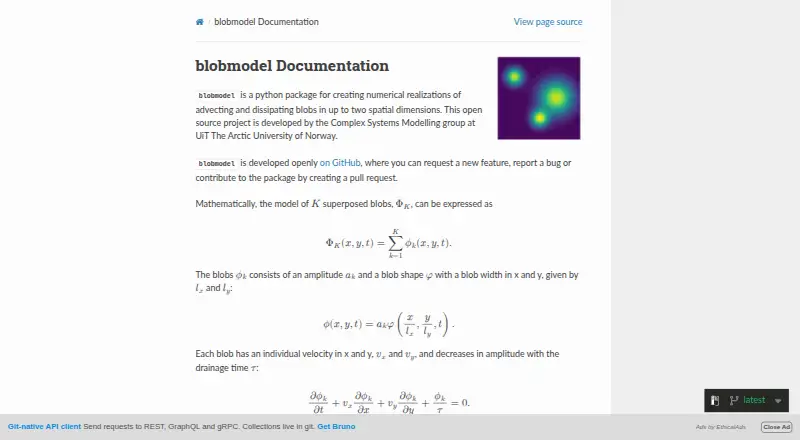
- blobmodel is a Python package for creating numerical realizations of advecting and dissipating blobs in up to two spatial dimensions.checked 12 Oct 2026
- Support and contribution
- The project invites users to report bugs or request features on GitHub and contribute pull requests.checked 12 Oct 2026
- Visualization
- The package provides `show_model` to plot a model realization as an animation.checked 12 Oct 2026
Money
- Free plan
- Yeschecked 23 Sep 2026
Where it runs
- Machine learning use
- The optional blob_labels field can label occupied regions or individual blobs, and the documentation says it can be useful for supervised machine learning training datasets.checked 11 Oct 2026
Alternatives to blobmodel
- 1

SimFlow
Free planWebLinuxmacOSWindows8.2From €8,000 a year - 2

COMSOL Multiphysics
WebAPILinuxmacOS7.7 - 3
FeenoX
Free planWebAPILinuxSelf-hosted7.5Free plan - 4
myPhysicsLab
Free planWebLinuxmacOSSelf-hosted7.5Free plan - 5

OpenFOAM
Free planLinuxmacOSSelf-hostedWindows7.3Free plan - 6
MPTRAC
Free planWebLinuxSelf-hosted7.2Free plan