Automatic API Attack Tool
Automatic API Attack Tool is a free, open-source tool that generates and runs tests from an API specification.
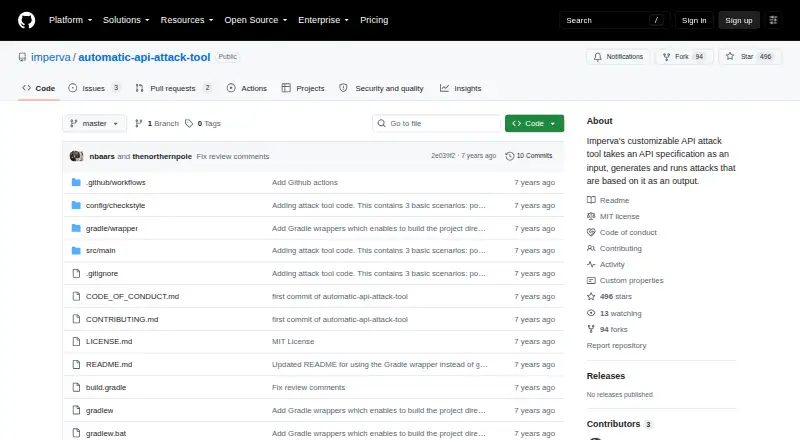
What Automatic API Attack Tool is
Automatic API Attack Tool is a free, open-source tool that generates and runs tests from an API specification. It requires Swagger 2.0 in JSON or YAML. Its fuzzing scenarios send generated values that either follow the specification or violate it, including a scenario that inserts a random invalid value into each checked parameter. The project says its request generation can be extended for specific needs, including attack types such as illegal resource access, XSS, SQL injection, and RFI.
The tool prints request details and whether responses matched expectations, writes TestNG results under build/testng-results, and stores bad requests in a bad_requests folder. Optional arguments can route requests through a proxy using its host and port. The project describes use in CI/CD, including a Jenkins job triggered by a schedule or code push. It runs on Windows and Linux, requires Java 8 or higher and Gradle, and is self-hosted. Windows build instructions use gradlew.bat build; on Linux, the instructions describe combining a runnable shell script with the JAR. Its repository lists an MIT license. It supports authorization and input-validation testing, but does not discover APIs.
Good
- Free and open source under an MIT license
- Generates valid and invalid parameter scenarios
- Can be used in Jenkins jobs
- Optional proxy routing is supported
Watch out
- Requires a Swagger 2.0 specification
- Requires Java 8 or higher and Gradle
- Does not discover APIs
Who it suits
This tool suits developers and security teams who have a Swagger 2.0 specification and want to run API tests locally or in a CI/CD job. It requires Java 8 or higher and Gradle.
Verdict
Automatic API Attack Tool offers specification-based fuzzing and reports for teams prepared to build and run it themselves. Its Swagger 2.0 requirement is a key constraint.
Plans and prices
From Automatic API Attack Tool's own pricing page, checked 8 Oct 2026.
| Plan | Price | What it gives you |
|---|---|---|
| MIT-licensed open-source tool | Free | Java 8 or higher · Gradle · Swagger 2.0 API specification |
The facts
Each one read from Automatic API Attack Tool's own pages, with the date it was checked.
What it does
- API format
- The required specification is Swagger 2.0 in JSON or YAML format.checked 8 Oct 2026
- Attack generation
- It creates fuzzing scenarios by sending generated values within and outside the boundaries defined in the API specification.checked 8 Oct 2026
- Attack vectors
- The README says the tool can be extended to run attacks such as illegal resource access, XSS, SQL injection, and RFI.checked 8 Oct 2026
- CI/CD
- The project says it was built with CI/CD in mind and describes running it in a Jenkins job triggered by a schedule or code push.checked 8 Oct 2026
- Extensibility
- The project says its fuzzing and request generation functionality can be extended for specific needs.checked 8 Oct 2026
- Fuzzing
- It creates positive and negative fuzzing scenarios using generated parameter values that follow or violate the API specification.checked 8 Oct 2026
- License
- The repository lists an MIT license.checked 8 Oct 2026
- Limits
- The README says the required API specification must be Swagger 2.0 and recommends precisely defining legitimate response codes for endpoints.checked 8 Oct 2026
- Proxy support
- Optional arguments let users route requests through a proxy by specifying its host and port.checked 8 Oct 2026
- Purpose
- The tool takes an API specification as input and generates and runs attacks based on it.checked 8 Oct 2026
- Reporting
- The tool writes TestNG results under `build/testng-results`, prints check details and a summary, and stores bad requests in a `bad_requests` folder.checked 8 Oct 2026
- Requirements
- Running the tool requires Java 8 or higher and Gradle.checked 8 Oct 2026
- Results
- The tool reports request details and whether responses matched expectations, writes TestNG results under build/testng-results, and stores bad requests in a bad_requests folder.checked 8 Oct 2026
- Specification support
- The required specification is Swagger 2.0 in JSON or YAML format.checked 8 Oct 2026
- Support
- The README directs users to source code documentation and gives an email address for questions; it directs bug reports to GitHub Issues.checked 8 Oct 2026
Where it runs
- Linux
- The README describes combining a runnable shell script with the JAR to make a Linux executable.checked 8 Oct 2026
- Test scenarios
- Supported scenarios include requests with generated valid values and requests that inject a random invalid value into each checked parameter.checked 8 Oct 2026
- Windows
- The README gives `gradlew.bat build` as the Windows build command.checked 8 Oct 2026
- Windows and Linux
- The README gives build instructions for Windows and describes how to create a Linux executable.checked 8 Oct 2026
The full review of Automatic API Attack Tool
Automatic API Attack Tool is a self-hosted utility for generating API security test requests from a specification. It suits developers and teams comfortable building Java projects who want focused checks of input handling and authorization.
Overview
The tool turns an API contract into positive and negative fuzzing scenarios: it sends generated values that follow the specification as well as values designed to violate its boundaries. That makes it useful for checking whether endpoints handle expected and malformed inputs appropriately. It does not discover APIs, so teams need a Swagger 2.0 specification ready before testing can begin.
It can run in a Jenkins job triggered by a schedule or code push, and optional host and port arguments let users route requests through a proxy. This suits teams adding repeatable checks to an existing workflow, but the project must be built and run by the team: it requires Java 8 or higher and Gradle.
Key features
Contract-based fuzzing
The required API specification is Swagger 2.0 in JSON or YAML. The supported scenarios include requests populated with generated valid values and requests that inject a random invalid value into each checked parameter. This is a focused way to probe input validation against a declared contract; it is not a fit for APIs described only in another format.
Extensible attack coverage
The project says its fuzzing and request-generation functions can be extended for specific needs, including attacks such as illegal resource access, XSS, SQL injection, and RFI. That flexibility can help teams adapt the tool to their own checks, but extending coverage requires technical work rather than selecting a ready-made service feature.
Results and workflow
The tool prints request checks and a summary, records whether responses matched expectations, writes TestNG results under build/testng-results, and saves bad requests in a bad_requests folder. These outputs give teams artifacts to review after a run or incorporate into their process. The project recommends defining legitimate response codes precisely for each endpoint; loose expectations can make response checks less useful.
Windows build instructions use gradlew.bat build. On Linux, the project describes packaging a runnable shell script with the JAR to create an executable. The repository uses the MIT license, and support is directed to source documentation and an email address, with bug reports handled through GitHub Issues.
Pricing
MIT-licensed open-source tool: free. The plan includes the tool, with Java 8 or higher, Gradle, and a Swagger 2.0 API specification as requirements. There are no paid tiers or seat and usage caps in the stated plan; the trade-off is that teams supply the build, execution environment, and any extensions themselves.
Platforms
Automatic API Attack Tool supports Linux and Windows, with build guidance for both. It is self-hosted, so users run it in their own environment rather than using a hosted deployment. Its supported API formats are Swagger 2.0 in JSON or YAML.
Who it's for
This is best for developers and security teams with a Swagger 2.0 contract who want free, repeatable input-validation and authorization testing inside a self-managed workflow. It is less suitable for teams that need API discovery, broad specification compatibility, or a managed setup that avoids Java and Gradle maintenance.
Pros and cons
- Pros: Free and MIT-licensed, with no per-seat price stated.
- Pros: Generates positive and negative cases from declared parameter constraints, directly supporting input-validation checks.
- Pros: Jenkins workflow support, proxy options, and stored TestNG results can fit an existing test process.
- Cons: Requires Swagger 2.0, excluding APIs without that specification.
- Cons: Java 8 or higher and Gradle, plus self-hosted execution, put setup and upkeep on the user.
- Cons: No API discovery; teams must bring a suitable specification.
Alternatives
For a wider set of API security options, compare the API Security Testing Software category.
- 42Crunch API Security Platform is worth considering for teams seeking a paid platform with a free plan and trial, plus an AI coding plugin, OpenAPI audit, vulnerability scans, and automatic fixes.
- OWASP Amass is another free, open-source option for teams looking for an Apache License 2.0 framework across Linux, macOS, Windows, and self-hosted environments.
- APISec Platform may suit teams wanting a freemium option with a free plan for public API testing, basic test simulations, and community support.
- VulnAPI is a free MIT-licensed alternative for educational and testing use across Linux, macOS, Windows, and self-hosted environments.
- WuppieFuzz is a free, open-source REST API fuzzer for teams comparing other self-hosted fuzzing options.
- AquilaX API Security Scanner has a free plan covering secrets scanning, PII detection, compliance auditing, unlimited scans, and CI/CD and IDE integration.
- Pynt offers a free Starter plan with limited API security testing for up to 10 API endpoints; its Business plan has custom pricing and full API security testing.
- Schemathesis is a free, open-source API testing tool that generates tests from OpenAPI and GraphQL schemas, making it a relevant alternative when those schema formats are preferred.
Verdict
Choose Automatic API Attack Tool if you have a Swagger 2.0 API, can manage a Java and Gradle build, and want free specification-driven fuzzing in a self-hosted workflow. Its main advantage is focused positive and negative testing without a license fee; look elsewhere if you need API discovery, a different specification format, or a managed platform.
Getting started
- Open the project website and obtain the source
- Prepare a Swagger 2.0 API specification in JSON or YAML
- Install Java 8 or higher and Gradle
- Build on Windows with gradlew.bat build, or create the described Linux executable
- Run the generated tests against the API
- Add proxy host and port arguments when routing through a proxy
- Integrate execution into a scheduled or code-push Jenkins job
Limits worth knowing
Testing requires a Swagger 2.0 specification; the README recommends precisely defining legitimate response codes. The self-hosted build also depends on Java 8 or higher and Gradle.
Questions
What API specification does it accept?
It requires Swagger 2.0 in JSON or YAML format.
Which operating systems are supported?
The project provides Windows and Linux build and execution guidance.
Is the tool open source?
Yes. The repository lists an MIT license, and the tool is free to use.
Can it test authorization and input validation?
Yes. Authorization testing and input-validation testing are listed capabilities.
Where are results stored?
TestNG results go under build/testng-results, and bad requests are saved in a bad_requests folder.
Can it run in CI/CD?
Yes. The project describes Jenkins jobs triggered by a schedule or code push.
Alternatives to Automatic API Attack Tool
- 1
42Crunch API Security Platform
Free planWebAPIExtensionLinux7.9From $9 a month - 2

APISec Platform
Free planWebAPIExtensionLinux7.5From $690 a month - 3
WuppieFuzz
Free planOpen sourceAPILinuxmacOSSelf-hosted7.3Free plan - 4

Beagle Security
Free planWebAPI6.9From $99 a month - 5
StackHawk HawkScan
WebAPILinuxmacOS6.8From $10 a month - 6
AquilaX API Security Scanner
Free planWebAPIExtensionSelf-hosted6.7From $19 a month