
ASUS GPU Tweak III
ASUS GPU Tweak III is free Windows software for adjusting system parameters on NVIDIA and AMD desktop graphics cards, including overclocking, voltage, and fa…
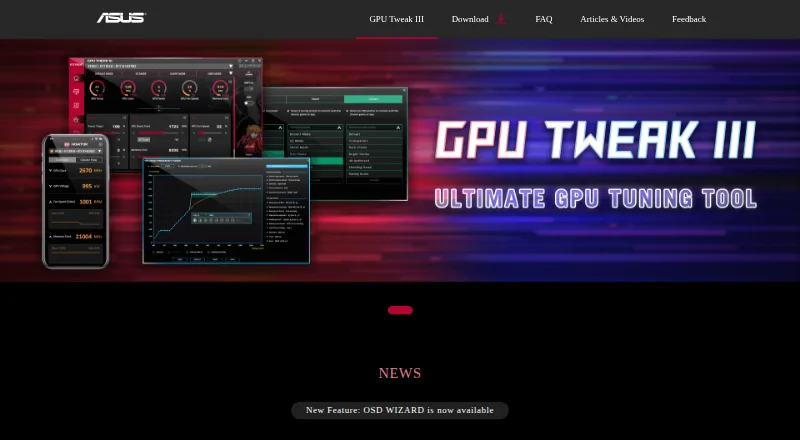
What ASUS GPU Tweak III is
ASUS GPU Tweak III is free Windows software for adjusting system parameters on NVIDIA and AMD desktop graphics cards, including overclocking, voltage, and fan control. OC Scanner automatically optimizes clock speeds for NVIDIA cards and saves the result as a profile without overwriting driver data. The Voltage-Frequency Tuner provides ways to manage the GPU boost curve. Profile Connect can load linked overclock, fan-curve, and OSD settings when a selected application runs. Users can set GPU fans and system fans connected to FanConnect headers to curves or fixed RPM values. The hardware monitor tracks fan RPM and system power metrics, displays system information over full-screen applications, and exports logs for analysis. A plug-in adds real-time statistics about components such as the motherboard, processor, and storage devices. The OSD can be customized for metric font, color, opacity, size, and position. ASUS lists Windows 10 and 11, at least 2 GB RAM, and 200 MB storage as minimum requirements for most versions. Excessive overclocking may cause instability, and operating products outside factory settings may affect performance or warranty coverage.
Good
- Supports NVIDIA and AMD graphics cards
- OC Scanner optimizes NVIDIA clock speeds
- Profile Connect loads settings for selected applications
- Fan control includes curves and fixed RPM settings
- OSD and monitoring logs support analysis
Watch out
- Excessive overclocking may cause instability
- Operation outside factory settings may affect performance or warranty coverage
- Power Detector+ works with select ROG graphics card models
- Minimum requirements include 2 GB RAM and 200 MB storage
Who it suits
GPU Tweak III suits Windows users who want to tune supported NVIDIA or AMD graphics cards, configure fans, or monitor system metrics. Users should be prepared for the instability risk ASUS associates with excessive overclocking.
Verdict
GPU Tweak III offers manual and automatic tuning alongside fan controls, monitoring, and a customizable OSD. Its overclocking features come with a stated instability risk, and Power Detector+ applies only to specified ROG models.
Plans and prices
From ASUS GPU Tweak III's own pricing page, checked 29 Sep 2026.
| Plan | Price | What it gives you |
|---|---|---|
| ASUS GPU Tweak III | Free | No price or usage limits stated on the product page |
The facts
Each one read from ASUS GPU Tweak III's own pages, with the date it was checked.
What it does
- Additional compatibility
- ASUS support says GPU Tweak III applies to all NVIDIA and AMD graphics cards, while some features have model-specific support limits.checked 28 Sep 2026
- Automatic profiles
- Profile Connect can link overclock settings, fan curves, and OSD settings to applications and load them when a target app runs.checked 29 Sep 2026
- Compatibility
- The FAQ states that GPU Tweak III supports graphics cards of any brand and AMD GPUs, and lists minimum graphics support as NVIDIA GeForce 200 series or later, AMD Radeon HD 7000 series or later, or any GPU with DirectX 11 support.checked 29 Sep 2026
- Cooling
- Users can set GPU and connected system fan curves or static RPM values, with hysteresis and update period options.checked 29 Sep 2026
- Current release
- The product page lists stable version 2.1.9.5, released September 18, 2026.checked 28 Sep 2026
- Hardware limits
- Power Detector+ monitors 12VHPWR pin current and warns at 0A or above 9.2A; ASUS lists compatibility for select ROG Astral RTX 5090 and RTX 5080 cards and the ROG Matrix RTX 4090 Platinum.checked 29 Sep 2026
- Hardware monitoring plug-in
- A plug-in provides real-time performance statistics about the motherboard, processor, storage devices, and other components.checked 29 Sep 2026
- Hardware plug-in
- A plug-in provides real-time performance statistics about the motherboard, processor, storage devices, and more in the app interface and OSD.checked 28 Sep 2026
- Integrations
- The page describes an Armoury Crate connection for unified RGB controls and a built-in TechPowerUp GPU-Z panel for graphics-card information.checked 29 Sep 2026
- Manual tuning
- The Voltage-Frequency Tuner provides discrete management of the GPU boost curve.checked 28 Sep 2026
- Monitoring
- The hardware monitor tracks fan RPM and system power metrics and can export logs for benchmarking analysis.checked 29 Sep 2026
- Monitoring and OSD
- The app can display system information over full-screen applications and export monitoring logs for benchmarking analysis.checked 28 Sep 2026
- On-screen display
- The built-in OSD displays system information in full-screen applications and allows adjustments to metric fonts, colors, opacity, size, and position.checked 29 Sep 2026
- Overclocking
- The software offers preset profiles, tuning sliders, and an OC Scanner that automates overclocking for Nvidia graphics cards.checked 29 Sep 2026
- Power Detector+ limit
- Power Detector+ monitors 12VHPWR pin current and is listed as compatible with specified ROG Astral RTX 5090 and 5080 models and the ROG Matrix RTX 4090 Platinum.checked 28 Sep 2026
- Purpose
- GPU Tweak III is ASUS graphics-card tuning software for adjusting GPU performance and efficiency.checked 29 Sep 2026
- Related tools
- The product page lists Armoury Crate, GPU-Z, ROG FurMark, and QuantumCloud in its additional information section.checked 28 Sep 2026
- Safety and limitation
- ASUS says excessive overclocking may cause instability such as artifacting or black screens, and product operation outside factory settings may affect performance or warranty coverage.checked 29 Sep 2026
- Support
- ASUS provides tutorials and a feedback form that asks users to submit the software version, graphics card, driver version, Windows version, and issue details.checked 29 Sep 2026
- Support resources
- ASUS provides a GPU Tweak III introduction and Q&A covering installation, features, troubleshooting, and supported hardware.checked 28 Sep 2026
Where it runs
- Application profiles
- Profile Connect can save and automatically load overclock, fan-curve, and OSD settings when a selected application runs.checked 28 Sep 2026
- Platform
- ASUS says GPU Tweak III supports Windows 10 and 11.checked 28 Sep 2026
The company
- Founded
- 1990checked 23 Sep 2026
- Headquarters
- Taipei City, Taiwanchecked 23 Sep 2026
The full review of ASUS GPU Tweak III
GPU Tweak III brings together GPU tuning, cooling controls, and system monitoring, with automatic clock optimization for NVIDIA cards and support for AMD and other-brand graphics cards. It is a strong fit for Windows users who want per-game settings and an in-game overlay; its deeper controls reward care, not guesswork.
Its appeal is breadth at no cost, though feature support varies by card and tuning beyond factory settings can bring instability or affect warranty coverage.
Overview
GPU Tweak III combines automatic and manual tuning with fan management, application profiles, and monitoring. ASUS says it supports graphics cards of any brand, but individual features have model-specific limits. That makes it a useful single control panel for many desktop GPU owners, not a promise that every control will be available on every card.
The OC Scanner automatically optimizes clock speeds on NVIDIA graphics cards and saves the result as a profile without overwriting driver data. Automatic optimization is the more approachable starting point; curve tuning gives experienced users more direct control.
ASUS lists minimum graphics support as NVIDIA GeForce 200 series or later, AMD Radeon HD 7000 series or later, or any GPU with DirectX 11 support. Minimum system requirements for most versions are 64-bit Windows 10 or 11, 2 GB RAM, and 200 MB of available storage.
Key features
Tuning and application profiles
Alongside clock and voltage adjustment, the app offers power-limit control and tuning profiles. Profile Connect can load overclock settings, fan curves, and OSD settings when a selected application runs. That suits people who want different setups tied to particular applications, while users who prefer one steady configuration may have less reason to use profile automation.
Cooling, monitoring, and OSD
Users can set GPU fan curves or static RPM values and control system fans connected to FanConnect headers. The hardware monitor tracks fan RPM and system power metrics, and can export logs for benchmarking analysis. The OSD puts system information over full-screen applications, with controls for metric fonts, colors, opacity, size, and position. These tools make it easier to watch behavior during use, though monitoring does not remove the risks of aggressive tuning.
Integrations and model-specific tools
A hardware plug-in adds live statistics for the motherboard, processor, storage, and other components to the app and OSD. The interface also includes a GPU-Z panel for graphics-card information, while the Armoury Crate connection provides unified RGB controls. Power Detector+ monitors 12VHPWR pin current and warns at 0A or above 9.2A, but its support is limited to specified ROG Astral RTX 5090 and RTX 5080 cards and the ROG Matrix RTX 4090 Platinum. Most users should treat that feature as a specialized extra, not a reason to choose the app.
Pricing
ASUS GPU Tweak III — free. The free plan has no price or usage limits stated on the product page. There is no paid tier or free-trial term to weigh; the practical limitation is compatibility, since some features only apply to particular models.
Platforms
GPU Tweak III supports Windows 10 and 11, with 64-bit Windows required. ASUS lists 2 GB RAM and 200 MB of available storage as minimum requirements for most versions. It is not the choice for Linux users.
Who it's for
This is a good fit for Windows desktop GPU owners who want tuning and fan controls alongside application-linked profiles and an adjustable in-game overlay. It is especially relevant to users who value both automated NVIDIA clock optimization and manual curve control. Owners of cards with limited feature support should check their model before relying on a particular control.
It is a poor fit for anyone who needs a risk-free, set-and-forget tuning utility. ASUS warns that excessive overclocking can cause instability, including artifacting or black screens, and that operation outside factory settings may affect performance or warranty coverage.
Pros and cons
- Pros: A broad set of tuning, cooling, profile, and monitoring controls is available in one free Windows app.
- Pros: Profile Connect can switch overclock, fan, and OSD settings when a selected application runs.
- Pros: The customizable OSD and exported monitoring logs serve both in-session monitoring and later benchmarking analysis.
- Cons: The OC Scanner optimizes clocks for NVIDIA cards, and other features can also have model-specific support limits.
- Cons: Excessive tuning can destabilize a system, and operation outside factory settings may affect performance or warranty coverage.
- Cons: Windows-only support rules it out for users who need a Linux GPU utility.
Alternatives
For category browsing, see GPU Tuning Software, GPU Overclocking Software, and PC Overclocking Software.
- AMD GPU Tuner is a free, open-source Windows option for Radeon GPUs using a compatible Adrenalin driver; choose it if that narrower AMD focus suits your setup.
- Intel VTune Profiler is a free download for Linux, Windows, or self-hosted use, with commercial and non-commercial use permitted and community support; consider it if those platform and licensing terms fit better.
- NVIDIA_OC Daemon is a free Linux option under the MIT License, for readers who need that platform instead of Windows.
- CoreCtrl is a free and open-source GNU/Linux application with no paid plans stated, for Linux users seeking a platform-specific alternative.
- LACT is a free Linux GPU configuration and monitoring tool; consider it if you need a Linux alternative.
- MoreClockTool is a free Windows option for newer AMD graphics cards, intended for experienced users and evaluation purposes, with overclocking at the user's risk.
- TuxClocker is a free GNU/Linux option under GPL-3 with hardware-specific GPU and CPU support.
- Green Curve is a free option for Linux and Windows users.
Verdict
Choose GPU Tweak III if you want a free Windows toolkit that combines GPU tuning, cooling, application-linked profiles, and a customizable OSD. Its breadth is the main reason to pick it; the need to respect tuning risks and check model-specific support is the main reason to look elsewhere.
Getting started
- Visit the ASUS GPU Tweak III website.
- Use a Windows 10 or Windows 11 computer that meets the listed minimum requirements for most versions.
- Install GPU Tweak III and consult ASUS's introduction or Q&A for installation and supported hardware guidance.
- Set tuning, fan, monitoring, or OSD options in the application.
Limits worth knowing
The free plan has no price or usage limits stated on the product page. Some features have model-specific support limits; Power Detector+ is listed for select ROG Astral RTX 5090 and RTX 5080 cards and the ROG Matrix RTX 4090 Platinum.
Questions
How much does ASUS GPU Tweak III cost?
The listed plan is free.
Which operating systems does it support?
ASUS says GPU Tweak III supports Windows 10 and 11.
Does it support AMD graphics cards?
Yes. The FAQ says it supports AMD GPUs and graphics cards of any brand. It lists minimum graphics support as AMD Radeon HD 7000 series or later, NVIDIA GeForce 200 series or later, or any GPU with DirectX 11 support.
What are the listed minimum system requirements?
For most versions, the FAQ lists 64-bit Windows 10 or Windows 11, at least 2 GB RAM, and 200 MB of available storage.
What is Power Detector+ compatible with?
ASUS lists select ROG Astral RTX 5090 and RTX 5080 cards and the ROG Matrix RTX 4090 Platinum.
Does it connect with other tools?
The page describes an Armoury Crate connection for unified RGB controls and a built-in TechPowerUp GPU-Z panel. It also lists Armoury Crate, GPU-Z, ROG FurMark, and QuantumCloud as related tools.
Alternatives to ASUS GPU Tweak III
- 1
CoreCtrl
Free planOpen sourceLinux7.1Free plan - 2
MSI Afterburner
Free planAndroidWindows7.1Free plan - 3

GALAX Xtreme Tuner Plus
Free planAndroidiOSWindows6.7Free plan - 4
Inno3D TuneIT
Free planWindows6.5Free plan - 5
Intel VTune Profiler
Free planLinuxSelf-hostedWindows6.5Free plan - 6
Gainward ExperTool
Free planWindows6.4Free plan