ARL Topologies
ARL Topologies is a free, self-hosted topology optimization program intended for research and general use.
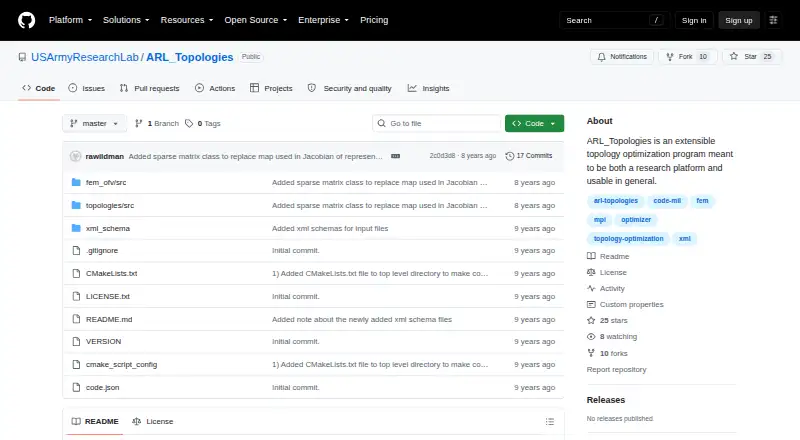
What ARL Topologies is
ARL Topologies is a free, self-hosted topology optimization program intended for research and general use. It separates a design representation, an optimizer, and an objective function. Supported representations include 2D and 3D element-based density discretization with SIMP interpolation, and nodal-based density discretization using Heaviside projection and filtering. Inputs can be ASCII ExodusII or GMSH meshes, or rectangular pixel and voxel regions. Implemented optimization methods include optimality criterion, method of moving asymptotes, BFGS through NLopt, and a genetic algorithm. Its implemented objective function performs static structural finite element analysis. Density-based results can be post-processed to STL, with VTK, GMSH, and Matlab among the output formats. The objective function loads from a shared library, allowing extension to other problems. The command-line program uses an XML input file and can take an optional -mpi argument when MPI is enabled and useful. Building requires a C++11-compatible compiler and listed libraries including CGAL, Boost, GMP, MPFR, PugiXML, NLopt, and Eigen for the finite element solver.
Good
- Supports 2D and 3D density representations.
- Includes four implemented optimization methods.
- Accepts mesh, pixel, and voxel inputs.
- Free under CC0 1.0 Universal terms.
Watch out
- Requires compiling from source.
- Build requires a C++11-compatible compiler and listed libraries.
- Command-line use requires an XML input file.
Who it suits
ARL Topologies suits researchers and other users working on topology optimization who can build and run self-hosted software. Its supported inputs and optimization methods are relevant to structural finite element analysis workflows.
Verdict
ARL Topologies provides multiple representations and optimization methods for structural finite element analysis. Its source-build requirements make it a fit for users comfortable managing the compiler and dependencies.
Plans and prices
From ARL Topologies's own pricing page, checked 4 Oct 2026.
| Plan | Price | What it gives you |
|---|---|---|
| CC0-licensed software | Free | Compile from source · C++11 compiler and listed libraries required |
The facts
Each one read from ARL Topologies's own pages, with the date it was checked.
What it does
- Build requirements
- Building requires a C++11-compatible compiler and libraries including CGAL, Boost, GMP, MPFR, PugiXML, NLopt, and Eigen for the finite element solver.checked 4 Oct 2026
- Contributions
- The project says outside contributions must include a Contributor License Agreement.checked 4 Oct 2026
- Design
- The program separates topology optimization into representation, optimizer, and objective function components.checked 4 Oct 2026
- Extensibility
- The objective function is loaded from a shared library, allowing the program to be extended to different problems.checked 4 Oct 2026
- License
- The repository license describes CC0 1.0 Universal terms, with a stated patent-license modification for contributions.checked 4 Oct 2026
- Mesh inputs
- It accepts ASCII ExodusII or GMSH meshes, as well as pixel or voxel rectangular regions.checked 4 Oct 2026
- MPI
- The default build configuration uses MPI, which can be removed by deleting -DUSE_MPI; the included FEM library does not use MPI.checked 4 Oct 2026
- Objective function
- The implemented objective function is static structural finite element analysis.checked 4 Oct 2026
- Optimizers
- Implemented optimizers include optimality criterion, method of moving asymptotes and BFGS via NLopt, and a genetic algorithm.checked 4 Oct 2026
- Outputs
- Density-based representations can be post-processed to STL, and output formats include VTK, GMSH, and Matlab.checked 4 Oct 2026
- Purpose
- ARL_Topologies is an extensible topology optimization program intended as both a research platform and a general-use tool.checked 4 Oct 2026
- Representations
- It supports 2D and 3D element-based density discretization with SIMP interpolation and nodal-based density discretization using Heaviside projection and filtering.checked 4 Oct 2026
- Usage
- The program runs from the command line with an XML input file, with an optional -mpi argument when MPI is enabled and useful.checked 4 Oct 2026
The company
- Headquarters
- Adelphi, Maryland, United Stateschecked 28 Sep 2026
- Maker
- The repository is published by USArmyResearchLab and describes the project as a work of the United States government.checked 4 Oct 2026