
Arbuz
Arbuz helps furniture and home décor retailers bring room discovery and visualization to their online stores.
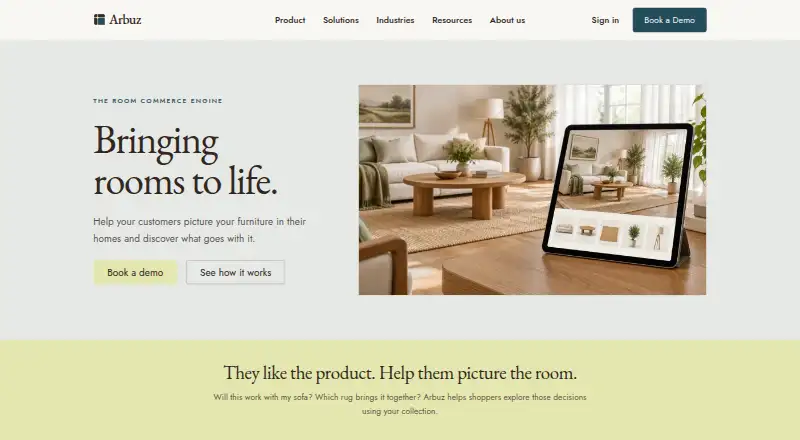
What Arbuz is
Arbuz helps furniture and home décor retailers bring room discovery and visualization to their online stores. It builds shoppable room suggestions from a retailer’s own catalog and merchandising rules. Shoppers can photograph a room to see products placed at a scale based on room and product measurements, or use a short phone-camera pass to create a measured plan with room dimensions, walls, doors, and windows. Arbuz prepares live catalog data for room-level merchandising without requiring a second system of record. Its 3D generation feature creates a model from a catalog photo, scaled to the dimensions on the product record. Retailers can add it to existing pages with one script tag; shoppers use the experience in a browser without a separate app download. The retailer keeps its product pages, cart, and checkout. Listed compatible ecommerce platforms include Shopify, WooCommerce, Magento, PrestaShop, Salesforce Commerce Cloud, BigCommerce, Wix, and Shopware. Room completion requires catalog records with dimensions, color, material, and finish, plus live stock. Items without dimensions cannot be placed to scale. Pricing is on request.
Good
- Builds shoppable room ideas from retailer catalogs
- Room plans include walls, doors, and windows
- Adds to existing pages with one script tag
- Works in a browser without a separate app
Watch out
- Room completion needs detailed catalog records and live stock
- Products without dimensions cannot be placed to scale
- Pricing is on request
Who it suits
Arbuz is aimed at furniture and home décor retailers that want shoppers to visualize products in their rooms and explore coordinated selections. It may suit retailers using one of its listed ecommerce platforms and maintaining detailed product catalog data.
Verdict
Arbuz connects room visualization and shoppable suggestions to a retailer’s existing catalog and ecommerce site. Its usefulness for scale-based placement depends on complete product dimensions and other catalog details.
The facts
Each one read from Arbuz's own pages, with the date it was checked.
What it does
- 3D generation
- The site describes 3D generation as producing a model from a catalog photograph, scaled to dimensions on the product record.checked 9 Oct 2026
- AI agents
- Arbuz agents for sales, product, marketing, and operations are described as planned rather than available today, and their suggestions are reviewed by the team.checked 9 Oct 2026
- Catalog preparation
- Catalog creation prepares a retailer’s live product data for room-level merchandising without requiring a second system of record.checked 9 Oct 2026
- Catalog requirements
- Room completion requires catalog records with dimensions, color, material, and finish, plus live stock.checked 9 Oct 2026
- Catalog tools
- Catalog creation prepares product data for room-level merchandising, and proposed values remain editable before publication.checked 9 Oct 2026
- Checkout
- Arbuz says the retailer’s product pages, cart, and checkout are not replaced.checked 9 Oct 2026
- Installation
- Arbuz says it can be added to existing pages with one script tag, while the shopper experience runs in a browser without a separate app download.checked 9 Oct 2026
- Integrations
- The homepage lists Shopify, WooCommerce, Magento, PrestaShop, Salesforce Commerce Cloud, BigCommerce, Wix, and Shopware as compatible ecommerce platforms.checked 9 Oct 2026
- Limit
- Without product dimensions, Arbuz says it cannot place a visualized piece to scale.checked 9 Oct 2026
- Privacy
- Arbuz says it does not sell personal information and may share data with retailers, service providers, and AI model or infrastructure providers as needed to deliver the service.checked 9 Oct 2026
- Product
- Arbuz helps furniture and home décor retailers bring their showroom experience online so shoppers can discover, visualize, and buy products that work together in their room.checked 9 Oct 2026
- Requirements
- Room completion calls for catalog records with dimensions, color, material, and finish, plus live stock data and a script tag on the retailer’s pages.checked 9 Oct 2026
- Room completion
- Room completion builds shoppable room suggestions from the retailer’s own catalog and merchandising rules.checked 9 Oct 2026
- Room scanning
- A short phone-camera pass can produce a measured plan with room type, width, length, floor area, wall lines, doors, and windows.checked 9 Oct 2026
- Room visualization
- Shoppers can photograph their room and see retailer products placed in it at a scale based on room and product measurements.checked 9 Oct 2026
- Security
- Arbuz says it uses reasonable technical and organizational measures to protect information but cannot guarantee absolute security.checked 9 Oct 2026
- Support and onboarding
- The company invites retailers to book a demo and says onboarding reviews the ecommerce platform, confirms integration requirements, and guides setup.checked 9 Oct 2026
- Target users
- Arbuz identifies furniture retailers, manufacturers, wholesalers, and designers as users for its agent offering.checked 9 Oct 2026
- Visualization limit
- Products without dimensions cannot be placed to scale, so catalog data limits visualization quality.checked 9 Oct 2026
- Website setup
- Arbuz says it can be added to an existing website with one script tag, while the retailer keeps its site, catalog, cart, and checkout.checked 9 Oct 2026
Where it runs
- Browser access
- The shopper experience runs in a web browser and does not require a separate app download.checked 9 Oct 2026
The company
- Company
- Arbuz identifies itself as Arbuz AI Inc and says it is based in Mountain View, California; the pages reviewed do not state a founding year.checked 9 Oct 2026
- Headquarters
- Mountain View, Californiachecked 28 Sep 2026