Apple container
Apple container creates and runs Linux containers as lightweight virtual machines on a Mac.
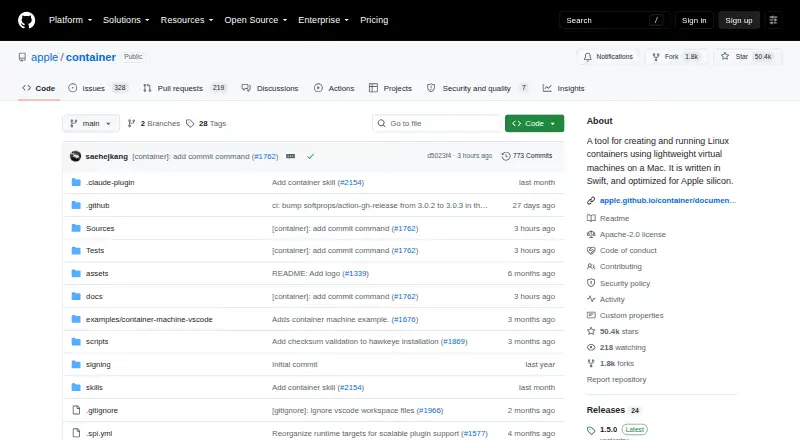
What Apple container is
Apple container creates and runs Linux containers as lightweight virtual machines on a Mac. Written in Swift and optimized for Apple silicon, it uses a separate lightweight virtual machine for each container, providing VM isolation with core utilities and libraries. Host data is shared by mounting only the required data into each virtual machine. The tool consumes and produces OCI-compatible images that work with standard container registries. Documented features include CPU and memory limits, bind mounts, named volumes, tmpfs, DNS-based names, port forwarding, and isolated networks. It can run local single-node or multi-node Kubernetes clusters for development and testing, and supports building, running, and publishing images for Apple silicon and x86-64. Apple container integrates with macOS Virtualization, vmnet, XPC, launchd, Keychain services, and unified logging. It is free, Apache-2.0 licensed, and supported on macOS 26.
Good
- Free and Apache-2.0 licensed
- Provides per-container VM isolation
- Supports OCI image workflows
- Includes Kubernetes cluster support
- Offers networking and storage features
Watch out
- Requires a Mac with Apple silicon
- Supported host is macOS 26
- Windows containers are unsupported
- Project features are under active development
Who it suits
It suits developers using Apple silicon Macs for backend work, reproducible CI/CD builds, or local Kubernetes testing. A supported macOS 26 host is required.
Verdict
Apple container is a free, Mac-focused container tool with OCI images, VM isolation, and Kubernetes support. Its Apple-silicon requirement and active-development status define its practical limits.
Plans and prices
From Apple container's own pricing page, checked 8 Oct 2026.
| Plan | Price | What it gives you |
|---|---|---|
| Free and open source | Free | Apache-2.0 license · requires a Mac with Apple silicon · supported on macOS 26 |
The facts
Each one read from Apple container's own pages, with the date it was checked.
What it does
- Container features
- Documented capabilities include CPU and memory limits, bind mounts, named volumes, tmpfs, DNS-based names, port forwarding, and isolated networks.checked 8 Oct 2026
- Host data
- Host data is shared by mounting only the necessary data into each virtual machine.checked 8 Oct 2026
- Implementation
- The tool is written in Swift and optimized for Apple silicon.checked 8 Oct 2026
- Intended workflows
- The overview describes backend development, reproducible CI/CD builds, and local container orchestration testing as common containerization workflows.checked 8 Oct 2026
- Kubernetes
- It can run local single-node or multi-node Kubernetes clusters for development and testing.checked 8 Oct 2026
- Memory limitation
- The technical overview says memory pages freed inside a container VM are not currently returned to the macOS host, so restarting containers may be needed after intensive use.checked 8 Oct 2026
- OCI images
- It consumes and produces OCI-compatible images that can be pulled from and pushed to standard container registries.checked 8 Oct 2026
- Open source
- The repository identifies the project as licensed under Apache-2.0.checked 8 Oct 2026
- Per-container isolation
- It runs a lightweight virtual machine for each container, providing VM isolation with a minimal set of core utilities and libraries.checked 8 Oct 2026
- Project status
- The project is under active development, and features marked experimental may change without backward compatibility guarantees.checked 8 Oct 2026
- Purpose
- Apple container creates and runs Linux containers as lightweight virtual machines on a Mac.checked 8 Oct 2026
- Requirements
- Running the tool requires a Mac with Apple silicon, and the project says it is supported on macOS 26.checked 8 Oct 2026
Where it runs
- macOS integrations
- The project integrates with Virtualization, vmnet, XPC, launchd, Keychain services, and macOS unified logging.checked 8 Oct 2026
- Multiplatform images
- The documentation describes building, running, and publishing images for Apple silicon and x86-64.checked 8 Oct 2026
Alternatives to Apple container
- 1

LXD
Free planWebAPILinuxSelf-hosted7.0From $25 a year - 2
BuildKit
Free planAPILinuxmacOSSelf-hosted6.8Free plan - 3
Incus
Free planAPILinuxmacOSSelf-hosted6.8Free plan - 4
Apptainer
Free planAPILinuxmacOSSelf-hosted6.7Free plan - 5
crun
Free planLinuxSelf-hosted6.5Free plan - 6

Buildah
Free planAPILinuxSelf-hosted6.4Free plan