Apertium
Apertium is a free, open-source platform for building rule-based machine translation systems.
What Apertium is
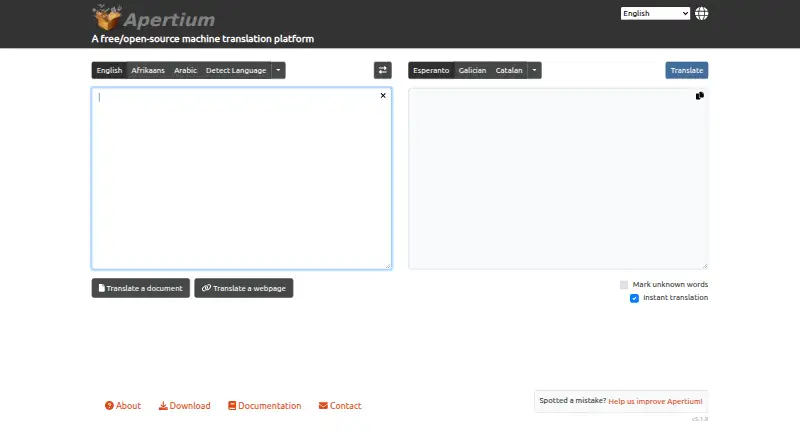
Apertium is a free, open-source platform for building rule-based machine translation systems. Its web app translates text, webpages, and documents, and also provides linguistic analysis and generation interfaces. The translation toolchain uses deterministic linguistic rules and does not currently include statistical or neural machine translation. Language resources are organized as reusable single-language packages and translation pairs. Document translation supports DOCX, XLSX, PPTX, ODT, TXT, RTF, HTML, and LaTeX, with a documented file limit below 32 MB. The web interface depends on an Apertium HTTP API such as APy or ScaleMT; APy offers text, document, and webpage translation alongside morphological analysis and generation. Apertium Simpleton provides a Windows and Mac graphical interface and can download language packages for offline translation. Linux users can use command-line tools, with installation options for several distributions. APy can be installed with pip or apt, or run from a Docker image. One documented format-handling limitation is that the tools cannot process reordered formatting markers, known as superblanks.
Good
- Translates text, webpages, and documents.
- Includes linguistic analysis and generation interfaces.
- Simpleton can download packages for offline translation.
- Supports several document formats, including DOCX and PDF-free alternatives.
Watch out
- Document files have a documented limit below 32 MB.
- Toolchain does not use statistical or neural translation.
- Tools cannot handle reordered formatting markers.
Who it suits
Apertium may suit people who want rule-based translation and language analysis, or developers building translation services from reusable language packages. Its desktop interface, web app, and Linux command-line options address different workflows.
Verdict
Apertium offers translation across web, desktop, and command-line workflows, with language data structured for reuse. Its rule-based approach and format-handling limitation are important fit considerations.
Plans and prices
From Apertium's own pricing page, checked 12 Oct 2001.
| Plan | Price | What it gives you |
|---|---|---|
| Free/open-source platform | Free | — |
The facts
Each one read from Apertium's own pages, with the date it was checked.
What it does
- Analysis and generation
- The web app also provides linguistic analysis and generation interfaces.checked 12 Oct 2001
- API access
- Yeschecked 21 Sep 2001
- API capabilities
- Apertium APy exposes text, document, and webpage translation, as well as morphological analysis and generation.checked 12 Oct 2001
- API deployment
- Apertium APy can be installed with pip or apt, or run from a Docker image.checked 12 Oct 2001
- Document formats
- The web interface supports document translation in DOCX, XLSX, PPTX, ODT, TXT, RTF, HTML, and LaTeX, with a documented file limit below 32 MB.checked 12 Oct 2001
- Document translation
- Yeschecked 21 Sep 2001
- Integration
- Apertium services are used by applications including Virtaal, Okapi, OmegaT, begiak, and Wikipedia Content Translation.checked 12 Oct 2001
- Known limitation
- Apertium’s official format-handling documentation says its tools cannot handle reordered formatting markers, called superblanks.checked 12 Oct 2001
- Language resources
- Language data is organized into reusable single-language packages and translation pairs.checked 12 Oct 2001
- Security and compliance
- The reviewed official pages do not state a security certification or compliance standard.checked 12 Oct 2001
- Translation memory
- Yeschecked 21 Sep 2001
- Translation style
- Apertium’s toolchain uses deterministic linguistic rules and does not currently include statistical or neural machine translation methods.checked 12 Oct 2001
- Website translation
- Yeschecked 21 Sep 2001
- Web translation
- The Apertium web app supports text, webpage, and document translation.checked 12 Oct 2001
- What it does
- Apertium describes itself as a free/open-source platform for developing rule-based machine translation systems.checked 12 Oct 2001
Where it runs
- Desktop platforms
- Apertium Simpleton provides a graphical interface for Windows and Mac and can download language packages for offline translation.checked 12 Oct 2001
- Linux support
- The project documents command-line use on Linux and provides installation options including Debian, Ubuntu, Fedora, CentOS, and OpenSUSE.checked 12 Oct 2001
- Web app requirement
- Apertium’s web interface relies on an Apertium HTTP API such as Apertium APy or ScaleMT.checked 12 Oct 2001
Money
- Free plan
- Yeschecked 21 Sep 2001
Alternatives to Apertium
- 1
QuillBot
Free planAndroidiOSWebExtension8.3From $0.69 a month - 2

iTranslate
Free planAndroidiOSWebAPI8.1Free plan - 3
SimpleLocalize
Free planAndroidiOSWebAPI8.1Free plan - 4

Lara Translate
Free planAndroidiOSWebAPI7.8From $9.99 a month - 5
Localizely
Free planWebAPILinuxmacOS7.8From $16 a month - 6

XTM Cloud
AndroidiOSWebAPI7.8From $1,375 a month