
aMule
aMule is a free, GPL-licensed peer-to-peer file-sharing client for the eD2k and Kademlia networks.
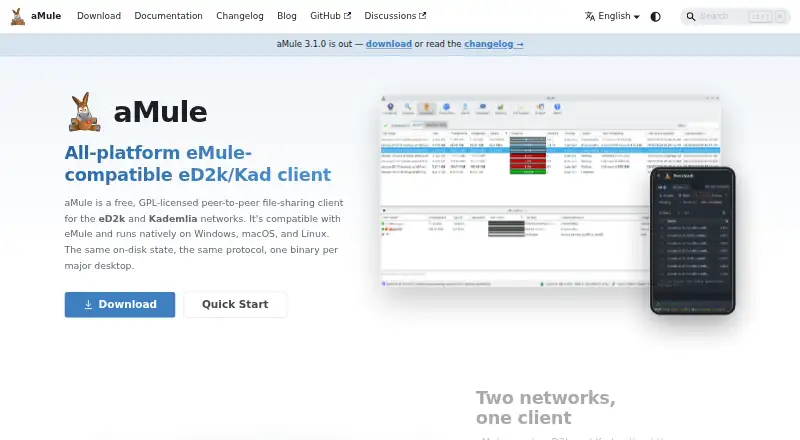
What aMule is
aMule is a free, GPL-licensed peer-to-peer file-sharing client for the eD2k and Kademlia networks. It can connect to both networks at the same time and is wire-compatible with eMule and other *Mule clients. Search covers eD2k servers and Kademlia, with filters for type, size, and availability, plus AND, OR, and NOT operators. ICH and AICH checks can detect and repair corrupted download chunks, and users can re-hash shared files to check integrity. Remote options include a native remote GUI, REST API, browser Web UI, command-line tool, and legacy WebUI. Its amuled daemon can run without a graphical display on a server, NAS device, or VPS. Remote interfaces encrypt connections to the core; new installations accept connections only from the local machine, and failed logins are throttled. Other options include IP filtering, secure user identification, SOCKS4, SOCKS5, and HTTP proxy support. Network interface binding is unavailable on BSD. Blocked ports can greatly reduce performance, and the documentation says the relevant ports need to be opened and forwarded.
Good
- Connects to eD2k and Kademlia simultaneously
- Search supports filters and Boolean operators
- Remote GUI, API, Web UI, and command-line options
- Headless daemon can run on servers and NAS devices
Watch out
- Blocked ports can greatly reduce performance
- Interface binding is unavailable on BSD
- Magnet handling is limited to eD2k-compatible links
Who it suits
aMule suits users seeking a free file-sharing client for eD2k and Kademlia, including those who want command-line or headless operation. It also provides remote-control options and download integrity checks.
Verdict
aMule offers network search, integrity checks, remote control, and headless operation at no cost. Users should account for port forwarding requirements and the BSD interface-binding limitation.
Plans and prices
From aMule's own pricing page, checked 8 Oct 2026.
| Plan | Price | What it gives you |
|---|---|---|
| aMule | Free | GPL-2.0 licensed · no telemetry · no advertisements |
The facts
Each one read from aMule's own pages, with the date it was checked.
What it does
- API scope
- The REST API covers downloads, clients, shared files, servers, friends, categories, preferences, network control, logs, statistics, search, chat and GeoIP.checked 15 Oct 2026
- API transport limitation
- amuleapi speaks HTTP only, so the documentation directs operators to terminate TLS in a reverse proxy.checked 15 Oct 2026
- Bandwidth controls
- Token-bucket limiters provide hard upload and download caps, while slot controls regulate simultaneous upload clients.checked 15 Oct 2026
- Build options
- CMake options can build the monolithic GUI, daemon, remote GUI, legacy WebUI or amuleapi separately.checked 15 Oct 2026
- Build system
- aMule uses CMake 3.10 or newer and requires wxWidgets 3.2, Crypto++ 8.1, Boost 1.70 and zlib 1.2.3.checked 15 Oct 2026
- Deployment packaging
- Official downloads include Windows installers and portable archives, a macOS Universal2 DMG, Linux AppImage and Flatpak packages, plus static headless binaries.checked 15 Oct 2026
- Desktop integrations
- aMule can register to open ed2k:// and magnet: links and .emulecollection files; magnet handling is limited to eD2k-compatible links.checked 8 Oct 2026
- Developer protocol
- The EC protocol is a binary TCP protocol on port 4712 by default, while the developer guide recommends REST for applications and scripts.checked 15 Oct 2026
- Documentation depth
- The documentation site includes installation, user manual, troubleshooting, FAQ, developer, protocol, file-format and contribution sections.checked 15 Oct 2026
- Download controls
- Users can set hard upload and download speed limits and control the number of simultaneous upload clients and per-slot bandwidth targets.checked 8 Oct 2026
- Download integrity
- ICH and AICH detect and repair corrupted download chunks, and users can re-hash shared files to check their integrity.checked 8 Oct 2026
- Download organization
- Downloads can be grouped into categories with separate save paths and priorities.checked 15 Oct 2026
- eMule interoperability
- aMule shares sources and servers with eMule and handles ed2k:// links.checked 15 Oct 2026
- Headless operation
- amuled runs without a graphical display on servers, NAS devices and VPS instances.checked 15 Oct 2026
- Headless use
- The amuled daemon can run without a graphical display on servers, NAS devices, or VPS instances.checked 8 Oct 2026
- Integrity checking
- Chunks are hashed and corrupt data is automatically detected and downloaded again.checked 15 Oct 2026
- License
- aMule is released under GNU GPL version 2.0.checked 15 Oct 2026
- Limit: API troubleshooting
- A recent Reddit user reported that amuleapi did not listen on the expected port in a Windows installation, while another user praised the new Web UI.checked 15 Oct 2026
- Limit: interface quality
- A SourceForge reviewer said the program had missing features and needed a better user interface.checked 15 Oct 2026
- Limit: legacy web UI
- A self-hosting community project describes the stock amuleweb interface as clunky and buggy, motivating a replacement controller.checked 15 Oct 2026
- Limit: port configuration
- The installation documentation says users must open firewall or router ports to obtain High ID and optimal connectivity and download speeds.checked 15 Oct 2026
- Link handling
- The application opens ed2k://, magnet: and .emulecollection links and registers as their handler on supported desktop systems.checked 15 Oct 2026
The company
- Founded
- 2003checked 28 Sep 2026
Where it runs
- Linux server builds
- Linux static binaries are headless and include amuled, amuleapi, and amulecmd, with no shared-library dependencies.checked 8 Oct 2026
The full review of aMule
aMule is a free, GPL-licensed peer-to-peer client for the eD2k and Kademlia networks. It suits users who need those networks on a desktop, NAS, VPS, or other server they can operate remotely. It is a focused choice for eD2k/Kademlia sharing, provided you can configure the required ports.
Overview
aMule connects to eD2k and Kademlia simultaneously and remains wire-compatible with eMule and other *Mule clients. That makes it appropriate for established users of those networks, but less suitable when your priority is a general-purpose BitTorrent workflow. The software is GPL-licensed, free, and provided without telemetry or advertisements.
Search covers eD2k servers and Kademlia, with filters for file type, size, and availability plus AND, OR, and NOT operators. ICH and AICH detect and repair corrupted download chunks, while re-hashing lets you verify shared files. These safeguards are valuable for large or long-running transfers. A blocked port can still produce a Low ID, sharply reducing performance and requiring port opening and forwarding.
Key features
Search, integrity, and transfer control
Combined network search and expressive filters make it practical to narrow results without repeatedly browsing separate sources. Integrity checking repairs damaged pieces instead of merely reporting them. Hard upload and download limits, simultaneous-upload-client controls, and per-slot bandwidth targets help prevent sharing from overwhelming a household or server connection.
Remote and headless operation
The amuled daemon runs without a graphical display on servers, NAS devices, and VPS instances. You can manage it through a native remote GUI, REST API, browser Web UI, command-line tool, or legacy WebUI, so it can continue operating away from your main computer. Remote connections to the core are encrypted; new installations accept connections only from the local machine, and failed logins are throttled. Those defaults provide a sensible starting boundary, although remote administration still requires careful network exposure.
Privacy and desktop integration
IP filtering, cryptographic secure user identification, and SOCKS4, SOCKS5, and HTTP proxy support cover common privacy and routing needs. Network-interface binding adds control over which connection carries traffic, but it is unavailable on BSD. aMule can register ed2k:// and magnet: links and .emulecollection files; magnet handling is limited to eD2k-compatible links, so it is not a universal magnet client.
Pricing
The aMule plan costs free. It is GPL-2.0 licensed, includes no telemetry and no advertisements, and has no trial or renewal commitment. The same free plan covers the full desktop and server feature set rather than imposing seats or usage quotas. It is the natural fit for individuals and self-hosted operators who want a network client without a subscription; organizations should still account for their own hosting and port-configuration work.
Platforms
Supported platforms are Windows, macOS, and Linux, with API, web, and self-hosted operation also supported. Download packages list Windows 10/11 for x64 and ARM64, macOS 11.0 or later for Apple Silicon and Intel, and Linux with glibc 2.35 or later for x64 and ARM64. Linux static server builds are headless and include amuled, amuleapi, and amulecmd without shared-library dependencies, which simplifies deployment on suitable systems.
Who it's for
aMule is aimed at people sharing on eD2k and Kademlia who value broad search, recoverable downloads, and remote administration. It is particularly well suited to a NAS, VPS, or always-on Linux server where the daemon can run independently of a desktop session. Choose another category of client if you do not control router port forwarding, need broad magnet compatibility, or primarily use networks outside eD2k and Kademlia.
Pros and cons
- Pros: simultaneous eD2k and Kademlia access; search operators and filters; ICH/AICH repair and re-hashing; multiple encrypted remote-control interfaces; headless Linux builds; no cost, telemetry, or advertisements.
- Cons: blocked ports can cause Low ID and substantially lower performance; interface binding is unavailable on BSD; magnet support is restricted to eD2k-compatible links; the network focus is unsuitable for users seeking a general-purpose torrent client.
Alternatives
Peer-to-Peer File Sharing Software is the broader category overview for comparing clients. Pick Feem instead for cross-platform direct transfers, including Android and iOS; its free plan allows unlimited file transfers, while Feem Pro iOS costs $4.99 a year and is manually renewed. Choose TorrServer for a GPL-3.0 self-hosted torrent-streaming server. BiglyBT is another free client spanning desktop, web, and Android platforms. BitComet is free for private, personal, non-commercial use. Choose Resilio Sync for device synchronization; its personal non-commercial plan is free but requires a license to activate. qBittorrent offers free open-source software without ads, while Transmission includes all features free with no ads or tracking. WebTorrent is a free, MIT-licensed option with a non-commercial desktop plan.
Verdict
Choose aMule if you specifically need eD2k and Kademlia search, integrity repair, and remote or headless control at no software cost. Look elsewhere if port forwarding is impractical, BSD interface binding is essential, or your sharing is centered on broader torrent and magnet ecosystems.
Alternatives to aMule
- 1

Feem
Free planAndroidiOSWebAPI8.0From $4.99 a year - 2

BiglyBT
Free planOpen sourceAndroidWebAPILinux7.7Free plan - 3

BitComet
Free planAndroidWebAPIExtension7.5Free plan - 4
Avidemux
Free planOpen sourceWebLinuxmacOSWindows7.3Free plan - 5
µTorrent Web
Free planWebmacOSWindows6.9From $6.95 a year - 6
µTorrent Classic
Free planAndroidWindows6.8From $6.95 a year