Alpine Linux
Alpine Linux is a free, independent Linux distribution for power users who value security, simplicity, and efficient resource use.
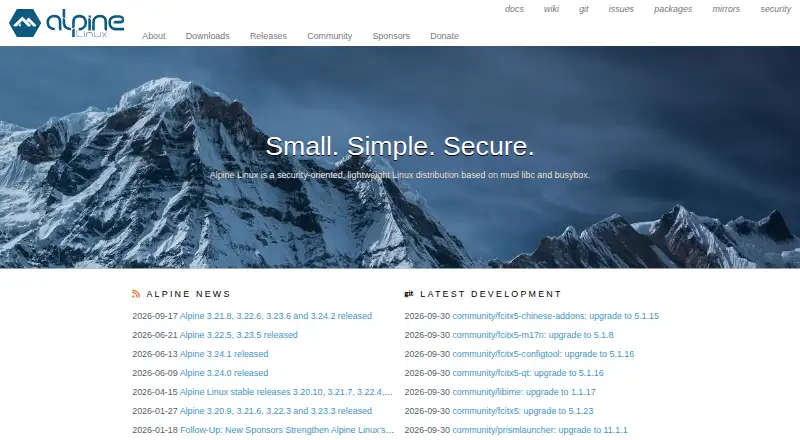
What Alpine Linux is
Alpine Linux is a free, independent Linux distribution for power users who value security, simplicity, and efficient resource use. It can run on physical computers, Raspberry Pi devices, routers, servers, virtual machines, cloud images, containers, and chroots. A container requires no more than 8 MB, according to the site, while a minimal disk installation needs around 130 MB of storage. Alpine is built around musl libc and BusyBox, with apk for package management and OpenRC for initialization. Its packages are split into binaries so users can control what they install from a large repository. Alpine says its userland binaries are compiled as Position Independent Executables with stack smashing protection, and it maintains a security tracker drawing on CVE, NVD, and its own security-fix data. Downloads include several image types, from Standard and Extended to Netboot, Virtual, and Mini root filesystem, with architectures varying by image. The Standard image needs network access; Extended includes commonly used packages and is described as suitable for routers and servers. Main-repository support typically lasts two years; community-repository support runs until the next stable release.
Good
- Free distribution with multiple deployment formats.
- Container footprint requires no more than 8 MB.
- Packages let users control what gets installed.
- Includes a security issue tracker.
- Download images list SHA-256 and GPG links.
Watch out
- Standard image requires a network connection.
- Main repository is typically supported for two years.
- Other use cases assume sufficient Linux familiarity.
Who it suits
Alpine Linux is suited to experienced Linux users choosing an operating system for physical, virtual, cloud, or container environments. Its handbook focuses on traditional desktop and server installations, while other uses assume Linux familiarity.
Verdict
Alpine Linux offers varied deployment images and package control, with a small stated footprint for containers. Review the repository support periods and image requirements against your intended use.
Plans and prices
From Alpine Linux's own pricing page, checked 11 Oct 2001.
| Plan | Price | What it gives you |
|---|---|---|
| Alpine Linux | Free | Independent, non-commercial Linux distribution · downloadable images and packages |
The facts
Each one read from Alpine Linux's own pages, with the date it was checked.
What it does
- Architectures
- The downloads page lists architectures including aarch64, armv7, loongarch64, ppc64le, riscv64, s390x, x86 and x86_64, depending on image type.checked 11 Oct 2001
- Container use
- The Mini root filesystem is intended for containers and minimal chroots.checked 11 Oct 2001
- Core components
- Alpine is built around musl libc and BusyBox, and uses the apk package manager and OpenRC init system.checked 11 Oct 2001
- Documentation audience
- The User Handbook focuses on traditional disk installations, primarily for desktop and server systems, and says other use cases assume sufficient Linux familiarity.checked 11 Oct 2001
- Download formats
- Downloads include Standard, Extended, Netboot, Raspberry Pi, Mini root filesystem, Virtual, Generic U-Boot and Xen images.checked 11 Oct 2001
- Extended image
- The Extended image includes commonly used packages, is described as suitable for routers and servers, runs from RAM, and includes AMD and Intel microcode updates.checked 11 Oct 2001
- Image verification
- The download page provides SHA-256 and GPG links alongside the listed images.checked 11 Oct 2001
- Package selection
- Its binary packages are split so users can control what they install, and the repository offers a large package selection.checked 11 Oct 2001
- Purpose
- Alpine Linux is an independent, non-commercial, general purpose Linux distribution designed for power users who value security, simplicity and resource efficiency.checked 11 Oct 2001
- Security design
- Alpine says all userland binaries are compiled as Position Independent Executables with stack smashing protection.checked 11 Oct 2001
- Security tracker
- The Alpine Security Issue Tracker monitors distribution security issues using the CVE dictionary, NVD database and Alpine's security fixes database.checked 11 Oct 2001
- Small footprint
- The site says a container requires no more than 8 MB and a minimal disk installation requires around 130 MB of storage.checked 11 Oct 2001
- Standard image requirement
- The Standard image is described as a minimal starting point that requires a network connection.checked 11 Oct 2001
- Support
- The community page lists #alpine-linux for general discussion and quick support questions, and mailing lists for support and development.checked 11 Oct 2001
- Virtualization
- The Virtual image has a slimmed down kernel and is optimized for virtual systems.checked 11 Oct 2001
Alternatives to Alpine Linux
- 1
Kali Linux
Free planOpen sourceAndroidLinuxmacOSSelf-hosted7.5Free plan - 2
Apache NuttX
Free planOpen sourceAPILinuxmacOSSelf-hosted7.3Free plan - 3
HPE Morpheus VM Essentials Software
WebLinuxSelf-hosted7.1From $50 a month - 4
AlmaLinux OS
Free planOpen sourceAPILinuxSelf-hostedWindows7.0Free plan - 5

OPNsense
Free planWebAPISelf-hosted7.0Free plan - 6
pfSense
Free planWebLinuxSelf-hosted7.0$189, paid once