
Alethia
Alethia is entity management software for private equity firms, funds, and investment managers.
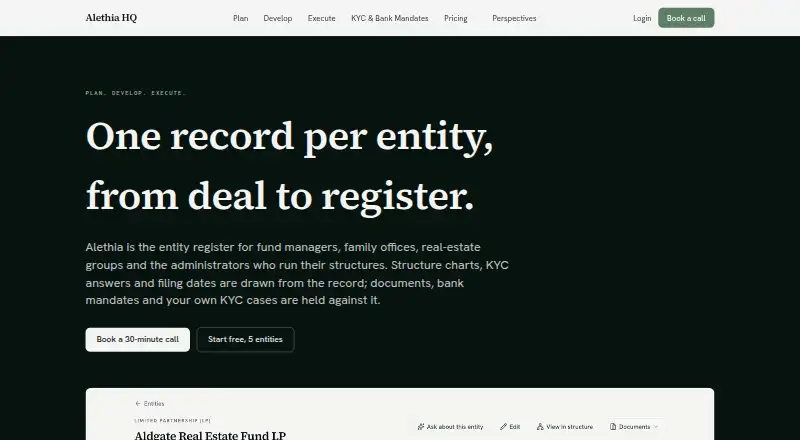
What Alethia is
Alethia is entity management software for private equity firms, funds, and investment managers. It keeps entity records, ownership, documents, and compliance information together, with structure charts generated from entity and ownership records and exportable to PDF, PowerPoint, or Excel. Its deal pipeline follows six stages and can create a draft holding entity at Heads of Terms. For funds flow, the Foundation workflow checks that sources and uses reconcile, and someone other than the preparer must approve release. Incoming KYC requests are divided into requirements with proposed answers and identified sources; each answer needs human approval. Alethia records bank accounts, signatories, and mandate controls, but does not move money or show live payments. Entities and key fields can be imported from CSV. Two-factor authentication is required for every user on every plan, and material changes enter an append-only audit trail. The free plan covers up to five managed entities. Registry is listed at £1,000 per year, billed yearly at £12,000, excluding VAT, with a 12-month commitment.
Good
- Structure charts export to PDF, PowerPoint, and Excel.
- Tracks deals through six stages.
- Requires two-factor authentication on every plan.
- Maintains an append-only audit trail.
- Includes onboarding and email support on every plan.
Watch out
- Free plan is limited to five entities.
- Does not move money or show live payments.
- No SOC 2 or ISO 27001 certificate yet.
- Paid plans require a 12-month commitment.
Who it suits
Alethia suits private equity, real estate investment, and fund managers, as well as corporate services, finance, legal, and compliance teams. It is designed for organizations managing entity structures, ownership records, and compliance workflows.
Verdict
Alethia brings entity records, ownership, documents, and approval workflows into one system. Check the entity limits and annual commitment, and note that bank mandate records do not include payments.
Plans and prices
From Alethia's own pricing page, checked 30 Sep 2026.
| Plan | Price | What it gives you |
|---|---|---|
| Free | Free | Maximum 5 managed entities · Free forever |
| Registry | £12,000 a year | 100 active managed entities included · £10/month for each additional entity · £12,000 billed yearly; paid plans commit for 12 months; prices exclude VAT |
| Enterprise | Priced on request | 100 active managed entities included · £15/month for each additional entity · 12-month commitment; prices exclude VAT |
| Governance | Priced on request | 100 active managed entities included · £12.50/month for each additional entity · 12-month commitment; prices exclude VAT |
The facts
Each one read from Alethia's own pages, with the date it was checked.
What it does
- AI and data
- AI proposes answers or drafts for human approval; workspace data is not used to train third-party models or sent to translation tooling.checked 30 Sep 2026
- API limits
- The Enterprise REST API allows 1,000 requests per key per 15 minutes; properties and fund commitments are read-only through the API.checked 30 Sep 2026
- Bank mandates
- Alethia records bank accounts, signatories and mandate controls, but it does not move money or show live payments.checked 30 Sep 2026
- Certifications
- Alethia states that it does not yet hold a SOC 2 or ISO 27001 certificate.checked 30 Sep 2026
- Deal pipeline
- The pipeline tracks deals through six stages and can create a draft holding entity at Heads of Terms.checked 30 Sep 2026
- Funds flow
- The Foundation workflow checks that sources and uses reconcile, and a person other than the preparer must approve release.checked 30 Sep 2026
- Hosting
- Database records and uploaded files are stored in Google Cloud's London region (europe-west2), and application servers run in Vercel's London region (lhr1).checked 30 Sep 2026
- Import
- Entities and key fields can be imported from a CSV.checked 30 Sep 2026
- Integrations
- Enterprise includes Google Workspace and Microsoft Entra ID directory sign-in, SCIM provisioning, API keys, webhooks and integrations.checked 30 Sep 2026
- Intended users
- The product is built for private equity firms, real estate investment managers, fund managers, and corporate services, finance, legal and compliance teams.checked 30 Sep 2026
- KYC
- Incoming KYC requests are broken into requirements with proposed answers that identify their source, and a person must approve each answer.checked 30 Sep 2026
- Product
- Alethia is entity management software for private equity, funds and investment managers, keeping entity records, ownership, documents and compliance in one system.checked 30 Sep 2026
- Security
- Two-factor authentication is required for every user on every plan, and material changes are written to an append-only audit trail.checked 30 Sep 2026
- Structure charts
- Structure charts are generated from entity and ownership records and can be exported to PDF, PowerPoint and Excel.checked 30 Sep 2026
- Support
- Every plan includes onboarding, help moving an existing register and email support; Governance and Enterprise add dedicated onboarding.checked 30 Sep 2026
The full review of Alethia
Alethia is entity-management software for private equity, fund and investment-management teams. It is best suited to organisations that need structured ownership records and controlled workflows across deals, funds flow and KYC. Its appeal is the link between records, approvals and audit history; its £1,000-per-month annual Registry price makes the entity cap and commitment important considerations.
Overview
Alethia brings entity and ownership records together with governance documents, filing-deadline tracking and workflows for investment operations. Multi-country coverage and structure charts generated from recorded ownership make it relevant to complex investment structures, rather than a simple company register. Charts export to PDF, PowerPoint and Excel, and CSV import covers entities and key fields to help move an existing register.
Security controls apply across plans: every user must use two-factor authentication, and material changes enter an append-only audit trail. Database records and uploaded files are stored in Google Cloud’s London region, while application servers run in Vercel’s London region. Alethia says workspace data is not used to train third-party models or sent to translation tooling; AI-generated answers and drafts still require human approval. It does not yet hold SOC 2 or ISO 27001 certification, a material drawback for buyers whose procurement requires either credential.
Key features
Deal, funds flow and KYC
The deal pipeline tracks six stages and can create a draft holding entity at Heads of Terms, linking early deal tracking to entity setup. The Foundation workflow checks that funds-flow sources and uses reconcile, then requires approval from someone other than the preparer before release. For incoming KYC requests, Alethia breaks requests into requirements and proposes answers with their sources identified; a person must approve every answer. These review steps suit teams that need accountable sign-off, though they keep people in the loop rather than automating final decisions.
Bank mandates and integrations
Alethia records bank accounts, signatories and mandate controls, but it neither moves money nor shows live payments. It can support mandate administration, not payment execution or monitoring. Enterprise adds Google Workspace and Microsoft Entra ID directory sign-in, SCIM provisioning, API keys, webhooks and integrations. Its REST API allows 1,000 requests per key per 15 minutes, while properties and fund commitments are read-only through the API; teams needing to write those data types programmatically should look elsewhere.
Pricing
Free
The Free plan costs nothing forever and supports up to five managed entities. It is a useful starting point for a very small register, but that cap makes it unsuitable once an organisation manages more than a handful of entities. There is no free trial.
Registry
Registry costs £1,000/mo (annual), billed £12,000 yearly, with a 12-month commitment and prices excluding VAT. It includes 100 active managed entities, with each additional entity costing £10/month. This is the only plan with a stated paid price, and it suits teams that can work within its included capacity and want a clear base cost; the yearly bill and entity overage charge deserve attention when forecasting growth.
Governance and Enterprise
Governance and Enterprise have custom pricing, 12-month commitments and prices excluding VAT. Each includes 100 active managed entities; additional entities cost £12.50/month on Governance and £15/month on Enterprise. Governance adds dedicated onboarding. Enterprise also adds dedicated onboarding plus the stated identity, provisioning, API and integration capabilities. Both plans include onboarding, help moving an existing register and email support, as does Free and Registry; the available plan details do not establish other differences, so buyers should compare the custom proposals against their workflow needs.
Platforms
Alethia is available on web and through an API. That suits browser-based administration and integration into other systems, but no mobile app platform is specified.
Who it's for
Private equity firms, real estate investment managers, fund managers and corporate services, finance, legal and compliance teams are the natural audience. Alethia is strongest where those groups need ownership records, governance material and approval workflows in one place. It is a weaker fit for teams whose priorities are payment execution, live payment status or a security certification requirement it does not hold.
Pros and cons
- Pros: Structure charts draw directly on entity and ownership records and export in three useful formats, reducing the need to recreate charts for sharing.
- Pros: Independent approval is built into funds-flow release, while KYC answers need human sign-off and material changes leave an append-only record.
- Pros: Every plan includes onboarding, register-migration help and email support, with dedicated onboarding on Governance and Enterprise.
- Cons: Free stops at five entities, while paid plans commit for 12 months and Registry bills £12,000 yearly before VAT.
- Cons: Alethia records mandates but does not execute payments or show live payment activity.
- Cons: It does not yet hold SOC 2 or ISO 27001 certification, and the API cannot write properties or fund commitments.
Alternatives
Legal Entity Management Software is the category guide for comparing tools in this area. EntityFlo is worth considering for a smaller organisation seeking a free first entity with full feature access, or a Starter plan capped at 25 entities and five users.
Inform Direct may suit readers managing up to 10 companies who prefer free standard functionality and separate charges for chargeable transactions. GlobalBoards is another paid option. Computershare BoardWorks may suit board-management needs: its subscription includes all modules and unlimited committees, with additional users charged. Consider Diligent Audit when a paid audit product with web, API and mobile platforms is a closer match; pricing is by request. CSC Corptax is the more relevant choice for enterprise corporate tax software, with pricing requested through a demo. TaxCalc is a paid desktop option for individual tax returns; its TaxCalc 2026 Individual 6 plan costs £42 a year and covers six returns for the 2025–26 tax year.
Verdict
Choose Alethia if your investment or fund team needs entity records, ownership structures and approval-led deal, funds-flow and KYC workflows together, and can budget for a 12-month paid commitment once the five-entity Free cap is outgrown. Its approval controls and audit trail are the strongest reasons to shortlist it. Look elsewhere if payment execution, live payment visibility, writable API access for properties or fund commitments, or SOC 2/ISO 27001 certification is essential.
Getting started
- Visit Alethia’s website.
- Start with the Free plan, which covers up to five managed entities, or choose a paid plan.
- Import entities and key fields from a CSV if you have an existing register.
- Set up user access; every user on every plan must use two-factor authentication.
- Use the included onboarding, help moving an existing register and email support.
Limits worth knowing
The Free plan is capped at five managed entities. Registry includes 100 active managed entities; additional entities cost £10/month each. Paid plans require a 12-month commitment and prices exclude VAT.
Questions
Is there a free plan?
Yes. Free is billed Free forever and allows up to five managed entities.
How much does Registry cost?
Registry is listed at £12,000 yearly. Prices exclude VAT, the commitment is 12 months, and 100 active managed entities are included; each additional entity costs £10/month.
Which platforms does Alethia support?
The listed platforms are API and web.
What integrations are included?
Enterprise includes Google Workspace and Microsoft Entra ID directory sign-in, SCIM provisioning, API keys, webhooks and integrations.
Does Alethia move money or show live payments?
No. It records bank accounts, signatories and mandate controls, but it does not move money or show live payments.
Does Alethia hold SOC 2 or ISO 27001 certification?
Alethia states that it does not yet hold a SOC 2 or ISO 27001 certificate.
Alternatives to Alethia
- 1

Inform Direct
Free planWebAPI7.5From £0.08 a month - 2
TaxCalc
LinuxmacOSWindows7.0 - 3
Computershare BoardWorks
AndroidiOSWebWindows6.9 - 4

EntityFlo
Free planWeb6.9From A$199 a month - 5
EntityKeeper
AndroidiOSWeb6.8From $50 a year - 6
Lextree
WebAPI6.8From $75 a month