
Alation Data Lineage
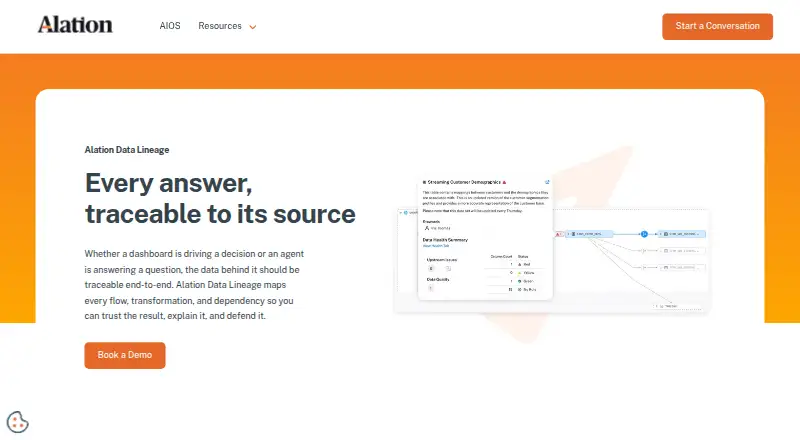
Alation Data Lineage maps data flows, transformations, and dependencies so users can follow data from its origin to its destination.
What Alation Data Lineage is
Alation Data Lineage maps data flows, transformations, and dependencies so users can follow data from its origin to its destination. Visual maps can display data-quality and trust flags, business metadata, and contextual details about assets. Alation describes automated lineage capture using metadata harvesting, connected-system query logs, and query parsing; users can also annotate lineage manually, including for spreadsheets and custom scripts. The views can show reports affected by a source change and help assess possible outages or migration impacts. Lineage can be linked with policies, data-quality rules, and team annotations in Alation’s catalog. The product lists more than 120 connectors, including database and BI-platform connectors, and offers an Open Connector Framework SDK for custom connector development. Lineage data can also be created or updated through a public API. Documentation covers Alation Cloud Service and customer-managed instances. Column-level lineage depends on the data source and connector. Pricing is on request, and there is no free plan.
Good
- Maps flows, transformations, and dependencies.
- Captures lineage automatically and supports manual annotations.
- Shows downstream reports affected by source changes.
- Links lineage to catalog policies and data-quality rules.
- Supports API updates and custom connectors.
Watch out
- There is no free plan.
- Column-level coverage varies by source and connector.
- Pricing requires a conversation with Alation.
Who it suits
It suits technical and non-technical users who need searchable lineage paths or visual data-flow maps. Teams assessing downstream effects of source changes may find its impact views useful.
Verdict
Alation Data Lineage combines automated capture, manual annotation, and catalog context for tracing data and assessing change impacts. Check connector coverage for the sources and column-level details you need.
Plans and prices
From Alation Data Lineage's own pricing page, checked 3 Oct 2026.
| Plan | Price | What it gives you |
|---|---|---|
| Alation Data Lineage | Priced on request | Pricing requires a conversation with Alation; the pricing page describes a shared pool of Alation Consumption Units. |
The facts
Each one read from Alation Data Lineage's own pages, with the date it was checked.
What it does
- API
- Alation’s user guide says lineage data can be created or updated through its public Lineage API.checked 3 Oct 2026
- Automated capture
- The product describes capturing lineage through metadata harvesting, connected-system query logs, and query parsing.checked 3 Oct 2026
- Catalog context
- Lineage information can link data assets to policies, data-quality rules, and team annotations in Alation’s catalog.checked 3 Oct 2026
- Compliance
- Alation reports ISO 27001:2022 certification and SOC 2 Type 2 controls, and says its SOC 2 report includes HIPAA and HITECH.checked 3 Oct 2026
- Deployment
- Alation documentation applies lineage to both Alation Cloud Service and customer-managed instances.checked 3 Oct 2026
- Impact analysis
- Lineage can show downstream reports affected by a source change and help identify potential outages or migration impacts.checked 3 Oct 2026
- Integrations
- Alation says it offers more than 120 connectors, including connectors for databases and BI platforms, and supports custom connector development through its Open Connector Framework SDK.checked 3 Oct 2026
- Intended users
- The product describes visual lineage graphs and searchable paths for both technical and non-technical users.checked 3 Oct 2026
- Lineage coverage limit
- Column-level lineage depends on the data source and connector; Alation directs customers to the support matrix for version-specific coverage.checked 3 Oct 2026
- Lineage views
- Visual lineage maps can show data quality, trust flags, business metadata, and contextual details about data assets.checked 3 Oct 2026
- Manual lineage
- Users can manually annotate lineage, including lineage from spreadsheets or custom scripts.checked 3 Oct 2026
- Purpose
- Maps data flows, transformations, and dependencies so users can trace data from source to destination.checked 3 Oct 2026
- Security
- Alation says Cloud Service customer data is encrypted and not accessible to its site engineers.checked 3 Oct 2026
- Support
- Alation offers product demonstrations and directs prospective customers to contact its sales team for pricing and product information.checked 3 Oct 2026
The company
- Founded
- 2012checked 23 Sep 2026
- Headquarters
- Redwood City, California, USAchecked 23 Sep 2026
The full review of Alation Data Lineage
Alation Data Lineage maps data flows and dependencies to help teams trace assets and assess the effects of changes. It suits organizations that need lineage tied to a broader data catalog, including both technical and non-technical users. Its mix of automated capture and manual annotation is useful, but coverage—especially at the column level—depends on the source and connector.
Overview
Alation brings lineage into the same catalog context as data policies, quality rules, and team annotations. That makes it more useful than a standalone flow diagram when readers need to understand not just where data travels, but how an asset is governed and trusted. Visual maps can surface quality indicators, trust flags, business metadata, and other context.
It can trace data from source to destination and help identify reports that may be affected by a source change. That makes it relevant to migration planning and outage prevention, though the usefulness of any particular path depends on lineage coverage for the systems involved.
Key features
Capture and coverage
Automated lineage capture draws on metadata harvesting, connected-system query logs, and query parsing. Teams can also annotate lineage manually, including paths involving spreadsheets or custom scripts. This combination can fill gaps left by automated discovery, but manual annotation adds upkeep; it is not a substitute for checking which sources and versions support the level of detail you require.
Alation offers more than 120 connectors for databases and BI platforms, and its Open Connector Framework SDK supports custom connector development. Column-level lineage is supported, as are pipeline and report lineage, but column-level coverage varies by source and connector. Confirm the support matrix for the specific versions you run before relying on it for precise impact analysis.
Impact analysis and APIs
Lineage can reveal downstream reports affected by a source change, helping teams assess potential outages or migration impacts before making changes. The public Lineage API can create or update lineage data, which is useful where teams need to integrate lineage maintenance into their own systems.
Deployment and security
Lineage applies to Alation Cloud Service and customer-managed instances. Alation says Cloud Service customer data is encrypted and inaccessible to its site engineers. It reports ISO 27001:2022 certification and SOC 2 Type 2 controls, with HIPAA and HITECH included in its SOC 2 report.
Pricing
Alation Data Lineage is paid, with custom pricing arranged through Alation’s sales team; there is no free plan. The pricing page describes a shared pool of Alation Consumption Units, so organizations should discuss expected consumption and licensing needs before committing. Product demonstrations are available for prospective customers.
Platforms
Alation Data Lineage supports web and API access, with deployment through Alation Cloud Service or customer-managed instances.
Who it's for
Choose Alation when your organization needs to connect data lineage to catalog governance and wants both automated capture and a way to document paths that automation misses. Searchable paths and visual graphs are intended for technical and non-technical users, while the API and custom connector framework suit teams integrating lineage into existing workflows.
Look elsewhere if you need a self-serve free tier or require guaranteed column-level detail across particular systems without first verifying connector coverage. The sales-led pricing model also makes it less suited to buyers who need a published price to compare costs quickly.
Pros and cons
- Pros: Catalog links connect lineage to policies, quality rules, and team annotations, giving change reviews governance context.
- Pros: Automated capture, manual annotations, and custom connector development offer several ways to build and fill lineage paths.
- Pros: Downstream report impact analysis can help teams plan source changes and migrations.
- Cons: Column-level coverage varies by source and connector, so buyers must verify support for their specific versions.
- Cons: Custom pricing and the absence of a free plan mean teams cannot evaluate costs through a published self-serve tier.
Alternatives
For a wider category comparison, see Data Lineage Tools.
- Google Cloud Knowledge Catalog may suit teams seeking a paid web option with a free tier covering the first 100 DCU-hours per month of standard processing.
- DataHub Cloud is another paid web and API service; it offers a free trial and prices according to data volume, users, and capabilities.
- Talend Data Catalog is a paid web-based alternative.
- Collibra is a paid option with API, extension, self-hosted, and web platforms; pricing requires a demo request.
- Coalesce Catalog is a freemium alternative with API and web access, a free Developer plan, and a paid Starter plan.
- Collate offers a free tier and API, extension, self-hosted, and web platforms; its OpenMetadata core is Apache 2.0, while the UI and connectors use a Community License.
- Grai is a free, open-source, self-hosted option for teams that want control over hosting and data.
- OpenMetadata is a free web-based alternative.
Verdict
Alation Data Lineage is a strong fit for organizations that want lineage embedded in catalog governance, with automated discovery, manual gap-filling, and downstream impact analysis in one system. Its main reason to choose is that catalog context makes data paths more actionable; its main reason to look elsewhere is the combination of custom pricing and connector-dependent coverage, particularly for column-level lineage.
Alternatives to Alation Data Lineage
- 1

Atlas
Free planOpen sourceWebAPILinuxmacOS8.3From $39 a month - 2
Coalesce Catalog
Free planWebAPIExtension7.5From $150 a month - 3
Microsoft Defender for Business
AndroidiOSAPImacOS7.5 - 4

Apache Atlas
Free planOpen sourceWebAPILinuxSelf-hosted7.2Free plan - 57.0From $1.15 a month
- 6

Dataedo
WebExtensionSelf-hostedWindows6.5From $18,000 a year