AI Data Analyst Chatbot
AI Data Analyst Chatbot is free, open-source software for exploring structured datasets through natural-language questions.
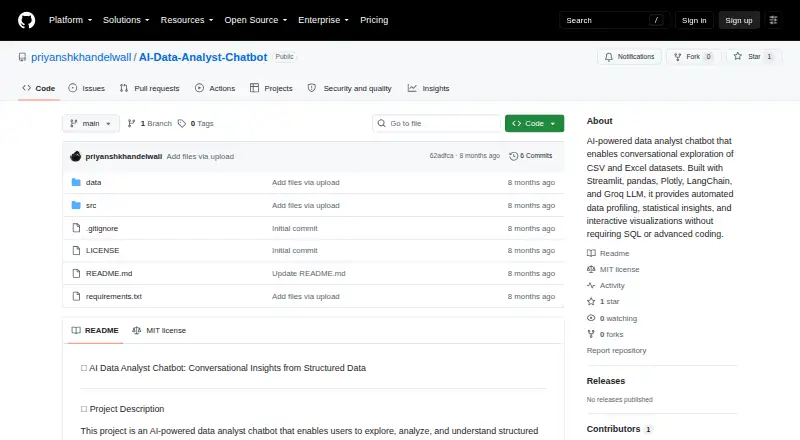
What AI Data Analyst Chatbot is
AI Data Analyst Chatbot is free, open-source software for exploring structured datasets through natural-language questions. It accepts uploaded CSV and Excel XLSX files and processes them during the session without permanently storing them. Automated profiling covers columns, distributions, summary statistics, missing values, duplicates, and data-quality issues. Statistical analysis can reveal variation, outliers, correlations, and patterns, while suggesting statistical tests. Interactive visualizations and explanations accompany the insights. Users can ask questions in plain English without SQL or extensive coding knowledge. The project uses Streamlit with pandas, NumPy, SciPy, Plotly, LangChain, and Groq LLM technology. Running the self-hosted web app requires a Groq API key in the GROQ_API_KEY environment variable; the README directs users to launch it through Streamlit at localhost:8501. The repository uses the MIT License.
Good
- Free MIT-licensed open-source software
- Accepts CSV and XLSX files
- Provides automated data profiling
- Offers interactive visualizations and explanations
- Does not permanently store uploaded data
Watch out
- Requires a Groq API key
- Requires self-hosted setup and dependencies
- No SQL connections
- No team collaboration features
Who it suits
It is aimed at analysts and data practitioners who want to inspect CSV or XLSX datasets through plain-English questions. It suits self-hosted use when a Groq API key is available.
Verdict
AI Data Analyst Chatbot combines conversational dataset exploration with profiling, statistical analysis, and visual output. Its self-hosted setup and Groq API requirement are the main prerequisites.
Plans and prices
From AI Data Analyst Chatbot's own pricing page, checked 8 Oct 2026.
| Plan | Price | What it gives you |
|---|---|---|
| Open-source software | Free | MIT-licensed · CSV and XLSX input · Requires a Groq API key |
The facts
Each one read from AI Data Analyst Chatbot's own pages, with the date it was checked.
What it does
- Data handling
- Uploaded data is processed in-session and is not permanently stored.checked 8 Oct 2026
- Data inputs
- It supports uploaded CSV and Excel (XLSX) files.checked 8 Oct 2026
- Data profiling
- The project describes automated profiling for columns, distributions, summary statistics, missing values, duplicates, and data quality issues.checked 8 Oct 2026
- Deployment
- The README instructs users to install dependencies and launch the app with Streamlit, which makes it available at localhost:8501.checked 8 Oct 2026
- Integration requirement
- Running the app requires a Groq API key set as the GROQ_API_KEY environment variable.checked 8 Oct 2026
- License
- The repository provides the software under the MIT License.checked 8 Oct 2026
- Natural language interface
- Users can ask questions in plain English without requiring SQL or extensive coding knowledge.checked 8 Oct 2026
- Statistical analysis
- It can surface variation, outliers, correlations, patterns, and recommendations for statistical tests.checked 8 Oct 2026
- Support and contributions
- The README invites users to contribute through forks, pull requests, or issues for enhancements and bug fixes.checked 8 Oct 2026
- Technology
- The project lists Streamlit, pandas, NumPy, SciPy, Plotly, LangChain, and Groq LLM (LLaMA 3.1) among its technologies.checked 8 Oct 2026
- Visualizations
- The chatbot provides interactive visualizations and explanations alongside statistical insights.checked 8 Oct 2026
- What it does
- The chatbot lets users explore, analyze, and understand structured datasets by asking questions in natural language.checked 8 Oct 2026
- Who it is for
- The project describes itself as built for analysts and data practitioners.checked 8 Oct 2026
The company
- Maker
- The GitHub profile identifies the maker as Priyansh Khandelwal and says he is pursuing a Master’s in Computer Science at the University of Sydney.checked 8 Oct 2026