
Aginsi
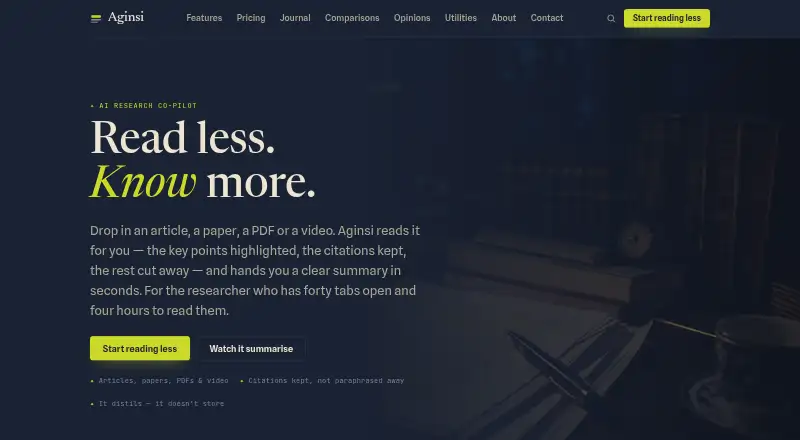
Aginsi is an AI research co-pilot that turns reading material into summaries with highlighted key passages.
What Aginsi is
Aginsi is an AI research co-pilot that turns reading material into summaries with highlighted key passages. It accepts articles, academic papers, PDFs, long threads, reports, and video transcripts. Summaries keep sources and references attached and show how much the original was shortened, along with the reading time saved. Aginsi says submitted source documents are discarded and only summaries a user chooses to save are retained; source text is processed temporarily and is not used to train models. Its free Margin plan provides 10 summaries per month for articles and PDFs, with key-point highlights and citations. Scholar costs $9 a month and adds unlimited summaries, papers and video transcripts, a library with tags and search, Markdown and PDF exports, and a browser companion. Faculty costs $29 a month and adds team seats, shared shelves, batch and API access, and priority support. Aginsi is available on the web, as an extension, and through an API. The company describes itself as a small studio in Helsinki. Its terms warn that machine-generated summaries can omit nuance or contain errors, so they are not a substitute for source material when accuracy matters.
Good
- Summarizes articles, papers, PDFs, reports, and transcripts.
- Keeps source references attached to summaries.
- Shows text compression and reading time saved.
- Source text is not used to train models.
- Has web, extension, and API access.
Watch out
- Free Margin is limited to 10 summaries monthly.
- Machine summaries may omit nuance or contain errors.
- Scholar costs $9 a month.
- Faculty costs $29 a month.
Who it suits
Aginsi may suit people with more reading than time, including students and researchers using Scholar. Faculty is aimed at teams and departments that need shared shelves, batch or API access.
Verdict
Aginsi combines source-linked summaries with visible compression and reading-time information. Its free plan is limited, and readers should check source material when accuracy matters because summaries may miss nuance or contain errors.
Plans and prices
From Aginsi's own pricing page, checked 4 Oct 2026.
| Plan | Price | What it gives you |
|---|---|---|
| Margin | Free | 10 summaries / month · Articles & PDFs · Key-point highlights · Citations kept |
| Scholar | $9 a month | Unlimited summaries · Papers & video transcripts · Library, tags & search · Export to Markdown & PDF · Browser companion · $9/mo |
| Faculty | $29 a month | Everything in Scholar · Team seats & shared shelves · Batch & API access · Priority support · $29/mo |
The facts
Each one read from Aginsi's own pages, with the date it was checked.
What it does
- AI training
- The privacy policy says source text is processed transiently to generate summaries and is not used to train models.checked 4 Oct 2026
- Data controls
- Users may access, correct, export, or delete account data and saved summaries by contacting [email protected].checked 4 Oct 2026
- Highlights and citations
- Aginsi highlights key passages and keeps sources and references attached to summaries.checked 4 Oct 2026
- Integrations and API
- The pricing page lists batch and API access in Faculty and a browser companion in Scholar; it does not name third-party integrations.checked 4 Oct 2026
- Intended users
- Aginsi presents itself for people with more to read than time, and describes Scholar for students and researchers and Faculty for teams and departments.checked 4 Oct 2026
- Notable limitation
- The terms caution that machine-generated summaries may omit nuance or contain errors and are not a substitute for the source where accuracy matters.checked 4 Oct 2026
- Product
- Aginsi describes itself as an AI research co-pilot that reads sources and produces summaries with highlighted key points.checked 4 Oct 2026
- Saved content
- Aginsi says it discards submitted source documents and retains only summaries users choose to save.checked 4 Oct 2026
- Security
- The privacy policy says Aginsi applies industry-standard safeguards and uses essential cookies and privacy-respecting analytics without third-party advertising trackers.checked 4 Oct 2026
- Support
- Aginsi lists [email protected] for support and says Faculty includes priority support.checked 4 Oct 2026
- Supported sources
- It accepts articles, academic papers, PDFs, long threads, reports, and video transcripts.checked 4 Oct 2026
- Visible compression
- Each summary shows how much the source was shortened and the reading time saved.checked 4 Oct 2026
The company
- Company location
- Aginsi describes itself as a small studio in Helsinki.checked 4 Oct 2026
- Headquarters
- Helsinki, Finlandchecked 28 Sep 2026
The full review of Aginsi
Aginsi is an AI research co-pilot that turns demanding reading into source-linked summaries. It suits students, researchers and teams processing papers, reports and mixed-format material, while its free tier is mainly a trial for light use. The strongest reason to choose it is traceable compression across many source types; the main caution is that machine summaries still require checking against originals.
Overview
Aginsi accepts articles, academic papers, PDFs, long discussion threads, reports and video transcripts, including uploaded files and webpages. Summaries retain highlighted passages, citations and attached references, so readers can move from a condensed point back toward its source. Each result also shows the degree of shortening and estimated reading-time savings. Those signals help with triage and prioritization, although they cannot ensure that every qualification survives compression.
The service says submitted source documents are discarded after processing, with only summaries that users deliberately save retained. Its privacy policy says source text is handled transiently and is not used to train models. Aginsi describes industry-standard safeguards, essential cookies and privacy-respecting analytics without third-party advertising trackers. Account data and saved summaries can be accessed, corrected, exported or deleted by contacting [email protected]. The terms nevertheless warn that generated summaries can contain errors or omit nuance, making the original source necessary when accuracy is critical.
Key features
- Broad source coverage: Articles, papers, PDFs, reports, long threads and video transcripts let one workflow handle academic and general reading instead of limiting you to a single document type.
- Highlights and citations: Key passages and references remain attached to the summary, giving students and researchers a practical way to verify claims.
- Visible compression: Shortening and reading-time indicators show whether a summary is a quick skim or a substantial reduction, useful for deciding what to read in full.
- Bullet outputs: The format favors rapid scanning and note triage rather than polished prose.
- Library tools: Paid Scholar adds a library, tags and search, turning saved summaries into a retrievable reading collection.
- Privacy controls: Transient source processing, no model training on source text and user-requested data export or deletion are meaningful safeguards for research material.
Pricing
Aginsi uses a freemium model. Margin costs nothing and allows 10 summaries per month, articles and PDFs, key-point highlights and retained citations. It is suitable for occasional reading or evaluating the workflow, but the monthly cap makes it impractical for regular research intake.
Scholar costs $9 a month, billed $9/mo. It removes the summary quota and adds papers and video transcripts, a library with tags and search, Markdown and PDF export, and a browser companion. This is the sensible individual plan for students, researchers and heavy readers; compared with Margin, it is the tier that adds both unlimited volume and the organization and export tools needed for ongoing work.
Faculty costs $29 a month, billed $29/mo. It includes everything in Scholar plus team seats, shared shelves, batch and API access, and priority support. Departments and teams that need shared collections or programmatic processing have a clear reason to upgrade, while solo users gain little unless they specifically need batch/API workflows or priority assistance.
Platforms
Aginsi is offered through the web, an API and an extension. Scholar's browser companion supports in-browser capture, while Faculty's batch and API access is aimed at team or automated workflows. No named third-party integrations are provided, so organizations should not assume connections to particular research or storage services.
Who it's for
Choose Aginsi if you routinely face more reading than time allows and want citations, highlights and compression indicators in one place. Scholar is the best fit for an individual building a searchable research library; Faculty fits teams and departments sharing shelves or feeding documents through batch and API access. Margin works for light, occasional article and PDF summarization. It is a poor fit when every statement must be authoritative without checking the source, or when a 10-summary monthly allowance cannot cover your workload.
Pros and cons
- Pros: Handles articles, papers, PDFs, reports, threads and transcripts; keeps highlights and citations with summaries; exposes compression and time saved; offers library search, tagging and exports; provides team shelves and API access on Faculty; states that source text is transient and excluded from model training.
- Cons: Margin is limited to 10 summaries monthly and only articles and PDFs; unlimited use starts at $9 per month; team/API capabilities require the $29 Faculty tier; machine output may omit nuance or contain errors, so citation links do not remove verification work.
Alternatives
If you need broad device coverage including mobile and desktop apps, ChatPDF offers Android, iOS, Linux, macOS, Windows, web and API access, with a free allowance of two documents per day. For a low-cost document question workflow, AskYourPDF provides a $11.99-per-year Premium plan billed yearly with 2,500 pages per document, 31MB uploads and 50 documents per day.
Readers wanting an open-source desktop option should consider OpenBrief, which is free for Linux, macOS and Windows. Scholarcy is a closer academic alternative with a free 10-summary tier and browser extension. For iOS-focused learning cards and quizzes, Summify offers five analyses per day on its free plan. genei suits browser-first webpage and PDF summarization, with a free extension and a $5.49-per-month Basic plan. Paperlayer is a free web demo limited to public arXiv papers and no private uploads. SciSummary is worth considering if you want an API/web service with a seven-day free trial and research-oriented word, figure and chat allowances.
See the Text Summarization Software list for more options.
Verdict
Aginsi is a strong choice for individuals and teams who need to triage varied reading while keeping citations, highlights and saved research organized. Scholar delivers the best balance for serious solo use, and Faculty earns its price when shared shelves or API processing matter. Look elsewhere if you need a larger free allowance, native mobile apps, or summaries you can trust without reviewing the source.
Alternatives to Aginsi
- 1

ChatPDF
Free planAndroidiOSWebAPI8.2From $89.99 a year - 2

AskYourPDF
Free planAndroidiOSWebAPI8.1From $11.99 a month - 3
Eightify
AndroidiOSWebExtension7.7From $59.99 a year - 4
Podwise
AndroidiOSWebAPI7.6From $70.80 a year - 5
Scholarcy
Free planWebAPIExtension7.5From $90 a year - 6
SciSummary
Free planWebAPIExtension7.4From $48 a year