AdNauseam
AdNauseam is a free browser extension designed to resist advertising surveillance and tracking.
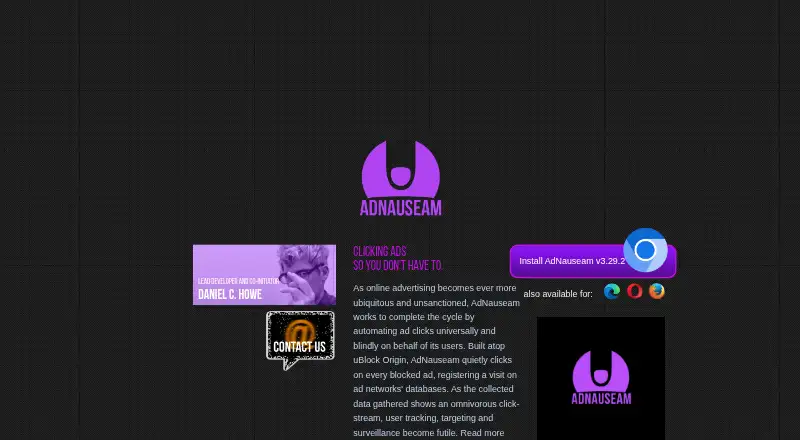
What AdNauseam is
AdNauseam is a free browser extension designed to resist advertising surveillance and tracking. Built on uBlock Origin, it blocks ads and quietly clicks blocked ads to add noise to advertising networks’ user profiles. Its interactive AdVault lets users explore captured ads. The FAQ says simulated clicks run as background requests and discard responses without executing them in the browser. AdNauseam supports major browsers, including Chromium-based browsers and Firefox derivatives, and is available on Firefox for Android. Google Chrome requires workarounds because it has disallowed the extension; the installation instructions describe those workarounds as temporary. The extension does not collect or click ads in private or incognito windows unless enabled manually. Its developer reports that the extension does not require data collection, though the Firefox add-on permissions include access to privacy settings, tabs, navigation activity and data for all websites. AdNauseam is available for desktop and mobile, is licensed under GNU General Public License v3.0 only, and has no free trial.
Good
- Free browser extension built on uBlock Origin.
- Blocks ads and adds noise to tracking profiles.
- AdVault lets users explore captured ads.
- Available on Firefox for Android.
Watch out
- Google Chrome workarounds are described as temporary.
- Firefox permissions include data access for all websites.
- Private-window activity is off unless enabled manually.
Who it suits
AdNauseam suits users seeking to resist advertising tracking and who are comfortable using a browser extension with broad website permissions. It is also available on Firefox for Android.
Verdict
AdNauseam combines ad blocking with simulated clicks intended to add noise to advertising profiles. Consider its Chrome limitation and listed permissions before choosing it.
Plans and prices
From AdNauseam's own pricing page, checked 7 Oct 2026.
| Plan | Price | What it gives you |
|---|---|---|
| Free browser extension | Free | Browser extension |
The facts
Each one read from AdNauseam's own pages, with the date it was checked.
What it does
- Ad blocking
- Built atop uBlock Origin, AdNauseam blocks ads and quietly clicks on blocked ads to add noise to advertising networks’ user profiles.checked 7 Oct 2026
- Ad click safety
- The FAQ says simulated clicks run as background requests whose responses are discarded without executing in the browser.checked 7 Oct 2026
- AdVault
- The interactive AdVault lets users visualize and explore ads AdNauseam has captured.checked 7 Oct 2026
- Audience
- The project describes AdNauseam as a tool for users seeking to resist advertising surveillance and tracking.checked 7 Oct 2026
- Chrome limitation
- The Chromium installation instructions say Google disabled Manifest V2 extension support, including AdNauseam, and describe workarounds as temporary.checked 7 Oct 2026
- Custom filter lists
- Yeschecked 21 Sep 2026
- Data collection
- The Firefox add-on page says the developer reports that the extension does not require data collection.checked 7 Oct 2026
- Element picker
- Yeschecked 21 Sep 2026
- Funding
- AdNauseam’s Open Collective page offers monthly backer contributions starting at $2 USD per month.checked 7 Oct 2026
- License
- The Firefox add-on page lists the license as GNU General Public License v3.0 only.checked 7 Oct 2026
- Mobile support
- The Firefox add-on page says AdNauseam is available on Firefox for Android.checked 7 Oct 2026
- Other blockers
- The FAQ recommends disabling other ad blockers because they may block ads before AdNauseam can identify or collect them.checked 7 Oct 2026
- Permissions
- The Firefox add-on lists permissions to read and modify privacy settings, access tabs and navigation activity, and access data for all websites.checked 7 Oct 2026
- Privacy mode
- The FAQ says AdNauseam does not collect or click ads in private or incognito windows unless the user enables it manually.checked 7 Oct 2026
- Purpose
- AdNauseam is a free browser extension designed to obfuscate browsing data and protect users from tracking by advertising networks.checked 7 Oct 2026
- Support
- The Firefox add-on page lists [email protected] as its support email.checked 7 Oct 2026
Where it runs
- Browser compatibility
- The FAQ says AdNauseam works with Chromium-based browsers and Firefox derivatives, while Google Chrome requires workarounds because it has been disallowed there.checked 7 Oct 2026
- Browser support
- major-browserschecked 21 Sep 2026
- Device coverage
- desktop-and-mobilechecked 21 Sep 2026
The company
- Founded
- 2014checked 28 Sep 2026
Money
- Free plan
- Yeschecked 21 Sep 2026
The full review of AdNauseam
Overview
AdNauseam is a free browser extension for people who want to resist advertising surveillance while blocking ads. It is best suited to privacy-conscious users who accept some browser configuration and compatibility trade-offs. The simulated-click model gives it a purpose beyond ordinary ad removal, but Chrome users face a particularly uncertain installation path.
Key features
Built on uBlock Origin, AdNauseam blocks advertising and then quietly generates clicks on blocked ads to make advertising-network profiles less dependable. The clicks are sent as background requests, and the responses are discarded rather than opened or executed in the browser. That makes the mechanism materially different from visiting ads yourself, while keeping its goal focused on disrupting profiling rather than merely hiding page elements.
The interactive AdVault lets users inspect and explore ads the extension has captured, giving the otherwise hidden process a useful visual record. Custom filter lists and an element picker help tailor blocking to particular sites or page elements. These controls make AdNauseam more adaptable than a fixed ruleset, although they also suit users willing to manage their own filtering choices.
The project reports that the extension does not require data collection. The Firefox add-on nevertheless asks for broad browser access: it can read and modify privacy settings, access tabs and navigation activity, and access data for all websites. That level of permission is understandable for a tool that must observe and alter page content, but it remains an important consideration for anyone choosing software specifically to reduce trust in intermediaries.
AdNauseam should generally be used without another ad blocker. Its FAQ warns that a second blocker can remove ads before AdNauseam identifies or captures them, undermining the simulated-click and AdVault functions. Private and incognito windows do not collect or click ads unless the user explicitly enables that behavior, a sensible default for keeping private sessions separate from the extension's anti-tracking activity.
Pricing
AdNauseam's Free browser extension costs nothing. There is no free trial because the product is free, and there are no paid tiers, seat limits, renewal charges, or usage quotas to weigh. Users who want to support development can make monthly contributions through Open Collective starting at $2 USD per month; that is funding rather than an upgraded plan.
Platforms
AdNauseam is offered for Android, as a browser extension, Linux, macOS, the web, and Windows, with desktop-and-mobile coverage. Browser support includes major browsers in general, plus Chromium-based browsers and Firefox derivatives. Firefox for Android is specifically supported.
Google Chrome is the significant exception. Google has disabled Manifest V2 extension support, which includes AdNauseam, and the project's Chromium instructions describe workarounds as temporary. Firefox or a compatible Chromium-based browser is therefore the more dependable choice; Chrome users should not treat the workaround as a permanent solution.
Who it's for
Choose AdNauseam if your priority is resisting advertising surveillance and making tracking profiles noisier, not simply removing banners. It also fits users who value inspectable captured-ad history, custom filters, and precise element-level controls. It is less suitable for people who need a no-maintenance Chrome setup, depend on private browsing with collection enabled, or want to run several blockers together.
Pros and cons
Pros
- Anti-profiling approach: simulated background clicks add noise to advertising data instead of stopping at visual ad removal.
- Strong filtering controls: custom lists and an element picker support site-specific decisions.
- Inspectable activity: AdVault provides a practical view of captured advertising.
- No subscription barrier: the complete extension is free, with no trial or recurring plan required.
- Stated non-collection: the project reports that the extension does not require data collection.
Cons
- Chrome uncertainty: Manifest V2 changes have displaced the extension, and documented workarounds are temporary.
- Broad permissions: access to privacy settings, tabs, navigation activity, and all websites may concern cautious users.
- Blocker conflicts: another ad blocker can prevent the identification and capture that AdNauseam relies on.
- Specialized behavior: simulated clicking is unnecessary for users who only want conventional ad blocking.
Alternatives
Adblock Plus is the better fit for users wanting a freemium blocker across Android, iOS, Linux, macOS, Windows, and browser extensions, with its web extension licensed under GPLv3.
AdBlocker Ultimate suits households or multi-device users who prefer personal and family plans covering three or ten devices, respectively, plus a free extension.
Blokada is a broader cross-platform freemium option, including Blokada 5 free on Android 5 or newer and a Blokada Plus plan at €5 a month.
Disconnect is worth considering when you want a basic browser extension or a paid Premium plan at $5 a month, with a free trial.
Ghostery offers a free, open-source tracker and ad blocker across desktop and mobile platforms without a subscription.
AdLock is the alternative for users seeking paid multi-device coverage, including a 5-device annual plan.
Adblock Fast is a free, GPL-licensed option for users who want conventional blocking across supported browsers and devices.
1Blocker fits Apple-focused users who want subscription-backed blocking categories and background filter updates.
For a wider comparison, see the Ad Blocking Software and Ad blockers lists.
Verdict
AdNauseam is the right choice for privacy-minded users who want ad blocking to actively disrupt advertising profiles and who can use Firefox or another compatible browser. Its free, configurable extension and AdVault make that specialized mission tangible. Look elsewhere if dependable Google Chrome support, minimal permissions, or painless coexistence with another blocker matters more than adding noise to tracking data.
Alternatives to AdNauseam
- 1

Ghostery
Free planOpen sourceAndroidiOSExtensionLinux8.8Free plan - 2
Adblock Plus
Free planAndroidiOSExtensionLinux8.7From $40 a year - 3

AdLock
Free planAndroidiOSmacOSWindows8.5Free plan - 4

Blokada
Free planAndroidiOSWebExtension8.4From €5 a month - 5

Disconnect
Free planAndroidiOSWebAPI8.4From $50 a year - 6

AdBlocker Ultimate
Free planAndroidiOSWebExtension8.4Free plan