
1C:Retail
1C:Retail is software for automating individual retail stores and retail chains.
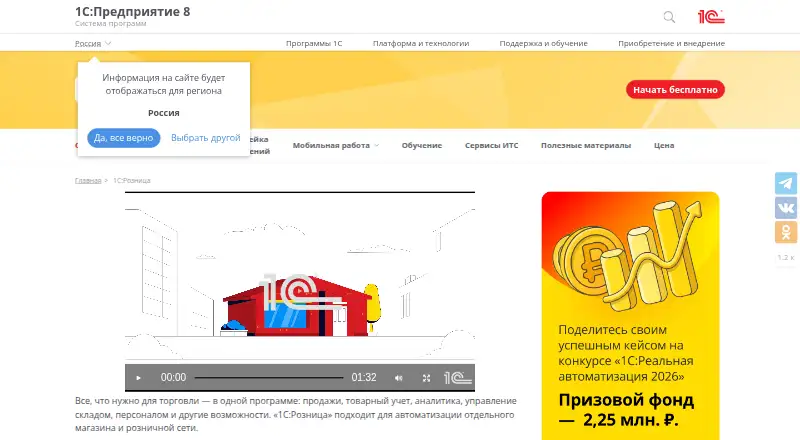
What 1C:Retail is
1C:Retail is software for automating individual retail stores and retail chains. It brings sales, product accounting, analytics, warehouse management and personnel management into one system. Retail 3.0 can handle online sales through a web storefront, website, marketplaces, social networks or a business’s own mobile app. For purchasing, it can estimate stock needs using store sales and customer orders, and work with supplier price lists and purchase price history. Supported equipment includes online cash registers, acquiring terminals, barcode scanners, label printers, data collection terminals and scales. The maker says cash-register data follows fiscal data format FFD 1.2, and receipts can be sent by email or SMS. Data exchange is available with several other 1C products, while 1C-EDI supports electronic document exchange with counterparties. Plans include cloud and local versions, and a 30-day trial is available. There is no free plan. The Cloud version is 755 RUB/month per user when paid for 12 months, with a one-month minimum payment; local versions cost 4,900 RUB or 23,000 RUB one time.
Good
- Covers sales, inventory, analytics and personnel management.
- Retail 3.0 supports sales through several online channels.
- Works with listed retail equipment including barcode scanners.
- A 30-day trial is available.
Watch out
- There is no free plan.
- Cloud pricing starts at 755 RUB/month per user on a 12-month payment term.
- The Basic local version is limited to one workstation.
- Professional updates require a 1C:ITS support contract.
Who it suits
It suits retailers needing store operations, inventory and purchasing tools, including businesses selling through online channels. The listed local and cloud options offer different workstation arrangements.
Verdict
1C:Retail covers core store operations and extends to online sales, purchasing and equipment support. Compare the cloud and local workstation terms, and note the ongoing support contract condition for Professional updates.
Plans and prices
From 1C:Retail's own pricing page, checked 3 Oct 2026.
| Plan | Price | What it gives you |
|---|---|---|
| Cloud version | 755 RUB a month | 30-day free period with all features · 2 workstations included · more can be added · from 755 RUB/month per user when paid for 12 months; payment from 1 month |
| Basic local version | 4,900 RUB, paid once | 1 workstation · additional workstations cannot be added · free updates · one-time payment |
| Professional local version | 23,000 RUB, paid once | 1 workstation · additional workstations available · service under 1C:ITS contract · one-time payment; 9,400 RUB for each additional workstation |
The facts
Each one read from 1C:Retail's own pages, with the date it was checked.
What it does
- Electronic documents
- The maker lists 1C-EDI as a service for exchanging invoices and other legally significant electronic documents with counterparties from 1C programs.checked 3 Oct 2026
- Equipment
- It supports online cash registers, acquiring terminals, barcode scanners, label printers, data collection terminals, scales, and other certified retail equipment.checked 3 Oct 2026
- Fiscal receipts
- The maker says transmitted cash register data conforms to fiscal data format FFD 1.2 and receipts can be emailed or sent by SMS.checked 3 Oct 2026
- Integrations
- Data exchange is available with 1C:Accounting, 1C:Cashier Workplace, 1C:Our Company Management, 1C:Trade Management, 1C:Cash Register, 1C:Mobile Cash Register, 1C:Warehouse Worker, and 1C:Orders.checked 3 Oct 2026
- Online sales
- Retail 3.0 supports sales through a web storefront, website, marketplaces, social networks, or a business’s own mobile app.checked 3 Oct 2026
- Professional edition support
- Professional edition users need an information and technology support contract to receive program updates.checked 3 Oct 2026
- Purchasing
- Retail 3.0 can calculate stock needs from store sales and customer orders and supports supplier price lists and purchase price history.checked 3 Oct 2026
- Purpose
- 1C:Retail is designed to automate individual retail stores and retail chains.checked 3 Oct 2026
- Retail operations
- The product covers sales, product accounting, analytics, warehouse management, and personnel management.checked 3 Oct 2026
- Security service
- 1C:Link is described as providing secure remote internet access to 1C programs installed on the customer’s computer.checked 3 Oct 2026
- Support
- Registered Basic edition users receive program documentation, regular updates, and telephone and email hotline consultations at no charge.checked 3 Oct 2026
The company
- Founded
- 1991checked 28 Sep 2026
- Headquarters
- Moscow, Russiachecked 28 Sep 2026
- Maker
- 1C says it was founded in 1991 and lists its address as 21 Seleznevskaya Street, Moscow.checked 3 Oct 2026
Where it runs
- Platform requirements
- The 1C:Enterprise platform lists Windows, Linux, and macOS client support; its mobile platform supports Android and iOS, while browser support includes limited functionality on Android and iPhone/iPad.checked 3 Oct 2026
The full review of 1C:Retail
1C:Retail is a retail operations system for individual shops and chains that need to coordinate store sales, stock, purchasing and online channels. It is best suited to retailers that need native POS support, multi-location operations or integration with other 1C programs. Its strongest case is breadth; the choice between cloud and local editions hinges on workstation needs and Professional support terms.
Overview
The system brings sales, product accounting, warehouse and personnel management, and analytics into a single retail workflow. Inventory management, purchase orders, barcode inventory, consolidated reporting and multi-location support make it a plausible fit for businesses managing stock across several stores. Smaller shops that only need a till may find this wider operational scope unnecessary.
Retail 3.0 extends sales beyond the shop floor to a web storefront, website, marketplaces, social networks or a business’s own mobile app. It can calculate stock needs from store sales and customer orders, while supplier price lists and purchase-price history help inform buying decisions. This combination is valuable to retailers connecting replenishment with several sales channels, though local workstation limits can constrain a growing team.
Key features
Equipment support includes online cash registers, acquiring terminals, barcode scanners, label printers, data collection terminals and scales, plus other certified retail equipment. The maker says transmitted cash-register data conforms to FFD 1.2; receipts can be emailed or sent by SMS. That equipment range matters to stores standardizing checkout and stock workflows, while the fiscal-format claim should be weighed against the retailer’s own compliance needs.
Data exchange is supported with a range of 1C products, including 1C:Accounting, 1C:Trade Management, 1C:Warehouse Worker and 1C:Orders. 1C-EDI handles invoices and other legally significant electronic documents with counterparties from 1C programs, while 1C:Link provides secure remote internet access to 1C programs installed on the customer’s computer. These services make the product more compelling in an existing 1C environment than for a retailer seeking a standalone till.
Pricing
There is no free plan, but a 30-day trial is available. The Cloud version costs 755 RUB a month, billed from 755 RUB/month per user when paid for 12 months; payment can start from 1 month. It includes a 30-day free period with all features and 2 workstations, with more workstations addable. This is the clearest option for a team that needs room to expand, though the per-user annual billing rate is the relevant price for a longer commitment.
The Basic local version costs 4,900 RUB, paid once, a one-time payment for 1 workstation, with free updates. Additional workstations cannot be added, making it suited only to a single-workstation setup that can accept a fixed seat limit. The Professional local version costs 23,000 RUB, paid once, with each additional workstation costing 9,400 RUB. It supports additional workstations, but service under a 1C:ITS contract is required for updates, so its upfront price does not remove the ongoing support condition.
Platforms
The listed platforms are Android, iOS, Linux, macOS, self-hosted, web and Windows. The 1C:Enterprise platform supports Windows, Linux and macOS clients; its mobile platform supports Android and iOS. Browser access has limited functionality on Android and iPhone/iPad, so mobile browser use should not be treated as equivalent to the mobile platform.
Who it's for
1C:Retail is strongest for stores and chains that need POS, stock control, purchasing, consolidated reporting and multiple locations in one system, especially when they already use 1C programs. The cloud plan suits teams that may add workstations; Basic local fits a fixed one-workstation operation, while Professional local accommodates added seats for businesses prepared to maintain the required 1C:ITS contract. A small retailer with no need for the wider operational or integration set should compare simpler POS options.
Pros and cons
- Pros: Connects store operations with several online sales channels and demand-based stock planning, useful for retailers balancing in-store and online sales.
- Pros: Supports multiple locations, consolidated reporting, barcode inventory and a broad range of retail equipment, covering needs beyond checkout.
- Pros: Registered Basic edition users receive documentation, regular updates and telephone and email hotline consultations at no charge.
- Cons: Basic local is capped at one workstation with no option to add more, limiting its usefulness as a team grows.
- Cons: Professional local workstations cost 9,400 RUB each, and updates require a 1C:ITS contract.
- Cons: Browser support on Android and iPhone/iPad is limited, which weakens the case for relying on mobile web access.
Alternatives
For a broader comparison, browse Retail Accounting Software. Choose BUSY instead if a free billing and accounting plan with multiple companies and financial years is the priority. AmisiERP is worth considering for its Starter plan, which specifies POS and inventory, eTIMS and M-Pesa reconciliation for 3 users, 1,000 products and 200 transactions per day.
SOFT1 Retail is another paid option with a free trial. Oracle Retail Xstore Point-of-Service uses custom pricing and invites retailers to request a demo. Cegid Retail also uses custom pricing. Xentral ERP may suit a business comparing a published order- and revenue-limited Launch plan at €99 a month. er4u has a Startup plan for 3 users and 1 outlet, with unlimited invoices and a basic feature set. GoFrugal Retail is a further paid alternative with a free trial.
Verdict
Choose 1C:Retail if your shop or chain needs a connected system for POS, stock, purchasing, multiple locations and online sales, particularly within a 1C environment. Its combination of retail equipment and operational coverage is the main reason to choose it. Look elsewhere if you need a flexible local seat arrangement without a support contract, or a lighter tool for a single shop.
Getting started
- Open the 1C:Retail website
- Choose the cloud, basic local, or professional local version
- Use the 30-day free period for the cloud version
- Install or access the selected edition on a supported platform
- Connect retail equipment and exchange data with supported 1C products
Limits worth knowing
The cloud version includes two workstations, with more available as additions. The basic local version includes one workstation and does not allow additional workstations; the professional local version includes one and charges 9,400 RUB for each added workstation. The cloud trial lasts 30 days.
Questions
Is there a free plan?
No. 1C:Retail is paid, although the cloud version includes a 30-day free period.
How much does it cost?
Cloud version: 755 RUB a month, billed from 755 RUB/month per user with 12-month payment. Basic local version: 4900.00 RUB once. Professional local version: 23000.00 RUB once.
Which platforms are supported?
The listed environments are Android, iOS, Linux, macOS, self-hosted, web, and Windows. The 1C:Enterprise platform lists Windows, Linux, and macOS clients, Android and iOS mobile support, and limited browser functionality on Android and iPhone/iPad.
Does it support online sales?
Retail 3.0 supports web storefronts, websites, marketplaces, social networks, and a business’s own mobile app.
Can it connect to retail hardware?
Yes. Supported equipment includes online cash registers, acquiring terminals, barcode scanners, label printers, data collection terminals, scales, and other certified retail equipment.
What integrations are available?
Data exchange is available with listed 1C products, and 1C-EDI handles invoices and other legally significant electronic documents with counterparties.
Alternatives to 1C:Retail
- 1
GoFrugal Retail
AndroidiOSWebAPI7.9 - 2
Jefacil
AndroidiOSWebAPI7.6From R$39.50 a month - 3
Biashara ERP
AndroidiOSWebAPI7.5From 300 KES a month - 4

BUSY
Free planWeb7.4From ₹5,000 a year - 5

Comcash
AndroidiOSWebAPI7.4From $49 a month - 6
Numbris Purchase & Suppliers
AndroidiOSWebAPI7.1From $25 a month