
Zvec
Zvec is an open-source vector database that runs inside an application, so indexing and querying vectors does not require a separate server or external infra…
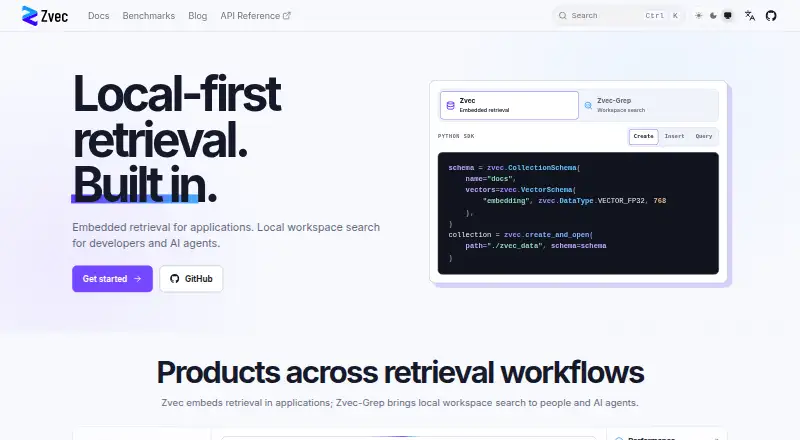
What Zvec is
Zvec is an open-source vector database that runs inside an application, so indexing and querying vectors does not require a separate server or external infrastructure. It handles dense and sparse vectors, full-text search, and hybrid retrieval with structured filters. Listed index choices include Flat, HNSW, IVF, DiskANN, and RaBitQ variants; quantization options include FP16, INT8, INT4, RaBitQ, and PQ. Write-ahead logging maintains persistence through process crashes or power failures. Multiple processes can read a collection concurrently, while writing is limited to one process at a time. SDKs are listed for Python, Node.js, Go, Rust, Dart/Flutter, C, and C++. The README lists Linux, macOS, and Windows, with prebuilt SDK binaries also available for Android and iOS. Integrations named on the product site include Logseq, MyContext, ReMe, txtai, and CocoIndex. Zvec-Grep, part of the product family, searches local code, documentation, and text-based data by exact text, keywords, or meaning. Zvec is free and Apache-2.0 licensed.
Good
- Runs without a server or external infrastructure.
- Supports dense, sparse, full-text, and hybrid search.
- Write-ahead logging preserves data across crashes or power failures.
- SDKs are listed for seven languages.
- Free and Apache-2.0 licensed.
Watch out
- Writes are exclusive to one process at a time.
- The opened pages state no security certification or compliance standard.
Who it suits
Zvec suits application developers who want local vector search for prototyping, embedded or edge applications, or production systems. It may also suit people seeking to search local workspaces with Zvec-Grep.
Verdict
Zvec combines local vector storage with several search and indexing options, plus SDKs for a range of languages. Its single-process write limit is important for teams planning concurrent access.
Plans and prices
From Zvec's own pricing page, checked 8 Oct 2026.
| Plan | Price | What it gives you |
|---|---|---|
| Zvec | Free | Open-source in-process vector database · Apache License 2.0 |
The facts
Each one read from Zvec's own pages, with the date it was checked.
What it does
- Agent tools
- The product family includes Zvec-Grep, a local workspace search CLI and MCP tool for people and AI agents.checked 8 Oct 2026
- Concurrency limit
- Multiple processes can read the same collection simultaneously, while writes are exclusive to one process.checked 8 Oct 2026
- Indexes
- The site lists Flat, HNSW, IVF, and DiskANN index types, plus FP16, INT8, INT4, RaBitQ, and PQ quantization.checked 8 Oct 2026
- Integrations
- The product site names integrations with Logseq, MyContext, ReMe, txtai, and CocoIndex.checked 8 Oct 2026
- Languages and APIs
- Official SDKs are listed for Python, Node.js, Go, Rust, and Dart/Flutter, with C and C++ also linked from the product site.checked 8 Oct 2026
- Privacy and deployment
- Zvec runs in-process and locally, with no server or external infrastructure required.checked 8 Oct 2026
- Search types
- It supports dense and sparse vectors, full-text search, and hybrid retrieval with structured filters.checked 8 Oct 2026
- Security and compliance
- The maker describes Zvec as private and the repository identifies Apache-2.0 licensing; the pages opened do not state a security certification or compliance standard.checked 8 Oct 2026
- Storage
- Write-ahead logging provides persistence across process crashes or power failures.checked 8 Oct 2026
- Support
- The documentation directs users to report issues on GitHub and lists community channels including DingTalk, WeChat, Discord, and X.checked 8 Oct 2026
- Supported content
- Zvec-Grep searches local code, documentation, and text-based data using exact text, keywords, or meaning.checked 8 Oct 2026
- What it does
- Zvec is an open-source, in-process vector database for indexing and querying vectors without a server, daemon, or external infrastructure.checked 8 Oct 2026
- Who it is for
- The maker describes Zvec for application developers and presents use cases spanning prototyping, local development, embedded and edge applications, and production systems.checked 8 Oct 2026
Where it runs
- Supported platforms
- The README lists Linux, macOS, and Windows, and says prebuilt SDK binaries are published for Linux, macOS, Windows, Android, and iOS.checked 8 Oct 2026
The full review of Zvec
Zvec is a free, open-source vector database for developers who want search embedded directly in an application. It is best suited to local, embedded, and edge projects that can keep writes within a single process.
Its mix of retrieval methods and index choices is substantial, but the exclusive-writer rule makes it a poor fit for workloads that need multiple processes to write concurrently.
Overview
Zvec indexes and queries vectors in the application process, without a separate server, daemon, or external infrastructure. That can simplify deployment for prototypes and local development, as well as embedded and edge applications. The maker also presents it for production systems, but teams should first check that its process-level write constraint fits their architecture.
Multiple processes can read a collection at once; writes are limited to one process. That arrangement works when an application can funnel changes through a single writer, while shared workloads requiring concurrent writers should look elsewhere. Write-ahead logging helps preserve data through process crashes and power failures.
Key features
Search and indexing
Zvec handles dense and sparse vectors, full-text search, and hybrid retrieval with structured filters. Its index options include Flat, HNSW, HNSW-RaBitQ, IVF, IVF-RaBitQ, and DiskANN. FP16, INT8, INT4, RaBitQ, and PQ quantization add further choices for developers shaping an index to their application. This breadth is useful when a project needs more than one retrieval approach, though it also puts the selection and configuration work on the development team.
SDKs and integrations
Official SDKs cover Python, Node.js, Go, Rust, and Dart/Flutter, while C and C++ are also linked from the product site. Named integrations include Logseq, MyContext, ReMe, txtai, and CocoIndex. These connections broaden its potential role in developer applications, but do not change the single-process write limit.
Local workspace search
Zvec-Grep is a separate tool in the product family: a local workspace search CLI and MCP tool for people and AI agents. It searches code, documentation, and text-based data by exact text, keywords, or meaning. It is relevant to users looking for local workspace search, not a substitute for evaluating Zvec's database architecture.
Privacy and support
Because Zvec runs locally in-process, it does not require sending data to a separate database service. The maker describes it as private, and the project uses the Apache-2.0 license. Support channels include GitHub issues, DingTalk, WeChat, Discord, and X. The project is not accompanied by a stated security certification or compliance standard, so organizations with formal requirements should assess that fit independently.
Pricing
Zvec costs free and is open source under the Apache License 2.0. There is no free trial; the software itself is free, so a trial period is not needed to access it. Its deployment model is self-hosted, with no paid service tier described. This suits developers comfortable managing the software within their own applications; teams seeking a managed database service should compare alternatives.
Platforms
The README supports Linux, macOS, and Windows, and prebuilt SDK binaries are published for Linux, macOS, Windows, Android, and iOS. The product is also presented for API use and self-hosted deployment. The SDK coverage makes it relevant to mobile and desktop application developers, although platform availability does not remove the need to account for its single-writer model.
Who it's for
Zvec is aimed at application developers building prototypes, local development tools, embedded or edge software, and production systems that can operate with one writing process per collection. It is a particularly sensible fit when avoiding a separately deployed database is a priority. It is less suitable when several processes need to update the same collection concurrently or when a project requires a managed service.
Pros and cons
Pros
- No separate database service: in-process operation avoids deploying a server, daemon, or external infrastructure.
- Broad retrieval toolkit: dense and sparse vectors, full-text search, hybrid retrieval, and structured filters support varied search patterns.
- Many implementation options: SDKs for multiple languages, several index types, and quantization choices give developers flexibility.
- Crash resilience: write-ahead logging preserves data across process crashes or power failures.
- Open-source and free: Apache-2.0 licensing and a price of no cost remove a software subscription cost.
Cons
- One process writes: concurrent readers are supported, but writes are exclusive to a single process, limiting shared-write architectures.
- Self-hosted responsibility: the team must incorporate and operate the database rather than rely on a managed service.
- No stated compliance standard: organizations with certification or compliance requirements will need to verify suitability before adoption.
Alternatives
For a broader comparison, browse Vector Databases.
- Chroma is worth comparing if you want a freemium option with both a self-hosted open-source database and a cloud offering powered by the same codebase.
- Qdrant may suit readers comparing a freemium option that includes a free cloud tier as well as Linux, macOS, and self-hosted platforms.
- Vespa is a paid alternative with a free trial, suited to readers willing to consider a paid offering.
- EmergentDB offers a free Community plan with unlimited vectors, queries, and writes, making it relevant to readers who prioritize those stated allowances and accept AGPL-3.0 licensing.
- Vearch is another free, self-hosted vector database under Apache License 2.0.
- Weaviate has a free tier with stated cluster, object, memory, disk, collection, and tenant caps; compare it if those limits suit your project.
- ZeusDB Vector Database is a free self-hosted option with a Python API, HNSW search, optional product quantization, persistence, and metadata filters.
- Epsilla has a freemium offering with a free tier capped at one team member, one project, one AI application, one knowledge base, 10M vector storage, and 50 messages per month; stored data is cleared after three months.
Verdict
Choose Zvec if you are a developer who wants a free, Apache-2.0 vector database embedded in an application, with a broad set of search and indexing options and no separate service to deploy. Its main limitation is decisive: only one process can write to a collection. If your architecture needs concurrent writers or a managed database, compare alternatives before committing.
Alternatives to Zvec
- 1

Chroma
Free planOpen sourceAndroidiOSWebAPI8.6From $250 a month - 2

Vespa
Open sourceWebAPILinuxmacOS8.4 - 3

Pinecone
Free planWebAPILinuxmacOS7.8From $20 a month - 4
Weaviate
Free planWebAPILinuxSelf-hosted7.0$45 usage-based - 5

Qdrant
Free planWebAPILinuxmacOS6.9Free plan - 6

Elasticsearch
WebAPILinuxSelf-hosted6.7From $99 a month