
EmergentDB
EmergentDB is an open-source, self-hosted vector database licensed under AGPL-3.0, with managed cloud also listed.
What EmergentDB is
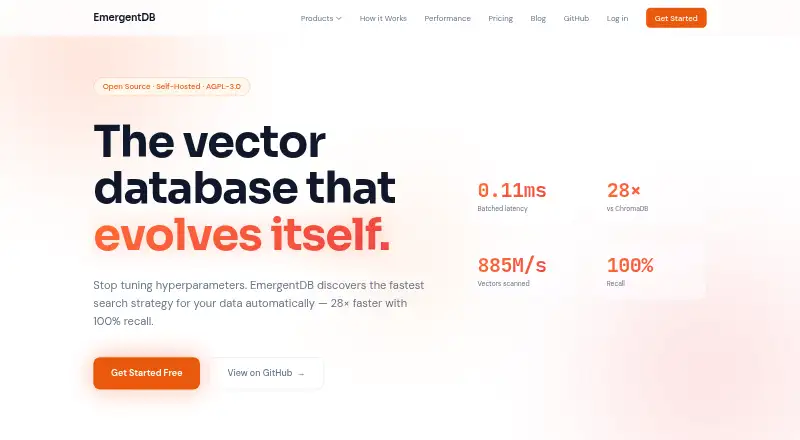
EmergentDB is an open-source, self-hosted vector database licensed under AGPL-3.0, with managed cloud also listed. It automatically selects a search strategy for the data without requiring manual tuning. Teams can insert batches of vectors and search through REST API endpoints; insertion is also supported through a TypeScript SDK, and the product accepts embeddings from any source. Listed index types include Flat, HNSW, IVF, PQ, and Emergent, while SDK languages include TypeScript and Python. The Community plan offers unlimited vectors, queries, and writes, with community support and the Bolt-lite engine. Managed Launch lists 500K vectors, while Scale lists 2.5M vectors and a dedicated instance; both include unlimited queries and writes. Prices are $24 per year, billed annually, for Launch and $66 per year, billed annually, for Scale. The service lists US, EU, and Asia-Pacific data residency, ISO 27001, SOC 2 Type II, GDPR, and HIPAA-ready status. It also describes a crash-safe write-ahead log. Its site claims 0.11ms batched latency and 100% recall in testing at 10M vectors across all dimensions, and reports comparative benchmark results across 768D–3072D.
Good
- Automatically chooses a search strategy.
- Supports batch insertion and REST API search.
- Community plan has unlimited vectors, queries, and writes.
- Lists data residency across three regions.
- Offers self-hosted and managed deployment.
Watch out
- Community support is listed for the free plan.
- Launch is limited to 500K vectors.
- Scale is limited to 2.5M vectors.
Who it suits
EmergentDB may suit developers and teams building vector search who want a self-hosted database or managed cloud option. Its TypeScript and Python SDKs and REST endpoints are relevant to teams working with those interfaces.
Verdict
EmergentDB offers both self-hosted and managed options, with automatic search-strategy selection and a free Community plan. Review the vector limits and the listed license before choosing a deployment or plan.
Plans and prices
From EmergentDB's own pricing page, checked 9 Oct 2026.
| Plan | Price | What it gives you |
|---|---|---|
| Community | Free | Unlimited vectors · Unlimited queries & writes · AGPL-3.0 · Community support · Bolt-lite engine |
| Launch | $24 a year | 500K vectors · Unlimited queries & writes · SOC 2 · GDPR · 99.9% SLA · billed annually |
| Launch | $29 a month | 500K vectors · Unlimited queries & writes · SOC 2 · GDPR · 99.9% SLA |
| Scale | $66 a year | 2.5M vectors · Unlimited queries & writes · Dedicated instance · HIPAA-ready · 99.95% SLA · billed annually |
| Scale | $79 a month | 2.5M vectors · Unlimited queries & writes · Dedicated instance · HIPAA-ready · 99.95% SLA |
The facts
Each one read from EmergentDB's own pages, with the date it was checked.
What it does
- Automatic optimization
- The database discovers the search strategy for your data automatically, without manual tuning or configuration.checked 9 Oct 2026
- Benchmarks
- The site reports 18–28× faster batched performance than ChromaDB and 2.5× faster than FAISS across 768D–3072D.checked 9 Oct 2026
- Data residency
- The site lists US, EU, and Asia-Pacific regions and says data residency is built in.checked 9 Oct 2026
- Durability
- The site describes a crash-safe write-ahead log and says a 10GB index reopens in microseconds.checked 9 Oct 2026
- Managed service
- Launch is listed as managed cloud with 500K vectors and unlimited queries and writes.checked 9 Oct 2026
- Performance claim
- The homepage claims 0.11ms batched latency and 100% recall, tested at 10M vectors across all dimensions.checked 9 Oct 2026
- Product
- EmergentDB is an open-source, self-hosted vector database licensed under AGPL-3.0.checked 9 Oct 2026
- Scale service
- Scale is listed with dedicated resources, a dedicated instance, and a 2.5M-vector limit.checked 9 Oct 2026
- SDK and embeddings
- Vectors can be inserted through a TypeScript SDK, and the site says any embedding source can be used.checked 9 Oct 2026
- Security and compliance
- The site lists ISO 27001, SOC 2 Type II, GDPR, and HIPAA-ready status.checked 9 Oct 2026
- Support
- The Community plan includes community support.checked 9 Oct 2026
- Vector operations
- The homepage describes batch vector insertion and vector search through REST API endpoints.checked 9 Oct 2026
The full review of EmergentDB
EmergentDB is an AGPL-3.0 vector database that runs self-hosted or as a managed service. It suits developers who want search strategy selection handled automatically, REST and SDK access, and uncapped queries and writes. The key trade-off is whether its vector ceilings, annual billing, and copyleft license fit the workload and governance model.
Overview
EmergentDB supports Linux, web, API, and self-hosted deployments. Its defining behavior is automatic optimization: it discovers a search strategy for a dataset without manual tuning or configuration. That can shorten setup and reduce ongoing index decisions, but teams that require explicit control of index selection may find the abstraction limiting.
Supported index types are Flat, HNSW, IVF, PQ, and Emergent. The homepage claims 0.11ms batched latency and 100% recall at 10 million vectors across all dimensions, and reports batched performance 18–28 times faster than ChromaDB and 2.5 times faster than FAISS across 768D–3072D. These claims make it a candidate for latency-sensitive systems, but they do not remove the need to measure your own workload.
Key features
Insertion and search
REST endpoints provide batch vector insertion and vector search. A TypeScript SDK offers another insertion path, while TypeScript and Python are the listed SDK languages. The product says any embedding source can be used, which suits teams that already operate an embedding pipeline instead of wanting a provider-specific workflow.
Operations and durability
A crash-safe write-ahead log is intended to protect writes, and the site says a 10GB index reopens in microseconds. Those characteristics matter for services that must recover quickly after interruption. Automatic strategy discovery is paired with the conventional index choices above, giving teams a broad vocabulary even though the product emphasizes automation.
Compliance and residency
EmergentDB lists ISO 27001, SOC 2 Type II, GDPR, and HIPAA-ready status. Data residency is built in across US, EU, and Asia-Pacific regions. These options make the managed service more relevant to regulated or geographically distributed deployments, subject to confirming that the selected plan and operating requirements match your obligations.
Pricing
The Community plan costs free. It includes unlimited vectors, unlimited queries and writes, AGPL-3.0 licensing, community support, and the Bolt-lite engine. It is the natural starting point for experimentation and self-hosted use, but community support is the support level and the license requires review before incorporating it into a proprietary distribution.
Launch costs $24 a year, billed annually. It is a managed-cloud offering with a 500K-vector limit, unlimited queries and writes, SOC 2, GDPR, and a 99.9% SLA. Choose it when that capacity is sufficient and a hosted service with formal service commitments is preferable to operating the database yourself. The 500K ceiling is the practical constraint for growing collections.
Scale costs $66 a year, billed annually. It raises the limit to 2.5M vectors and adds dedicated resources, a dedicated instance, HIPAA-ready status, and a 99.95% SLA, while retaining unlimited queries and writes. It fits production workloads that need isolation or stronger availability commitments, but the vector cap still requires capacity planning. The pricing note also describes paid access from $24/mo (annual); confirm the applicable billing presentation before committing.
Platforms
Use the API, Linux, web, or self-hosted deployment paths. Self-hosting favors teams that need infrastructure control and AGPL-3.0 is acceptable; managed Launch and Scale favor teams that want hosted operations, regional residency, and SLA-backed service.
Who it's for
EmergentDB is a strong fit for developers building retrieval systems who want automatic search configuration, existing TypeScript or Python tooling, and no query or write quota on the listed plans. It is less suitable when the collection may exceed 500K or 2.5M vectors on paid tiers, when annual billing is undesirable, or when AGPL-3.0 conflicts with distribution policy.
Pros and cons
- Pros: automatic search-strategy discovery reduces tuning work; REST, TypeScript, and Python access supports varied stacks; unlimited queries and writes are unusually generous; regional residency and listed compliance statuses help regulated deployments; self-hosted and managed options cover different operational preferences.
- Cons: paid plans impose 500K and 2.5M vector ceilings; annual billing limits flexibility; Community support is the included support level on the free plan; AGPL-3.0 may not suit proprietary redistribution; vendor performance figures may not represent every dataset or traffic pattern.
Alternatives
Browse the Vector Databases category for a wider comparison.
Chroma is the better choice when you want an Apache 2.0 open-source database and broader device coverage, including Android, iOS, macOS, and Windows, alongside self-hosting and cloud options.
Choose Qdrant instead if its free tier’s single-node 0.5 vCPU, 1GB RAM, and 4GB disk allowance matches a small cloud deployment.
Vespa suits teams that prefer usage-based paid infrastructure and a free trial rather than EmergentDB’s annual plan structure.
Pick Zvec or Vearch when a free, Apache-licensed, self-hosted vector database is the priority.
Weaviate is an alternative for a managed free tier capped at one cluster, 100,000 objects, 1GB memory, and 10GB disk.
ZeusDB Vector Database fits readers seeking a free self-hosted option with a Python API, HNSW search, persistence, and metadata filters.
Epsilla is worth considering for a free tier centered on one team member, one project, one AI application, and 10M-vector storage.
Verdict
Choose EmergentDB when automatic search optimization, unlimited operations, and a choice between self-hosting and managed service matter more than fine-grained index control. Its strongest case is a developer team that can work within the paid vector caps and accept AGPL-3.0 or Community support. Look elsewhere if you need a permissive license, unconstrained paid growth, or billing that is not tied to an annual term.
Alternatives to EmergentDB
- 1

Chroma
Free planOpen sourceAndroidiOSWebAPI8.6From $250 a month - 2

Vespa
Open sourceWebAPILinuxmacOS8.4 - 3

Pinecone
Free planWebAPILinuxmacOS7.8From $20 a month - 4
Weaviate
Free planWebAPILinuxSelf-hosted7.0$45 usage-based - 5

Qdrant
Free planWebAPILinuxmacOS6.9Free plan - 6

Elasticsearch
WebAPILinuxSelf-hosted6.7From $99 a month