ZMap
ZMap is a free, open-source command-line scanner for Internet-wide network surveys.
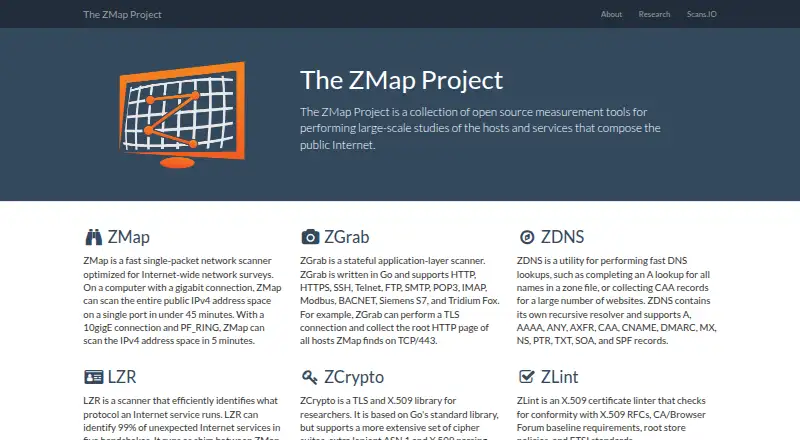
What ZMap is
ZMap is a free, open-source command-line scanner for Internet-wide network surveys. It sends single-packet probes to study hosts and services across the public Internet. On a typical gigabit Ethernet desktop, the project says it can scan the public IPv4 space on one port in under 45 minutes; with 10gigE plus netmap or PF_RING, the stated time is under five minutes. Probe modules cover TCP SYN, ICMP, DNS, UPnP, and BACNET, and UDP probes are supported. ZGrab adds stateful application-layer scans, handshakes, and service data collection for protocols including HTTP, HTTPS, SSH, SMTP, Modbus, and BACNET. The project also lists ZDNS, LZR, and ZLint for related measurement tasks. ZMap runs on GNU/Linux, macOS, and BSD, with package-manager or source installation. A simple IPv4 scan requires root privileges. Output formats include CSV, JSON, and plain text. The project warns about ethical and operational implications of Internet-wide scanning.
Good
- Single-packet scanning for Internet-wide surveys
- Probe modules for TCP, ICMP, DNS, and UDP
- Under-45-minute typical gigabit IPv4 scan
- Related tools support application-layer measurements
- CSV, JSON, and plain-text output
Watch out
- Simple IPv4 scans require root privileges
- Internet-wide scanning has ethical implications
- No service detection in ZMap itself
Who it suits
ZMap suits researchers and operators conducting large-scale studies of public Internet hosts and services. It is a command-line tool for Linux, macOS, and BSD environments.
Verdict
ZMap provides high-speed probing for broad Internet measurement work, with related tools for deeper protocol analysis. Users must account for root access and the project’s guidance on responsible scanning.
The facts
Each one read from ZMap's own pages, with the date it was checked.
What it does
- Ethical scanning
- The project cautions that Internet-wide scans can have serious ethical and operational implications and advises scanning slowly and providing an opt-out for network operators.checked 8 Oct 2026
- High-speed scanning
- With a 10gigE connection and netmap or PF_RING, ZMap can scan the IPv4 address space in under five minutes.checked 8 Oct 2026
- Installation
- The project provides installation instructions for package managers and building from source.checked 8 Oct 2026
- Intended audience
- The project describes its collection of open-source tools as intended for large-scale studies of hosts and services on the public Internet.checked 8 Oct 2026
- Intended users
- The project describes ZMap as a tool for Internet-wide network surveys and lists research among the repository topics.checked 8 Oct 2026
- License
- ZMap is licensed under Apache License 2.0.checked 8 Oct 2026
- Operating systems
- ZMap operates on GNU/Linux, macOS, and BSD.checked 8 Oct 2026
- Privileges
- The README's example scan requires root privileges.checked 8 Oct 2026
- Probe support
- ZMap has probe modules for TCP SYN scans, ICMP, DNS queries, UPnP and BACNET, and can send UDP probes.checked 8 Oct 2026
- Probe types
- ZMap has implemented probe modules for TCP SYN scans, ICMP, DNS queries, UPnP, and BACNET, and can send many UDP probes.checked 8 Oct 2026
- Project
- The ZMap Project is a collection of open source measurement tools for large-scale studies of hosts and services on the public Internet.checked 8 Oct 2026
- Project tools
- The project also lists ZDNS for DNS lookups, LZR for protocol identification, and ZLint for X.509 certificate checks.checked 8 Oct 2026
- Purpose
- ZMap is a fast single-packet network scanner designed for Internet-wide network surveys.checked 8 Oct 2026
- Related scanner
- ZGrab is the project's stateful application-layer scanner and supports protocols including HTTP, HTTPS, SSH, SMTP, Modbus and BACNET.checked 8 Oct 2026
- Related tool
- The project describes ZGrab as a stateful application-layer scanner that can perform handshakes and collect service data from hosts found by ZMap.checked 8 Oct 2026
- Requirements
- The README says a simple scan of the IPv4 space requires root privileges.checked 8 Oct 2026
- Scanning guidance
- The README warns that Internet-wide scanning can have ethical and operational implications and advises scanning as slowly as necessary and providing network operators a way to opt out.checked 8 Oct 2026
- Scan speed
- On a typical gigabit Ethernet desktop, ZMap can scan the public IPv4 address space on one port in under 45 minutes.checked 8 Oct 2026
- Support
- The README directs users to the FAQ and GitHub Discussions for usage and support questions.checked 8 Oct 2026
- Workflow
- The project describes using ZGrab with ZMap in measurement pipelines for more involved scans such as banner grabs or TLS handshakes.checked 8 Oct 2026
Where it runs
- Platforms
- The README says ZMap operates on GNU/Linux, Mac OS and BSD, and that the latest stable release supports Linux, macOS and BSD.checked 8 Oct 2026
Alternatives to ZMap
- 1
Avidemux
Free planOpen sourceWebLinuxmacOSWindows7.3Free plan - 2
Masscan
Free planOpen sourceLinuxmacOSSelf-hostedWindows7.2Free plan - 3
Nmap
Free planLinuxmacOSSelf-hostedWindows7.0From $9,980 a month - 4
Naabu
Free planAPILinuxmacOSSelf-hosted6.8Free plan - 5

Pentest-Tools Port Scanner
Free planWebAPI6.8From $95 a month - 6

ScanSearch
Free planWebAPILinux6.8From $0.30 a month