Yugandhar Open MDM Hub
Yugandhar Open MDM Hub is a free, Apache 2.0-licensed hub for integrating and harmonizing customer master data.
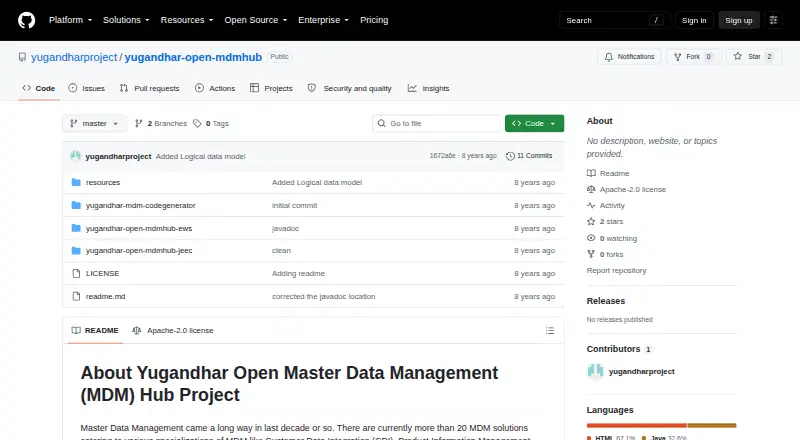
What Yugandhar Open MDM Hub is
Yugandhar Open MDM Hub is a free, Apache 2.0-licensed hub for integrating and harmonizing customer master data. Its extendable model covers people, organizations, accounts, addresses, phone numbers, identifiers, relationships, vehicles, preferences, and properties. The project describes more than 450 prebuilt services, including composite and base-table services. RESTful and message-queue interfaces are available, along with embedded validations, business rules, and match-and-merge for data quality and deduplication. MariaDB and Oracle are preconfigured, with stated extension options for MySQL, DB2, NoSQL, and PostgreSQL. The project also lists ActiveMQ, JTA transaction management, ORM, Spring Boot, Hibernate, JBoss, and Maven. User- and role-based authorization and row-level audit history are included. Other capabilities include multilingual reference data, event management, paginated retrieval and search, and JSR 107-compliant Ehcache caching. It can use an embedded Spring Boot web server such as Tomcat or a JEE container such as Red Hat JBoss. Production hosting supports most Linux distributions; CentOS and Ubuntu have been tested. Documented production requirements include Java JDK 1.8 and MariaDB 10.3 or later or Oracle.
Good
- Extendable customer data model
- Includes more than 450 prebuilt services
- Embedded validations and match-and-merge framework
- Supports user- and role-based authorization
Watch out
- Production requirements include Java JDK 1.8
- No releases are published on GitHub
- JEE deployment specifies JBoss EAP 7.1 or later
Who it suits
The hub suits teams integrating and harmonizing customer master data across systems, particularly those using its listed databases and Java-based deployment options.
Verdict
Yugandhar Open MDM Hub offers broad customer-data modeling and integration capabilities under a free Apache 2.0 license. Review the documented production requirements and deployment options before adopting it.
Plans and prices
From Yugandhar Open MDM Hub's own pricing page, checked 14 Oct 2026.
| Plan | Price | What it gives you |
|---|---|---|
| Free | Free | completely free · Apache 2.0 license |
The facts
Each one read from Yugandhar Open MDM Hub's own pages, with the date it was checked.
What it does
- Access and audit
- Capabilities include user- and role-based authorization and row-level transaction history through audit logs.checked 7 Oct 2026
- Architecture
- The software uses Spring Boot, Hibernate and JBoss in a service-oriented architecture.checked 14 Oct 2026
- Audit
- Row-level transaction history is maintained through audit logging.checked 14 Oct 2026
- Authorization
- User- and role-based authorization is included.checked 14 Oct 2026
- Caching
- The project lists a JSR107-compliant Ehcache caching framework.checked 14 Oct 2026
- Code generation
- Rapid extension is supported through Hibernate reverse engineering and Freemarker code-generation templates.checked 14 Oct 2026
- Customer data model
- Its extendable model covers people, organizations, accounts, addresses, phones, identifiers, groups, vehicles, preferences, properties and party relationships.checked 14 Oct 2026
- Databases
- MariaDB and Oracle are preconfigured, and the project says it can be extended for MySQL, DB2, NoSQL, and PostgreSQL.checked 7 Oct 2026
- Database support
- MariaDB and Oracle are preconfigured, with stated extensibility to MySQL, DB2, NoSQL and PostgreSQL.checked 14 Oct 2026
- Data model
- Its extendable customer data model covers people, organizations, accounts, addresses, phone numbers, identifiers, relationships, vehicles, preferences, and properties.checked 7 Oct 2026
- Data quality
- It includes embedded validations, business rules, and a match-and-merge framework.checked 7 Oct 2026
- Deployment
- It can run with an embedded Spring Boot web server such as Tomcat or inside a Java EE container such as Red Hat JBoss.checked 14 Oct 2026
- Development requirements
- The development setup lists Windows 7 SP1+, 8 GB RAM, 100 GB storage, Eclipse Java EE, Maven 3.5+, Spring Boot 2.0.2, Java 8 and database tooling.checked 14 Oct 2026
- Documentation
- The repository links project guides, an API and transaction reference, data-model and customization guides, Javadoc and database documentation.checked 14 Oct 2026
- Independent catalog description
- A community-curated MDM list describes the hub as a Java Spring/Hibernate service-oriented CDI and MDM system with preconfigured enterprise-master-data microservices.checked 14 Oct 2026
- Independent review evidence
- The opened independent category pages provide no verified Yugandhar user praise, complaints or review counts.checked 14 Oct 2026
- Interfaces
- The hub exposes RESTful and message-queue enabled integration patterns.checked 14 Oct 2026
- JEE requirements
- The JEE deployment option requires Linux, Java 8, Oracle 11g Enterprise or later, JBoss EAP 7.1+ and Artemis or JBoss AMQ 7.0.2.checked 14 Oct 2026
- Latest repository activity
- The latest listed commit is titled “Added Logical data model” and dated 27 July 2018.checked 14 Oct 2026
- Licence
- The project is released under the Apache 2.0 license.checked 14 Oct 2026
- License and security
- The project states it is licensed under Apache 2.0 and lists role-based authorization and audit logging; it does not state a security certification on the repository page.checked 7 Oct 2026
- Limit: legacy stack
- The documented environment is tied to Java 8, Spring Boot 2.0.x and older Oracle, JBoss and Windows versions.checked 14 Oct 2026
- Limit: operational burden
- Deployment is self-hosted and requires teams to provide Linux, Java, database, messaging and application-server infrastructure.checked 14 Oct 2026
The company
- Founded
- 2017checked 28 Sep 2026
The full review of Yugandhar Open MDM Hub
Yugandhar Open MDM Hub is a customer master-data integration hub for teams building and operating their own data systems. It is most compelling for Java-capable organizations that need an adaptable customer model and can accommodate its production stack; teams seeking a packaged, current-generation service should look elsewhere.
Overview
This project is designed to harmonize customer records across systems, not to act as a general-purpose CRM. Its extendable model spans people, organizations, accounts, addresses, phone numbers, identifiers, relationships, vehicles, preferences, and properties. That breadth can support a shared structure across varied customer data, but tailoring and running the hub remain engineering responsibilities.
Integration and data-quality capabilities are substantial: REST and message-queue interfaces sit alongside validations, business rules, deduplication, and match-and-merge. The tradeoff is the documented production environment: Java JDK 1.8 and MariaDB 10.3 or later or Oracle, with JBoss EAP 7.1 or later for the JEE deployment route. The GitHub releases page has no published releases, which makes release and production planning a point of caution.
Key features
- Broad customer model: The model covers customer entities from contact details to vehicles and relationships. This is useful when a simple contact schema is too limited, though teams must adapt it to their own records and processes.
- Prebuilt services: More than 450 services include 50+ composite services and 400 base table services. They provide a broad set of integration building blocks, but their presence does not remove the need to assess fit and maintain the deployment.
- Data quality: Embedded validations, business rules, deduplication, and match-and-merge address inconsistent and duplicate records. These capabilities make the hub relevant to customer-data consolidation, rather than just storage.
- Integration and transactions: The hub supports REST and MQ, ActiveMQ integration, JTA transaction management, ORM, Spring Boot, Hibernate, JBoss, and Maven. This stack will suit teams already working with these technologies better than organizations seeking a low-maintenance turnkey tool.
- Access, audit, and retrieval: User- and role-based authorization, row-level transaction history, pagination, event management, multilingual reference data, and JSR 107 compliant Ehcache caching cover operational needs around access and retrieval. These features do not substitute for a stated security certification.
- Database choices: MariaDB and Oracle are preconfigured; the project says it can be extended for MySQL, DB2, NoSQL, and PostgreSQL. Production requirements specifically name MariaDB 10.3 or later or Oracle, so teams relying on the other options should verify their deployment needs before committing.
Pricing
The Free plan costs free and is described as completely free under the Apache 2.0 license. There are no paid tiers or seat, quota, trial-length, or renewal terms to weigh in the stated plan. The price is attractive for teams able to supply their own hosting and engineering effort; free licensing does not remove the production requirements or operational burden.
Platforms
Yugandhar Open MDM Hub is offered for API, Linux, self-hosted, and web environments. Production hosting supports most Linux distributions, with CentOS and Ubuntu identified as tested. Deployment can use an embedded Spring Boot web server such as Tomcat or a JEE container such as Red Hat JBoss. The documented Java JDK 1.8 requirement and database choices make platform fit an infrastructure decision, not a simple desktop or mobile app choice.
Who it's for
This is a strong candidate for integration teams consolidating customer master data across systems, especially those needing a flexible model, duplicate handling, and Java-based integration components. It is a weaker fit for small teams without Java and database administration capacity, or buyers who need a defined release cadence and a managed service. Project documentation, Javadoc, database documentation, and an email contact provide routes for implementation questions and contributions.
Pros and cons
- Pro: An extendable model spanning many customer entities gives integration teams more room than a basic contact schema.
- Pro: The free Apache 2.0 license and more than 450 prebuilt services offer a substantial starting point without a license charge.
- Pro: Validation, deduplication, match-and-merge, and audit history address data quality and traceability needs.
- Con: Java JDK 1.8 and the specified database requirements make production deployment dependent on an older Java runtime and compatible infrastructure.
- Con: No GitHub releases are published, so teams looking for a clear packaged release channel may be more comfortable with another product.
- Con: Self-hosting and model adaptation put ongoing implementation and maintenance work on the adopting team.
Alternatives
For a wider comparison, browse Customer Data Quality Software. These alternatives target different data-quality needs and operating models:
- Melissa Data Quality is worth considering when address verification matters: its GAV Free plan is free and covers 250 records/month with CASS & DPV Certified capabilities.
- Paribus 365 suits teams looking for search-and-detect with a larger stated record allowance: its free edition supports unlimited users and up to 100K records.
- ZeroBounce is a more focused option for business email verification, with 100 free monthly verifications; its Pay-As-You-Go plan starts at $39, paid once for 2,000 addresses.
- OpenDQ is another free, self-hosted data-quality option, with optional subscription-based external data enrichment and enhancement.
- Zingg is a free Linux and self-hosted alternative for batch probabilistic matching across millions of records; its enterprise tier adds batch and real-time use.
- Senzing Entity Resolution may fit buyers seeking entity resolution with a stated annual subscription: its 10M DSR plan is $58,560 a year.
- Byteplant Data Validation is an alternative for address validation with one-time credits that never expire; pricing depends on country or region and volume.
- Workbooks is a broader CRM option rather than a direct master-data hub comparison.
Verdict
Choose Yugandhar Open MDM Hub if your team needs an adaptable customer master-data foundation, can work within its Java and database requirements, and values a free Apache 2.0 license. Its breadth of services and built-in quality controls are persuasive; the older production stack, self-hosting burden, and lack of published GitHub releases make it a less convincing choice for teams prioritizing managed operations or a clear release channel.
Getting started
- Open the project's GitHub website
- Prepare a Linux host with Java JDK 1.8
- Install MariaDB 10.3 or later, or use Oracle
- Choose an embedded Spring Boot server or JEE container
- Deploy with Tomcat or Red Hat JBoss
- Configure users, roles, and integrations
Questions
Is Yugandhar Open MDM Hub free?
Yes. The listed Free plan costs nothing and uses the Apache 2.0 license.
Which platforms does it support?
It supports API, Linux, self-hosted, and web environments.
Which databases are available?
MariaDB and Oracle are preconfigured. The project describes extensions for MySQL, DB2, NoSQL, and PostgreSQL.
Does it support deduplication and validation?
Yes. It includes embedded validations, business rules, and a match-and-merge framework.
How can it be deployed?
You can use an embedded Spring Boot web server such as Tomcat or a JEE container such as Red Hat JBoss.
Alternatives to Yugandhar Open MDM Hub
- 1
Melissa Data Quality
Free planAndroidiOSWebAPI8.1From $350 a year - 2

ZeroBounce
Free planAndroidiOSWebAPI8.1Free plan - 3
Paribus 365
Free planWebAPIWindows7.4Free plan - 4

Zingg
Free planOpen sourceAPILinuxmacOSSelf-hosted7.4Free plan - 5

Workbooks
AndroidiOSWeb6.9From $47 a month - 6

DataMatch Enterprise
WebAPILinuxSelf-hosted6.8