Yugami
Yugami is a free, open-source 64-bit binary packer for Windows PE executables, written in Rust.
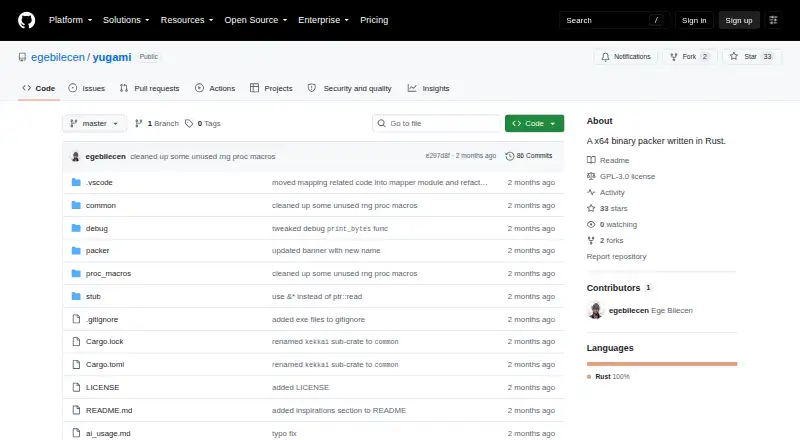
What Yugami is
Yugami is a free, open-source 64-bit binary packer for Windows PE executables, written in Rust. It pads payloads to 4KB page boundaries, encrypts them with ChaCha20, and appends encrypted data and metadata as an overlay. A random 256-bit base key is generated, with BLAKE3 deriving a separate key for each page. At runtime, pages are decrypted only when a page fault occurs. Decrypted pages stay in an LRU cache capped at 256 pages; evicted pages are encrypted again and protected as PAGE_NOACCESS. The README documents building the workspace in Cargo release mode, then running the packer against a target executable. The resulting file is named packed.exe and appears in the current directory. Yugami is licensed under GPL-3.0. The maker is identified as Ege Bilecen, whose profile lists Ireland. The repository has no releases, so users follow the source-build workflow.
Good
- Free and open source under GPL-3.0
- ChaCha20 encryption with per-page BLAKE3 keys
- Just-in-time page decryption at runtime
- LRU cache re-encrypts evicted pages
- Documented Cargo build and packing command
Watch out
- Windows 64-bit PE support only
- Requires a Rust Cargo source build
- Repository has no releases
- Cache is limited to 256 pages
Who it suits
It suits Windows developers working with 64-bit PE binaries who can build and run Rust projects through Cargo.
Verdict
Yugami provides a documented source-based packing workflow with page-level encryption and runtime handling. It is most practical for users comfortable building Rust software rather than downloading a release.
The facts
Each one read from Yugami's own pages, with the date it was checked.
What it does
- Build
- The README gives a Cargo command to build the workspace in release mode.checked 11 Oct 2026
- Distribution
- The repository's Releases page says there are no releases.checked 11 Oct 2026
- Encryption
- It encrypts PE executables with the ChaCha20 stream cipher and derives keys per page.checked 11 Oct 2026
- Input and output
- The README shows packing a target.exe file and says the output is packed.exe in the current directory.checked 11 Oct 2026
- Key derivation
- The README says Yugami generates a random 256-bit base key and derives per-page keys using BLAKE3.checked 11 Oct 2026
- License
- The repository lists the GPL-3.0 license.checked 11 Oct 2026
- Memory handling
- The README says decrypted pages are tracked in an LRU cache with a maximum of 256 pages, and evicted pages are re-encrypted.checked 11 Oct 2026
- Page decryption
- At runtime, it decrypts pages just in time when a page fault occurs.checked 11 Oct 2026
- Page handling
- The payload is padded to 4KB page boundaries, and encrypted payload plus metadata are appended as an overlay.checked 11 Oct 2026
- Product
- Yugami is a x64 binary packer written in Rust.checked 11 Oct 2026
- Purpose
- Yugami is a 64-bit binary packer written in Rust.checked 11 Oct 2026
- Runtime cache
- Decrypted pages are held in an LRU cache with a maximum of 256 pages; evicted pages are re-encrypted and protected as PAGE_NOACCESS.checked 11 Oct 2026
- Usage
- The README shows packing an executable with `cargo run --release --bin packer -- --path path/to/target.exe`, which outputs `packed.exe` in the current directory.checked 11 Oct 2026
The company
- Maker
- The GitHub profile identifies the maker as Ege Bilecen and lists Ireland as the location.checked 11 Oct 2026
Alternatives to Yugami
- 1
Obsidian
Free planOpen sourceAndroidiOSExtensionLinux8.4From $48 a year - 2
Enigma Protector
WebAPILinuxSelf-hosted7.4 - 3

Virbox Protector
AndroidiOSLinuxmacOS7.1CN¥2,499 one-time - 4
VMProtect
LinuxmacOSWindows6.6 - 5
Crinkler
Free planWindows6.3Free plan - 6

Themida
Windows6.3From €79 a year