WiKID
WiKID provides an on-premises two-factor authentication solution for organizations.
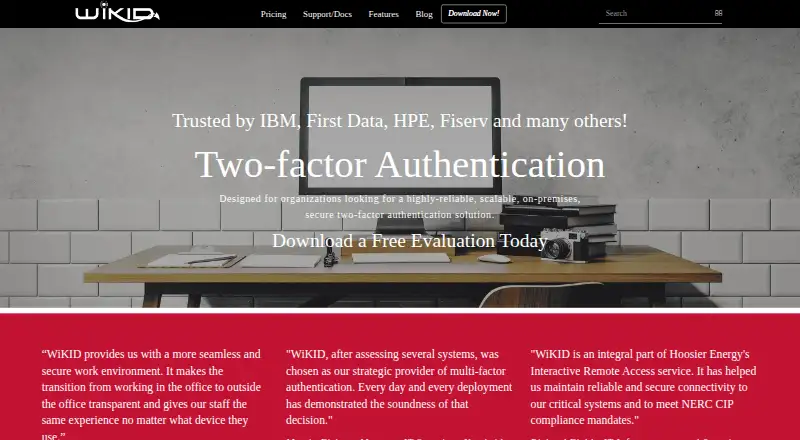
What WiKID is
WiKID provides an on-premises two-factor authentication solution for organizations. Its supported factors are a PIN and a WiKID software token or device. The maker lists RADIUS, LDAP, TACACS+, SAML, and native Active Directory, as well as API and network clients, as integration methods. Compatible tools named by the maker include Cisco, Checkpoint, Fortinet, pfSense, and enterprise VPN solutions. Security features listed include self-hosting, asymmetric keys generated on the device, a hardened VM appliance, RSA 4096-bit encryption keys, and customizable security parameters. The server is available as Linux packages, an ISO for virtual appliances or bare metal, and a VirtualBox image. Listed Linux packages cover RedHat, CentOS, Fedora, and Ubuntu; the recommended 64-bit ISO is based on Rocky 9. Token clients are listed for Windows, Mac, Linux, Android, and iOS, and API packages are available for Python, Ruby, Java, C#, and PHP. Pricing is paid annually upfront.
Good
- Supports RADIUS, LDAP, TACACS+, SAML, and Active Directory.
- Self-hosted deployment with a hardened VM appliance.
- Software token clients span desktop and mobile platforms.
- Free enterprise version supports up to five users.
- API packages cover five programming languages.
Watch out
- Free plan is limited to five users.
- Pricing is based on annual upfront payments.
- Self-hosted deployment requires an on-premises setup.
Who it suits
WiKID suits organizations seeking a self-hosted authentication system with support for directory, network, and application integrations. It may also suit teams choosing among Windows, macOS, Linux, Android, and iOS token clients.
Verdict
WiKID offers an on-premises authentication model with several integration methods and token platforms. Compare the five-user free limit and annual paid terms with your organization’s deployment needs.
Plans and prices
From WiKID's own pricing page, checked 9 Oct 2026.
| Plan | Price | What it gives you |
|---|---|---|
| WiKID Strong Authentication Server | Free | Up to 5 users · Enterprise version |
| WiKID Strong Authentication Server | $240 a year | 10 users · Subsequent licensing starts at this price · Annual upfront payment; $240 per year for 10 users for one year |
The facts
Each one read from WiKID's own pages, with the date it was checked.
What it does
- API
- WiKID offers API packages for Python, Ruby, Java, C#, and PHP to add two-factor authentication to custom applications.checked 9 Oct 2026
- Discounts
- Educational and nonprofit institutions receive a stated 25% discount for 25 seats or more.checked 9 Oct 2026
- Integrations
- The maker lists Cisco, Checkpoint, Fortinet, pfSense, and enterprise VPN solutions as compatible tools.checked 9 Oct 2026
- Pricing terms
- Pricing is based on annual upfront payments, and the maker states that a 25% discount is available for a three-year license agreement.checked 9 Oct 2026
- Product
- WiKID provides an on-premises two-factor authentication solution for organizations.checked 9 Oct 2026
- Protocols
- WiKID supports RADIUS, LDAP, TACACS+, SAML, and native Active Directory.checked 9 Oct 2026
- Security
- The maker lists self-hosting, asymmetric keys generated on the device, a hardened VM appliance, RSA 4096-bit encryption keys, and customizable security parameters.checked 9 Oct 2026
- Support
- The maker links to support forums and provides documentation and installation instructions.checked 9 Oct 2026
- Use case
- The maker describes the system as designed for organizations seeking a scalable on-premises authentication solution.checked 9 Oct 2026
The company
- Company
- WiKID Systems says it was founded in 2001 and is based in Atlanta, Georgia.checked 9 Oct 2026
Where it runs
- Server Linux support
- The download page lists Linux packages for RedHat, CentOS, Fedora, and Ubuntu, and says the recommended 64-bit ISO is based on Rocky 9.checked 9 Oct 2026
- Server platforms
- The server is offered as Linux packages, an ISO for virtual appliances or bare metal, and a VirtualBox image.checked 9 Oct 2026
- Token platforms
- The maker lists software token clients for Windows, Mac, Linux, Android, and iOS.checked 9 Oct 2026
The full review of WiKID
WiKID is an on-premises two-factor authentication server for organizations that want to connect authentication to existing network and directory systems. It suits teams able to run their own server; its broad integration options are the main draw, while self-hosting and annual upfront billing narrow its appeal.
Overview
WiKID pairs a self-hosted server with software token clients and supports a PIN alongside a WiKID token or device. Connections can use RADIUS, LDAP, TACACS+, SAML, native Active Directory, or API and network clients. This gives organizations several ways to fit two-factor authentication into existing infrastructure, but operating the server remains the organization’s responsibility.
Its security approach includes asymmetric keys generated on the device, RSA 4096-bit encryption keys, a hardened virtual-machine appliance, and customizable security parameters. Self-hosting gives organizations control over deployment, but it is a practical advantage only for teams equipped to manage their own authentication environment.
Key features
Protocols and integrations
Alongside its directory and network protocols, WiKID supports integrations with Cisco, Checkpoint, Fortinet, pfSense, and enterprise VPN solutions. That breadth is useful where authentication must work across different network systems. Organizations building custom applications can use API packages for Python, Ruby, Java, C#, and PHP, rather than being limited to the named integrations.
Server and token options
The server is offered as Linux packages, an ISO for virtual appliances or bare metal, and a VirtualBox image. Linux packages are available for RedHat, CentOS, Fedora, and Ubuntu; the recommended 64-bit ISO is based on Rocky 9. Software token clients are available for Windows, Mac, Linux, Android, and iOS. These choices suit organizations with varied deployment environments, although they also place setup and ongoing server operation on the organization.
Pricing
WiKID uses a freemium model. The WiKID Strong Authentication Server free plan costs nothing and supports up to five users, while retaining the enterprise version. That cap makes it a useful starting point for a small team or an initial deployment, but it is not a free path for a larger organization.
Paid plans start at $24/user/yr. Payments are annual and upfront, so the price structure is less suitable for teams that need monthly billing. A three-year license agreement receives a stated 25% discount. Educational and nonprofit institutions receive a 25% discount for 25 seats or more. A 30-day trial gives prospective users a limited period to assess fit before committing.
Platforms
WiKID covers Android, iOS, Linux, macOS, Windows, web, API, and self-hosted deployments. The mix reflects a server-centered product with token clients for desktop and mobile platforms, rather than a hosted authentication service.
Who it's for
WiKID is a strong candidate for organizations that want on-premises control, need to connect two-factor authentication to existing directory or network systems, and can operate the server themselves. Its multiple protocols and API packages also make it relevant to teams integrating authentication with custom applications.
It is a weaker fit for small groups that need more than five users without a paid license, or for organizations that prefer a managed service or monthly payments. The operational demands of self-hosting matter as much as the protocol coverage when choosing it.
Pros and cons
- Pros: Supports RADIUS, LDAP, TACACS+, SAML, native Active Directory, and API or network clients, giving organizations several integration routes.
- Pros: Server formats include Linux packages, an ISO, and a VirtualBox image, with software tokens spanning desktop and mobile platforms.
- Pros: The free enterprise version covers up to five users, and eligible educational and nonprofit institutions can receive a 25% discount for 25 seats or more.
- Cons: The free plan’s five-user ceiling limits its use for larger teams.
- Cons: Paid pricing is annual and upfront, which rules out monthly billing flexibility.
- Cons: Self-hosting requires the organization to provide and operate the authentication server.
Alternatives
Compare multi-factor authentication software if you want to weigh WiKID against a broader category of options.
Protectimus MFA is worth comparing if you want a paid option with a free plan and trial; its listed Custom plan is $2 a month billed per user for an individual, and its Starter plan is $33 a month. LoginTC has a free Cloud Starter plan for up to three users with VPN and firewall protection, making it a comparison point for teams whose needs fit that smaller free tier.
OpenOTP Authentication Server offers a free 25-user plan with limits including 10 SpanKey hosts, one server, and no high availability, which may suit an organization that can work within those caps. LinOTP is a free option developed and maintained by netgo software GmbH. miniOrange Multi-Factor Authentication offers a free plan and a paid Essential plan, and is another option to compare.
Spriv Adaptive MFA has a free Startup plan for up to two users and two servers, with SMS usage billed at carrier cost; that tier may be a better starting point for a very small deployment. Duo Mobile offers a free plan for 10 users and a paid Essentials plan at $3 a month. Entrust Identity App is free to download, but activation requires an organization using Identity Enterprise.
Verdict
Choose WiKID if your organization needs on-premises two-factor authentication, values broad protocol and API integration, and has the capacity to run its own server. The five-user free enterprise version is a useful small-scale entry point, but organizations that need a managed service, monthly billing, or more users without paying should look elsewhere.
Alternatives to WiKID
- 1

Duo Mobile
Free planAndroidiOS7.7From $3 a month - 2
HYPR Authenticate
AndroidiOSWebAPI7.5From $3 a month - 3

LoginTC
Free planAndroidiOSWebAPI7.5From $36 a year - 4

IBM Verify
AndroidiOSWebAPI7.3From $15,899.29 a year - 5
OpenOTP Authentication Server
Free planAndroidiOSLinuxmacOS7.3Free plan - 6

Protectimus MFA
Free planAndroidiOSWebAPI7.3From $2 a month