miniOrange Multi-Factor Authentication
miniOrange Multi-Factor Authentication requires users to verify their identity with two or more factors before accessing an account or system.
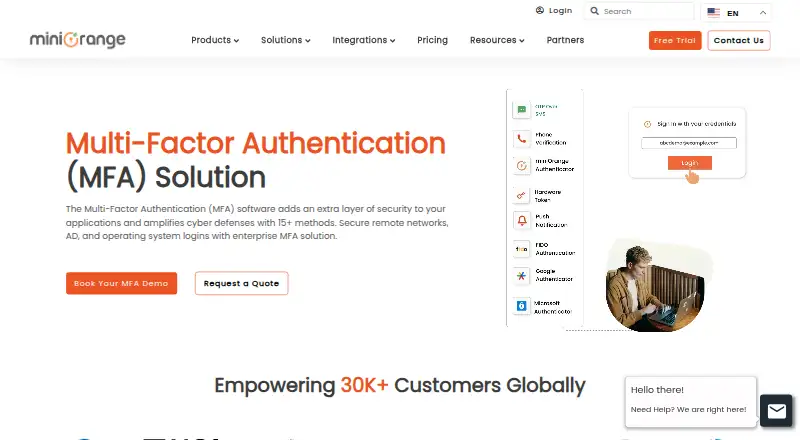
What miniOrange Multi-Factor Authentication is
miniOrange Multi-Factor Authentication requires users to verify their identity with two or more factors before accessing an account or system. It adds MFA to Windows login, RDP, RD Web, Linux SSH, Mac, VPNs, web apps, and legacy applications. Adaptive policies can use IP address, device, location, and time to allow access, require MFA, or deny access. Passwordless options include biometrics, push notifications, and authenticator apps, while security questions and email OTPs can serve as fallbacks when a primary method is unavailable. Users can self-enroll in administrator-approved methods at first login. Reports, audit logs, and an Endpoint Dashboard cover MFA activity, agent health, deployment status, and troubleshooting. Deployment is available in cloud, on-premise, and hybrid environments. Plans include a free option, Essential at $2 per user per month, and Premium at $3 per user per month. A 30-day trial includes all features without restrictions and requires no credit card.
Good
- Adaptive policies use IP, device, location, and time
- Passwordless options include biometrics and push notifications
- Covers Windows, Linux, Mac, VPNs, and web apps
- 30-day trial includes all features without a credit card
Watch out
- Essential costs $2 per user per month
- Some enterprise plans require a personalized quote
Who it suits
It suits organizations adding MFA across endpoints, VPNs, web apps, or legacy applications. Its adaptive policies and reporting also serve administrators managing access rules and deployments.
Verdict
miniOrange covers multiple access points and supports both passwordless sign-in and fallback methods. The no-card trial allows a full-feature period, while paid plans start at $2 per user per month.
Plans and prices
From miniOrange Multi-Factor Authentication's own pricing page, checked 1 Oct 2026.
| Plan | Price | What it gives you |
|---|---|---|
| Free | Free | For individuals just getting started with miniOrange · Starting at $0 per month |
| Essential | $2 a month | Unlimited SAML, OAuth SSO connections · MFA for VPN and VDI · Desktop MFA (Windows, Linux, Mac) · Basic conditional access · $2 /user/month |
| Premium | $3 a month | Everything in Essential · Passwordless MFA (FIDO2, WebAuthn) · Advanced adaptive authentication · AAA/TACACS+ · SCIM provisioning · $3 /user/month |
| Basic | $49 a month | Up to 500 users · External identity integration · Multiple social connections · Starting at $49 per month |
| Professional | $99 a month | Up to 500 users · Basic MFA · Limited identity-source and external-database connections · Starting at $99 per month |
| Enterprise IAM Suite | Priced on request | Everything in Premium · Legacy and thick-client integrations · Access approval workflows · Role-based application access · SIEM integrations · Contact us for a personalized quote |
| Enterprise | Priced on request | For government and healthcare projects · Advanced security · Enterprise integration · Custom plan pricing · Contact us |
The facts
Each one read from miniOrange Multi-Factor Authentication's own pages, with the date it was checked.
What it does
- Adaptive policies
- Adaptive MFA can use IP, device, location, and time to trigger Allow, Challenge MFA, or Deny actions.checked 1 Oct 2026
- Deployment
- The solution can be deployed in cloud, on-premise, and hybrid environments.checked 1 Oct 2026
- Endpoint coverage
- The product adds MFA to Windows login, RDP, RD Web, Linux SSH, and Mac, including domain-joined and standalone machines.checked 1 Oct 2026
- Enrollment
- Users can self-enroll with administrator-approved MFA methods during their first login.checked 1 Oct 2026
- Fallback
- Backup authentication options include security questions and email OTPs when the primary method is unavailable.checked 1 Oct 2026
- Passwordless
- Passwordless MFA supports biometrics, push notifications, and authenticator apps.checked 1 Oct 2026
- Purpose
- The MFA solution requires users to verify identity with two or more factors before accessing an account or system.checked 1 Oct 2026
- Reporting
- It provides detailed reports, audit logs, and an Endpoint Dashboard for MFA activity, agent health, deployment status, and troubleshooting.checked 1 Oct 2026
- Security
- miniOrange encrypts confidential database data with symmetric 256-bit AES encryption and uses AWS infrastructure for its Identity-as-a-Service platform.checked 1 Oct 2026
- Support
- The company states it provides 24/7 support for its secure identity solutions.checked 1 Oct 2026
- VPN integrations
- VPN MFA supports Fortinet, Cisco, Palo Alto, SonicWall, OpenVPN, Citrix, and all RADIUS protocols including CHAP and PAP.checked 1 Oct 2026
The company
- Founded
- 2012checked 23 Sep 2026
Money
- Trial
- miniOrange offers a 30-day free trial, with no credit card required and all features available without restrictions during the free one-month trial.checked 1 Oct 2026
Where it runs
- Web and legacy apps
- Web-app MFA supports PHP, .NET, React, and Node.js with SAML, RADIUS, OpenID, and JWT; legacy integrations include Oracle EBS, SAP, QlikView, PeopleSoft, OWA, and Siebel CRM.checked 1 Oct 2026
The full review of miniOrange Multi-Factor Authentication
miniOrange Multi-Factor Authentication adds identity checks across endpoints, VPNs, web applications, and legacy systems. It suits organizations that need one MFA approach across mixed environments; its breadth is compelling, though the richer access controls sit above the entry plan.
Overview
The service requires two or more factors before granting access, and can be deployed in cloud, on-premise, or hybrid environments. Its coverage ranges from Windows, Linux, and Mac sign-in to VPNs and web and legacy applications, making it a stronger fit for organizational access management than for someone seeking only a phone-based authenticator.
Passwordless sign-in supports biometrics, push notifications, and authenticator apps. Adaptive policies can use IP, device, location, and time to allow access, require an MFA challenge, or deny it. Self-enrollment and backup security questions or email OTPs help users get started and retain a fallback when their primary method is unavailable.
Key features
- Broad access coverage: MFA can be added to Windows login, RDP, RD Web, Linux SSH, and Mac, including domain-joined and standalone machines. VPN support covers Fortinet, Cisco, Palo Alto, SonicWall, OpenVPN, Citrix, and RADIUS protocols including CHAP and PAP. This makes the product relevant where access spans both remote connections and local endpoints.
- Application integration: Web applications built with PHP, .NET, React, and Node.js can use SAML, RADIUS, OpenID, or JWT. Legacy integrations include Oracle EBS, SAP, QlikView, PeopleSoft, OWA, and Siebel CRM. Pre-built connectors and no-code integrations offer additional routes; the breadth is useful, but organizations should match integrations to their actual systems before choosing a plan.
- Visibility and policy: Detailed reports, audit logs, and an Endpoint Dashboard cover MFA activity, agent health, deployment status, and troubleshooting. Adaptive policies can act on IP, device, location, and time, giving administrators more control than basic MFA alone.
- Security and support: Confidential database data is encrypted using symmetric 256-bit AES encryption, and the Identity-as-a-Service platform uses AWS infrastructure. The company states that it provides 24/7 support for its secure identity solutions.
Pricing
The 30-day free trial requires no credit card and includes all features without restrictions during the trial. That gives teams time to assess the product’s broad integration scope before committing. The free plan is described as being for individuals just getting started, but no seat cap or feature allowance is stated.
- Free: free.
- Essential: $2 /user/month. Includes unlimited SAML and OAuth SSO connections, MFA for VPN and VDI, desktop MFA for Windows, Linux, and Mac, and basic conditional access. This is the entry paid tier for organizations focused on core endpoint and VPN coverage.
- Premium: $3 /user/month. Adds passwordless MFA with FIDO2 and WebAuthn, advanced adaptive authentication, AAA/TACACS+, and SCIM provisioning to Essential. The extra dollar per user is relevant for teams that need those controls; buyers who only need Essential’s listed capabilities may not need the upgrade.
- Basic: Starting at $49 per month, up to 500 users. Includes external identity integration and multiple social connections. It is a separate plan from the per-user Essential and Premium tiers, so buyers should compare its stated scope with their deployment needs.
- Professional: Starting at $99 per month, up to 500 users. Includes basic MFA and limited identity-source and external-database connections. The user ceiling and limited connections make it a more bounded option than the MFA-focused per-user tiers.
- Enterprise IAM Suite: Custom pricing. Includes everything in Premium, plus legacy and thick-client integrations, access approval workflows, role-based application access, and SIEM integrations.
- Enterprise: Custom plan pricing. Intended for government and healthcare projects, with advanced security and enterprise integration.
Platforms
miniOrange supports Linux, macOS, Windows, web, and self-hosted environments. Its deployment options span cloud, on-premise, and hybrid setups, while integrations reach endpoints, VPNs, web applications, and legacy systems.
Who it's for
Organizations managing access across a mix of desktop operating systems, VPNs, and applications are the clearest fit, especially those that need adaptive policies, passwordless sign-in, or detailed endpoint reporting. The Essential tier covers core VPN and desktop MFA; Premium is the more suitable choice when advanced adaptive authentication, passwordless methods, or SCIM provisioning are required. Individuals can start with the free plan, but its included capabilities are not defined here.
Pros and cons
- Pro: Endpoint, VPN, web, and legacy application coverage can reduce the need to assemble separate MFA approaches for different access points.
- Pro: A no-card, full-feature 30-day trial lets teams assess integrations and policies before paying.
- Pro: The Endpoint Dashboard, audit logs, and adaptive policies support administration beyond simply issuing second-factor prompts.
- Con: Several advanced capabilities, including passwordless MFA and advanced adaptive authentication, are reserved for Premium rather than the $2 /user/month Essential tier.
- Con: Enterprise IAM Suite and Enterprise require custom pricing, so their costs cannot be compared from a published rate.
Alternatives
For a different MFA fit, consider Multi-Factor Authentication Software options as well as these products:
- LoginTC is worth considering when a free cloud plan capped at three users is enough; its stated Starter plan includes VPN and firewall protection.
- LinOTP is an option for readers seeking free, open-source MFA software under AGPLv3 and GPLv2.
- Duo Mobile may suit small teams looking for a free plan for 10 users or a $3 monthly tier that includes phishing-resistant MFA and passwordless authentication.
- HYPR Authenticate is another paid option, with a $3 monthly Identity Assurance Access plan that includes web access and phishing-resistant onboarding.
- Deepnet DualShield MFA Platform is an alternative for organizations considering an on-premises or private-cloud MFA platform with quote-based pricing.
- Imprivata Enterprise Access Management uses modular licensing, with Core Access required for all deployments and add-on modules varying by workflow.
- Rublon Authenticator may fit a single user seeking a free plan, while its Business plan requires a minimum of 15 licenses.
- Secret Double Octopus offers Starter and Enterprise plans for passwordless MFA, with pricing not stated.
Verdict
Choose miniOrange if your organization needs MFA across endpoints, VPNs, and a varied application estate, with adaptive policies and passwordless options available as needs grow. Its 30-day unrestricted trial is a practical way to validate that scope. Look elsewhere if you need clearly defined free-plan limits or a published enterprise price, or if your needs are confined to a small, straightforward MFA deployment.
Alternatives to miniOrange Multi-Factor Authentication
- 1

Duo Mobile
Free planAndroidiOS7.7From $3 a month - 2
HYPR Authenticate
AndroidiOSWebAPI7.5From $3 a month - 3

LoginTC
Free planAndroidiOSWebAPI7.5From $36 a year - 4

IBM Verify
AndroidiOSWebAPI7.3From $15,899.29 a year - 5
OpenOTP Authentication Server
Free planAndroidiOSLinuxmacOS7.3Free plan - 6

Protectimus MFA
Free planAndroidiOSWebAPI7.3From $2 a month