Whole Tale
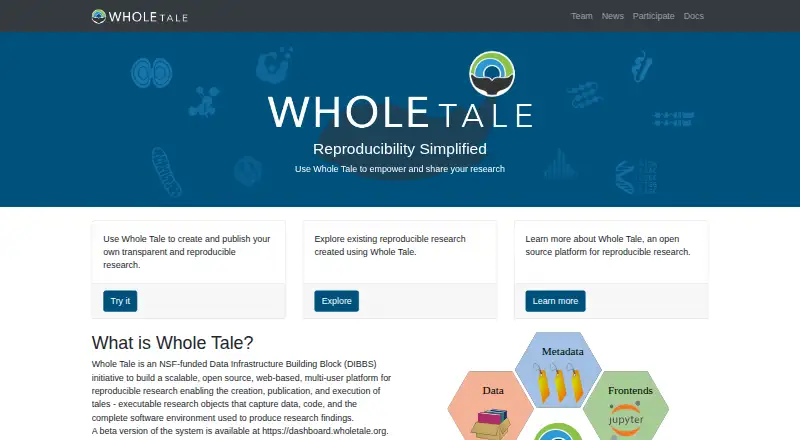
The facts below are what the maker publishes about Whole Tale, checked and dated. Our editors have not written about it yet.
The facts
Each one read from Whole Tale's own pages, with the date it was checked.
What it does
- Collaboration
- Users can share Tales with other Whole Tale users using read or edit permissions.checked 12 Oct 2026
- Compute limit
- The STATA tutorial states that each Tale instance is limited by default to 2 CPUs and 8GB RAM.checked 12 Oct 2026
- Data integrations
- The documentation lists Zenodo, Dataverse, Globus, DataONE, and DERIVA as supported external data sources, with DERIVA support described as being tested.checked 12 Oct 2026
- Deployment
- The project describes the platform as a building block intended to be deployable in a variety of environments.checked 12 Oct 2026
- Eligibility
- The hosted operational version on Jetstream2 is for academic use and limited to fair and reasonable use.checked 12 Oct 2026
- Environment customization
- Users can customize environments with packages using repo2docker-compatible configuration files.checked 12 Oct 2026
- Environments
- Supported interactive environments include JupyterLab, RStudio, MATLAB, and STATA.checked 12 Oct 2026
- Full-stack runtime
- Nochecked 22 Sep 2026
- Interactive environments
- Supported environments include JupyterLab, RStudio, MATLAB, and STATA.checked 12 Oct 2026
- Licensed software
- The terms say MATLAB use is academic-only, is not guaranteed in perpetuity, and does not permit proprietary, closed, or for-profit use.checked 12 Oct 2026
- Purpose
- Whole Tale is an open-source, web-based platform for creating, publishing, and running reproducible research objects called Tales.checked 12 Oct 2026
- Real-time collaboration
- Nochecked 22 Sep 2026
- Recorded runs
- Recorded runs execute a specified workflow in an isolated container and capture an immutable copy of outputs plus runtime information such as memory and CPU usage.checked 12 Oct 2026
- Repository publishing
- The platform supports publishing Tales to external research repositories and assigning persistent identifiers through the repository.checked 12 Oct 2026
- Repository workflows
- Whole Tale supports repository data registration, Analyze in Whole Tale launches, and publishing Tale packages to repositories.checked 12 Oct 2026
- Reproducibility
- The platform captures code, data, workflow information, and the computational environment to support review and reproduction of research results.checked 12 Oct 2026
- Reproduction
- Users can interactively create and edit Tales, then rerun them to reproduce and verify results.checked 12 Oct 2026
- Security
- The documentation says Whole Tale uses Globus Auth for authentication and access to data on users’ behalf through the Globus network.checked 12 Oct 2026
- Security and access
- The architecture documentation says identity and access management use OAuth 2.0/OpenID Connect and that the production service uses Globus Auth for federated login.checked 12 Oct 2026
- Sharing controls
- access_controlchecked 22 Sep 2026
- Sign-in
- Users can browse public Tales without signing in; account sign-in supports institutional credentials, ORCID, or Google through Globus Auth.checked 12 Oct 2026
- Support
- The project invites users to join its Slack workspace or email list to ask questions and participate in community discussion.checked 12 Oct 2026
- Support and community
- The project directs users to its Slack workspace and email list for questions and community discussion.checked 12 Oct 2026
The company
- Founded
- 2016checked 19 Oct 2026
Alternatives to Whole Tale
- 1

Replit
Free planAndroidiOSWebLinux9.2From $18 a month - 2

StackBlitz
Free planAndroidiOSWebAPI8.9Free plan - 3

Playcode
Free planAndroidiOSWebAPI8.9From $25 a month - 4
Paperspace Gradient
Free planOpen sourceWebAPIExtensionLinux8.7From $8 a month - 5
GitHub Codespaces
Free planAndroidiOSWebAPI8.6Free plan - 6

JDoodle
Free planAndroidiOSWebAPI8.6From $4 a month