
VitalSentinel Schema Validator
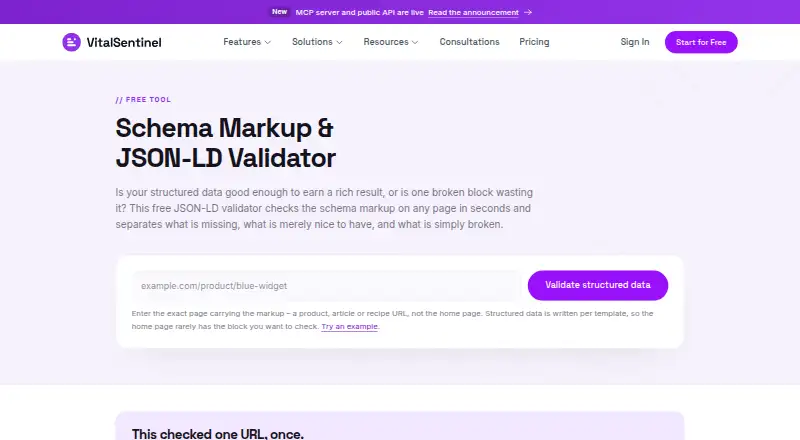
VitalSentinel Schema Validator checks structured data on one page URL and sorts findings into missing, recommended, and broken information.
What VitalSentinel Schema Validator is
VitalSentinel Schema Validator checks structured data on one page URL and sorts findings into missing, recommended, and broken information. It examines JSON-LD blocks separately, including nested entities and entities inside an @graph. For broken blocks, it points to the line and column and identifies common syntax problems such as trailing commas, curly quotes, and HTML entities. For Article, Product, FAQPage, Recipe, Event, BreadcrumbList, LocalBusiness, and Organization, it separates Google-required properties from recommended ones; other schema types are listed but not graded. The validator also flags non-absolute image URLs, dates outside ISO format, and prices containing currency symbols. The free checker reads server-sent HTML, so it cannot see JSON-LD added by JavaScript. It reports microdata and RDFa when present but does not grade them. Valid markup alone does not guarantee a Google rich result. REST API and MCP access are available on every plan, with monthly credits depending on the plan. The free tool is limited by request quotas and a per-site limit.
Good
- Checks nested JSON-LD blocks separately.
- Reports broken-block line and column details.
- Distinguishes required and recommended properties for eight types.
- REST API and MCP are available on every plan.
Watch out
- Free checker reads only server-sent HTML.
- Microdata and RDFa are reported but not graded.
- Free requests are subject to rate and per-site limits.
- A valid result does not ensure a Google rich result.
Who it suits
It suits website owners, developers, SEO professionals, and agencies who need to inspect JSON-LD on a page. The API and MCP options may also suit users integrating validation into their workflows.
Verdict
VitalSentinel Schema Validator offers detailed JSON-LD checks and identifies syntax and value issues. Its server-rendered HTML scope and schema grading limits matter when checking pages that rely on JavaScript or other markup formats.
Plans and prices
From VitalSentinel Schema Validator's own pricing page, checked 7 Oct 2026.
| Plan | Price | What it gives you |
|---|---|---|
| Free plan | Free | Up to 1 domain · 3 Synthetic URLs · 1 monitoring location · 25K RUM page views/mo · 100K Web Analytics events/mo · 5 CrUX URLs · 500 API credits/mo · Monthly; no credit card required |
| Starter | $39 a month | Up to 3 domains · 10 Synthetic URLs · 1 monitoring location · 100K RUM page views/mo · 1M Web Analytics events/mo · 10 CrUX URLs · 2,500 API credits/mo · Monthly |
| Lite | $129 a month | Up to 5 domains · 50 Synthetic URLs · 2 monitoring locations · 250K RUM page views/mo · 5M Web Analytics events/mo · 100 CrUX URLs · 25,000 API credits/mo · Monthly |
| Standard | $249 a month | Up to 25 domains · 100 Synthetic URLs · 3 monitoring locations · 2M RUM page views/mo · 25M Web Analytics events/mo · 1,000 CrUX URLs · 100,000 API credits/mo · Monthly |
| Advanced | $449 a month | Up to 50 domains · 250 Synthetic URLs · 5 monitoring locations · 5M RUM page views/mo · 50M Web Analytics events/mo · 5,000 CrUX URLs · 250,000 API credits/mo · Monthly |
The facts
Each one read from VitalSentinel Schema Validator's own pages, with the date it was checked.
What it does
- API and MCP
- The REST API and MCP server are available on every plan, including Free, with plan-dependent monthly API credits.checked 7 Oct 2026
- Audience
- The maker presents the wider platform for website owners, web developers, SEO professionals, and agencies.checked 7 Oct 2026
- Error details
- For a broken block, it identifies the line and column and names common causes such as trailing commas, curly quotes, and HTML entities.checked 7 Oct 2026
- Fair use
- The free tool is limited to 5 requests per minute, 25 per hour, and 100 per day per IP, plus a per-site limit.checked 7 Oct 2026
- Google properties
- It distinguishes properties Google requires from those it recommends using Google's tables for each schema type.checked 7 Oct 2026
- Input limits
- The free tool checks one URL once and reads server-sent HTML, so JSON-LD added by JavaScript is not visible to it.checked 7 Oct 2026
- Integrations
- VitalSentinel lists Google Analytics 4 and Google Search Console as integrations, each with a stated two-minute setup time.checked 7 Oct 2026
- JSON-LD blocks
- It checks each JSON-LD block separately, including nested entities and entities inside an @graph.checked 7 Oct 2026
- Markup formats
- It does not grade microdata or RDFa, though it reports them when present.checked 7 Oct 2026
- Privacy and compliance
- VitalSentinel's privacy policy says it is committed to GDPR and UK GDPR compliance, encrypts Google OAuth tokens, and uses encryption for data in transit and at rest.checked 7 Oct 2026
- Purpose
- The Schema Markup & JSON-LD Validator checks structured data on one page URL and separates missing, recommended, and broken information.checked 7 Oct 2026
- Rich results
- The validator says valid markup does not guarantee a Google rich result and recommends using Google's Rich Results Test as well for rendered pages and eligibility checks.checked 7 Oct 2026
- Support
- The pricing page says custom solutions for large organizations can include dedicated support and SLAs.checked 7 Oct 2026
- Supported types
- Property checks grade Article, Product, FAQPage, Recipe, Event, BreadcrumbList, LocalBusiness, and Organization; other types are listed but not graded.checked 7 Oct 2026
- Value checks
- It flags non-absolute image URLs, dates not in ISO format, and prices containing a currency symbol.checked 7 Oct 2026
The company
- Founded
- 2024checked 28 Sep 2026
- Headquarters
- Bratislava, Slovakiachecked 28 Sep 2026
The full review of VitalSentinel Schema Validator
VitalSentinel Schema Validator is a JSON-LD checker for people who need page-level syntax and Google property guidance. It is a sensible fit for developers and SEO professionals working with markup delivered in server-rendered HTML; its narrow input and grading scope make it a poor sole check for JavaScript-rendered pages or other markup formats.
Overview
The validator examines one page URL and separates missing, recommended, and broken information. It checks JSON-LD blocks individually, including nested entities and those inside an @graph. When a block is broken, line-and-column pointers and examples of common causes—such as trailing commas, curly quotes, or HTML entities—give developers a useful starting point for repairs.
Its strongest distinction is between Google-required and Google-recommended properties, based on Google's tables for each schema type. That makes prioritizing fixes more practical than treating every omission alike. The trade-off is coverage: only Article, Product, FAQPage, Recipe, Event, BreadcrumbList, LocalBusiness, and Organization receive graded property checks. Other types may be identified, but detection is not a grade.
Key features
Syntax and value checks
Beyond malformed JSON, the validator flags non-absolute image URLs, dates outside ISO format, and prices that contain a currency symbol. Those targeted checks can catch formatting errors that would otherwise survive a syntax review. The output is focused on repairable issues rather than a broad assessment of every possible schema type.
Input and eligibility limits
The free checker reads server-sent HTML, so JSON-LD injected by JavaScript is outside its view. It does not grade microdata or RDFa, though it reports those formats when present. A valid result also does not guarantee a Google rich result; VitalSentinel recommends Google's Rich Results Test for rendered-page and eligibility checks. For JavaScript-heavy pages or a final eligibility assessment, use that complementary tool rather than relying on this validator alone.
The free tool allows one URL check once and is subject to fair-use limits of 5 requests per minute, 25 per hour, and 100 per day per IP, plus a per-site limit. That is suitable for a focused spot check, not repeated free auditing across a site.
Integrations and access
Google Analytics 4 and Google Search Console are listed as integrations, each with a stated two-minute setup. The REST API and MCP server are included on every plan, including Free, with monthly API credits varying by plan. VitalSentinel says its privacy policy commits to GDPR and UK GDPR compliance, encrypts Google OAuth tokens, and encrypts data in transit and at rest. Large-organization custom solutions can include dedicated support and SLAs.
Pricing
VitalSentinel uses a freemium model, with paid plans starting at $39/mo. The plans cover a wider platform than schema validation alone, combining domain, monitoring, analytics, CrUX, and API allowances. Choose by those broader limits as well as API credits; the schema checker itself has a one-URL free allowance.
| Plan | Price | Included limits |
|---|---|---|
| Free plan | free, billed Monthly | Up to 1 domain, 3 Synthetic URLs, 1 monitoring location, 25K RUM page views/mo, 100K Web Analytics events/mo, 5 CrUX URLs, and 500 API credits/mo; no credit card required. |
| Starter | $39 a month, billed Monthly | Up to 3 domains, 10 Synthetic URLs, 1 monitoring location, 100K RUM page views/mo, 1M Web Analytics events/mo, 10 CrUX URLs, and 2,500 API credits/mo. |
| Lite | $129 a month, billed Monthly | Up to 5 domains, 50 Synthetic URLs, 2 monitoring locations, 250K RUM page views/mo, 5M Web Analytics events/mo, 100 CrUX URLs, and 25,000 API credits/mo. |
| Standard | $249 a month, billed Monthly | Up to 25 domains, 100 Synthetic URLs, 3 monitoring locations, 2M RUM page views/mo, 25M Web Analytics events/mo, 1,000 CrUX URLs, and 100,000 API credits/mo. |
| Advanced | $449 a month, billed Monthly | Up to 50 domains, 250 Synthetic URLs, 5 monitoring locations, 5M RUM page views/mo, 50M Web Analytics events/mo, 5,000 CrUX URLs, and 250,000 API credits/mo. |
Free is the right starting point for occasional checks and limited API use. Starter raises the domain allowance to three and API credits to 2,500; Lite, Standard, and Advanced progressively expand the platform quotas and credits for larger operations. There is no seat allowance in these plan details, so teams should not infer one.
Platforms
VitalSentinel Schema Validator is available on web and through an API. The MCP server is also available on every plan, including Free, with monthly API credits tied to the plan.
Who it's for
This is a good fit for web developers and SEO professionals checking server-rendered JSON-LD for common Google-supported schema types. Website owners and agencies may also find it useful when they need a quick, focused diagnosis or want API access alongside the wider VitalSentinel platform. It is not the right standalone choice for auditing JavaScript-added markup, grading microdata or RDFa, or evaluating rich-result eligibility.
Pros and cons
Pros
- Line-and-column error locations and named syntax causes make broken JSON-LD more actionable to fix.
- Required-versus-recommended Google properties help prioritize corrections across eight graded schema types.
- Specific checks for image URLs, date format, and prices catch value issues as well as syntax problems.
- REST API and MCP access are available even on Free, with 500 monthly API credits on that plan.
Cons
- The free checker reads server-sent HTML and checks one URL once, limiting its usefulness for JavaScript-rendered pages and ongoing audits.
- Only eight types receive property grades; reported support for other types does not provide equivalent grading.
- Microdata and RDFa are reported but not graded, and a valid result does not establish rich-result eligibility.
- Paid plans bundle broad platform quotas, so buyers seeking only recurring schema checks may not need the other allowances.
Alternatives
- Schema Markup Tools is a broader directory for comparing schema markup options.
- Baseline Labs Schema Generator is a better fit when the job is generating schema: its free tool supports rolling schema for one domain and five pages, and single-page generation needs no account or card; Standard is €79 per mo.
- JSON Schema App SaaS Schema suits users wanting basic structured-data setup, a checker, and up to 50 URLs on its free plan, though its schema types are limited to Product, Service, and Articles.
- EasySchema is a free web-based option for schema markup generation and SEO tools.
- JSON-LD Generator is a free web alternative with 17 schema types and no signup stated.
- Rolling Schema is worth considering for rolling-schema pages: its free plan includes one domain, 500 credits per month, and five pages, but no API access.
- Schema.biz is a free web option whose plan includes all tools without premium tiers or feature gates.
- Schema.dev is another free option available on web, as an API, and as an extension.
- SchemaValid is a free, browser-based web checker that requires no account or installation.
Verdict
Choose VitalSentinel Schema Validator if you need precise JSON-LD syntax and Google-property feedback on server-rendered pages, especially when API access is useful alongside a broader site-monitoring platform. Its clearest advantage is actionable, type-specific guidance; look elsewhere when your pages depend on JavaScript-rendered markup, your schema is outside its graded types, or you need a rich-results eligibility check.
Getting started
- Open https://www.vitalsentinel.com/tools/schema-validator.
- Submit a page URL to inspect its server-sent HTML.
- Review missing, recommended and broken JSON-LD findings.
- Check line and column details for broken blocks.
- Choose the Free plan or a paid plan starting at $39 a month.
- Use REST API or MCP access with the plan's monthly API credits.
Limits worth knowing
The free tool checks one URL once, reads server-sent HTML and cannot see JSON-LD added by JavaScript. Free use is limited to 5 requests per minute, 25 per hour and 100 per day per IP, plus a per-site limit; the Free plan includes 500 API credits per month.
Questions
Is there a free plan?
Yes. The Free plan costs nothing, requires no credit card and includes 500 API credits per month.
What do paid plans cost?
Paid plans start with Starter at $39 a month. Lite, Standard and Advanced are also listed at higher monthly prices.
Which platforms are supported?
VitalSentinel Schema Validator is listed for web and API platforms.
Does it validate JSON-LD added by JavaScript?
The free checker reads server-sent HTML, so JSON-LD added by JavaScript is not visible to it.
Does it grade microdata or RDFa?
It reports microdata and RDFa when present but does not grade them.
Are API and MCP integrations available on the free plan?
Yes. REST API and MCP server access are available on every plan, with monthly API credits depending on the plan.
Alternatives to VitalSentinel Schema Validator
- 1

Baseline Labs Schema Generator
Free planWebAPISelf-hosted7.3From €79 a month - 2

Rolling Schema
Free planWebAPI6.7From €79 a month - 3

BlueGrid Schema Validator
Free planWeb6.6Free plan - 4

JSON Schema App SaaS Schema
Free planWeb6.6From $14 a month - 5
EasySchema
Free planWeb6.2Free plan - 6

Google Rich Results Test
Free planWeb6.1Free plan