VARGO COFE WES
VARGO COFE WES is a warehouse execution system that assigns work as capacity becomes available across people, automation, and equipment.
What VARGO COFE WES is
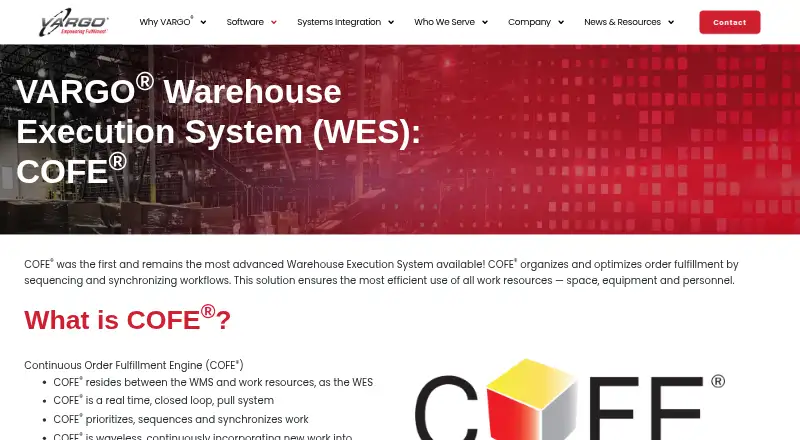
VARGO COFE WES is a warehouse execution system that assigns work as capacity becomes available across people, automation, and equipment. Rather than releasing tasks in fixed waves, it prioritizes, sequences, and synchronizes activity in real time, using order priority, inventory location and volume, and current operating conditions. COFE sits between a warehouse management system and operational resources, and is designed to communicate with existing systems, PLCs, material handling equipment, and automation such as robotic arms, shuttles, and autonomous mobile robots. It can manage put-away, replenishment, picking, routing, induction, sorting, packing, and shipping. Deployment options include on-premises, cloud-hosted, and hybrid edge setups. Browser-based dashboards, reporting, and handheld devices provide operational visibility; routing, capacity rules, and automation logic can be configured for each fulfillment environment. VARGO describes its SaaS offering for smaller retailers and third-party logistics operations, including those processing as few as 2,000 orders a day or 44,000 units a week. SaaS pricing depends on order volume, but no numeric price is listed.
Good
- Releases work as capacity becomes available.
- Supports warehouse processes from put-away through shipping.
- Can interface with PLCs and automation hardware.
- Offers on-premises, cloud-hosted, and hybrid edge deployment.
- Includes role-specific training and floor-level stabilization support.
Watch out
- SaaS price depends on processed order volume.
- No numeric SaaS price is listed.
- Routing and automation logic are configured for each environment.
Who it suits
COFE WES may suit fulfillment operations dealing with congestion, variable labor, underused automation, or wave processes that cannot adjust quickly to demand. The SaaS offering is described for smaller retailers and third-party logistics companies.
Verdict
COFE WES focuses on coordinating warehouse work in response to available capacity, with integrations for systems and automation. Its SaaS price is volume-based, so buyers need to request the applicable pricing.
Plans and prices
From VARGO COFE WES's own pricing page, checked 5 Oct 2026.
| Plan | Price | What it gives you |
|---|---|---|
| COFE® SaaS WES | Priced on request | Designed for smaller operations processing as few as 2,000 orders/day or 44,000 units/week · Pricing based on the number of orders processed; the page gives no price. |
The facts
Each one read from VARGO COFE WES's own pages, with the date it was checked.
What it does
- Architecture
- The vendor describes COFE® as a message-based workflow manager built with a distributed, microservices architecture that can scale to an operation’s volume.checked 4 Oct 2026
- Automation compatibility
- The vendor lists robotic arms, shuttles, and autonomous mobile robots among the automation COFE® can interface with.checked 4 Oct 2026
- Configuration
- The vendor says routing, sequencing, capacity rules, and automation logic are configured around each fulfillment environment.checked 4 Oct 2026
- Customization
- Routing, sequencing, capacity rules, and automation logic can be configured for each fulfillment environment.checked 5 Oct 2026
- Deployment
- COFE® can be deployed on-premises or hosted off-premises using cloud providers such as AWS and Azure.checked 5 Oct 2026
- Execution coverage
- COFE® monitors picking, sortation, packing, and other execution points to identify available capacity.checked 5 Oct 2026
- Hardware support
- The platform lists support for Put to Light, PLCs, and device-management hardware drivers.checked 5 Oct 2026
- Integration
- COFE® is designed to sit between a warehouse management system and operational resources, and the vendor says it interfaces with material handling equipment, PLCs, and hardware automation.checked 4 Oct 2026
- Integrations
- The platform supports real-time message-based communication with PLCs and other systems and is designed to integrate with existing warehouse systems.checked 5 Oct 2026
- Intended customers
- The SaaS offering is described for small to medium retailers and third-party logistics companies, including operations processing as few as 2,000 orders a day or 44,000 units a week.checked 5 Oct 2026
- Intended operations
- The vendor describes COFE® as particularly suited to operations facing congestion, labor variability, underused automation, or wave-based processes that cannot adapt quickly to changing demand.checked 4 Oct 2026
- Notable pricing limit
- The SaaS price is based on processed order volume, but the page does not state a numeric price.checked 5 Oct 2026
- Operational scope
- The vendor says COFE® can manage processes including put-away, replenishment, picking, routing, induction, sorting, packing, and shipping.checked 4 Oct 2026
- Prioritization
- Work is prioritized using order priority, inventory location and volume, and current operating conditions.checked 5 Oct 2026
- Product
- COFE® WES is a real-time, pull-based Warehouse Execution System between the system of record and operational resources.checked 5 Oct 2026
- Purpose
- COFE® is a real-time, pull-based Warehouse Execution System that matches work to available capacity across people, automation, and equipment.checked 4 Oct 2026
- Software updates
- The COFE® platform page says the software follows a date-driven release model with monthly regression testing and updates.checked 4 Oct 2026
- Support and onboarding
- VARGO® says deployments include role-specific training, hands-on testing, and floor-level support through stabilization.checked 5 Oct 2026
- Support and training
- VARGO says its deployment includes role-specific training, hands-on testing, and floor-level support through stabilization.checked 4 Oct 2026
- Updates
- The platform page describes date-driven releases with monthly regression testing and updates.checked 5 Oct 2026
- User access
- The vendor says operational visibility is available through browser-based dashboards and reporting, as well as handheld devices.checked 4 Oct 2026
The company
- Company history
- VARGO says it was founded in 1971 by Julius Vargo.checked 4 Oct 2026
- Founded
- 1971checked 28 Sep 2026
- Headquarters
- Dublin, Ohio, United Stateschecked 28 Sep 2026
The full review of VARGO COFE WES
VARGO COFE WES is a warehouse execution system for coordinating fulfillment work across people, equipment, and automation. It suits retailers and third-party logistics operations whose capacity changes during the shift, particularly when congestion or fixed waves limit throughput. The main reason to consider it is live, capacity-driven execution; the main caution is a deployment-led product with custom pricing.
Overview
COFE operates between a warehouse management system and the resources doing the work. Its pull-based model releases tasks as capacity opens up instead of issuing fixed waves, then keeps priorities and sequencing aligned with current conditions. That makes it a stronger fit for variable labor, mixed automation, and facilities where queues build because work was released too early.
VARGO has developed warehouse technology since 1971 and is headquartered in Dublin, Ohio. COFE can run on premises, in a hosted cloud, or as a hybrid edge deployment, giving operations with infrastructure or latency requirements more control over placement.
Key features
The execution engine dynamically prioritizes, sequences, and synchronizes work using order priority, inventory location and volume, and operating conditions. It monitors points such as picking, sortation, and packing to identify available capacity, while also covering put-away, replenishment, routing, induction, and shipping. Buyers needing one control layer across these stages get broader scope than a tool focused on a single process.
COFE uses real-time, message-based communication and a distributed microservices architecture intended to scale with operational volume. The vendor describes interfaces for PLCs, material-handling equipment, Put to Light, and device-management hardware drivers, as well as robotic arms, shuttles, and autonomous mobile robots. This is useful for sites combining conventional equipment with robotics, but routing, sequencing, capacity rules, and automation logic must be configured around the individual fulfillment environment.
Browser dashboards, reporting, and handheld access provide operational visibility. Automation orchestration, labor workflows, order-release control, and real-time visibility are core capabilities rather than add-ons. Date-driven releases with monthly regression testing provide a stated update cadence.
Pricing
The COFE SaaS WES plan uses custom pricing based on the number of orders processed. No numeric price is published, so budget comparisons require a volume-based quote. The plan is designed for smaller operations processing as few as 2,000 orders per day or 44,000 units per week. That makes it the relevant starting point for small and medium retailers and third-party logistics providers in that range, while buyers wanting a transparent self-serve subscription will find the purchasing process less convenient.
There are no published seat, quota, trial, or renewal terms. The volume basis also means a growing operation should clarify how changes in order throughput affect its quote.
Platforms
COFE WES supports Linux, web access, and self-hosted deployment. Its on-premises, cloud-hosted, and hybrid edge options suit organizations that need to place execution services close to warehouse equipment or retain local control.
Who it's for
COFE is aimed at fulfillment operations dealing with congestion, labor variability, underused automation, or wave processes that cannot react quickly enough to demand. It is especially relevant to retailers and 3PLs processing at least the stated 2,000 daily orders or 44,000 weekly units. It is less compelling for a small warehouse seeking a simple standalone task list or a fixed-wave system with minimal integration work.
Pros and cons
Pros
- Pull-based release ties work to live capacity, reducing the mismatch created by fixed waves.
- Dynamic prioritization can account for order priority, location, volume, and current operating conditions.
- Broad equipment and automation interfaces support PLCs, Put to Light, device drivers, and several robotic categories.
- Coverage from put-away through shipping gives one execution layer across many warehouse processes.
- Role-specific onboarding and stabilization support address the operational change involved in deploying a WES.
Cons
- Pricing is quote-only and tied to processed order volume, making upfront cost comparison difficult.
- Configuration is environment-specific, so implementation is not presented as a plug-in deployment.
- The product is oriented to integrated warehouse operations; simpler facilities may not need its orchestration scope.
Alternatives
KNAPP KiSoft WES is a paid option spanning Android, iOS, Linux, macOS, Windows, web, API, and self-hosted environments; choose it when broad client-platform coverage is the priority.
Dematic Warehouse Execution System is a paid, configurable system for warehouse and production operations with scalable support; consider it when that scope and support model fit better.
LogisQ-WES is a paid WES for Linux and Windows.
Numina RDS is a paid option for Linux, self-hosted, and web deployments.
WISE WES is paid and modular, with modules sold together or decoupled, making it worth considering when staged functionality matters.
Exacta WES is a paid web and Windows product from Toyota Automated Logistics.
Mecalux Easy WES is a paid Android, self-hosted, and web option.
Prime Execution System offers a paid software license, a free trial, and a Robotics as a Service plan; choose it when those commercial options are preferable.
For a wider category comparison, see Warehouse Execution Software.
Verdict
Choose VARGO COFE WES if your retailer or 3PL operation needs execution that continuously matches orders to changing labor, equipment, and automation capacity. Its integration breadth and pull-based control are the strongest reasons to buy. Look elsewhere if transparent pricing, a lightweight standalone workflow, or a less tailored implementation matters more than orchestration across a complex fulfillment floor.
Alternatives to VARGO COFE WES
- 1
WISE WES
AndroidiOSWebAPI6.7 - 2
KNAPP KiSoft WES
AndroidiOSWebAPI6.4 - 3
WeLogis WES
AndroidiOSWeb6.4From 100,000 KRW a month - 4

Mecalux Easy WES
AndroidWebAPISelf-hosted6.3 - 5

Dematic Warehouse Execution System
AndroidiOSWeb6.0 - 6
 6.0