Unsurface
Unsurface analyzes images and video for AI-generated content, deepfakes, and alterations made with editing software.
What Unsurface is
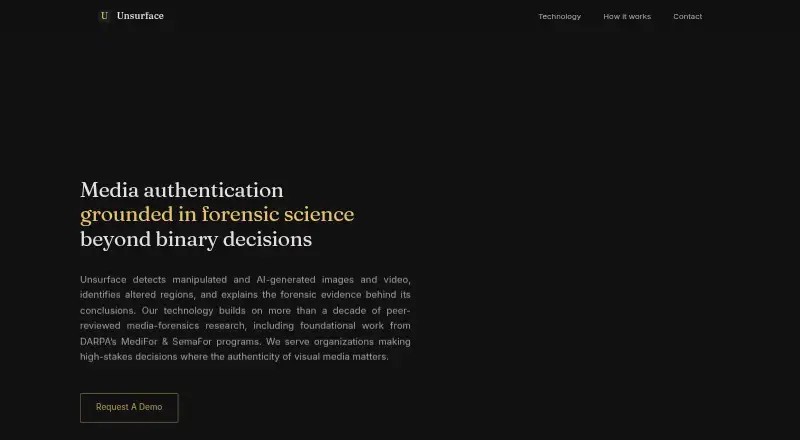
Unsurface analyzes images and video for AI-generated content, deepfakes, and alterations made with editing software. It can identify affected image regions and video frames, and indicate likely cameras, AI generators, or editing tools involved in falsifying media. Its forensic findings are presented as evidence analysts can inspect and interpret when visual authenticity matters to high-stakes decisions. The company says its method uses statistical relationships between pixels left by cameras, generators, and editing software. It describes the technology as building on more than a decade of peer-reviewed media-forensics research, including work associated with DARPA’s MediFor and SemaFor programs. Unsurface also says the approach has been validated in dozens of peer-reviewed publications and early versions of its core technology have been used in government systems and by news agencies. The paid service has pricing on request. The company says it is working with a limited number of founding partners and invites prospective users to request a demo.
Good
- Detects AI-generated images, video, and deepfakes
- Pinpoints altered image regions and video frames
- Can indicate likely tools or devices used
- Presents forensic evidence for analyst review
Watch out
- Pricing is available on request
- Working with a limited number of founding partners
Who it suits
Unsurface is aimed at organizations making high-stakes decisions where the authenticity of images or video matters. Its current availability is focused on a limited number of founding partners.
Verdict
Unsurface focuses on identifying and explaining visual-media manipulation rather than offering a broadly available consumer tool. Organizations interested in its high-stakes verification workflows can request a demo and ask about pricing.
The facts
Each one read from Unsurface's own pages, with the date it was checked.
What it does
- Access
- The site invites prospective users to request a demo and says founders typically respond within two business days.checked 8 Oct 2026
- Attribution
- It determines likely cameras, AI generators, or editing tools used to falsify or modify media.checked 8 Oct 2026
- Availability
- The company says it is working with a limited number of founding partners to shape the product for high-stakes verification workflows.checked 4 Oct 2026
- Demo response
- The company says it reads every demo request personally and founders typically respond within two business days.checked 4 Oct 2026
- Detection
- It identifies AI-generated images and video, deepfakes, and manipulations made with editing software.checked 8 Oct 2026
- Explainable evidence
- It combines forensic findings into evidence analysts can inspect, interpret, and use to support high-stakes decisions.checked 4 Oct 2026
- Forensic method
- Its analysis uses minute statistical relationships between pixels left by cameras, AI generators, or editing software.checked 8 Oct 2026
- Intended customers
- Unsurface says it serves organizations making high-stakes decisions where visual media authenticity matters and is working with a limited number of founding partners.checked 8 Oct 2026
- Localization
- It pinpoints image regions or video frames that contain manipulated or AI-generated content.checked 8 Oct 2026
- Prior use
- The company says early versions of its core technology have been deployed in government systems and used by several news agencies to authenticate images and videos.checked 8 Oct 2026
- Purpose
- Unsurface detects manipulated and AI-generated images and video, identifies altered regions, and explains the forensic evidence behind its conclusions.checked 8 Oct 2026
- Research background
- The company says its technology builds on more than a decade of peer-reviewed media-forensics research, including work associated with DARPA’s MediFor and SemaFor programs.checked 8 Oct 2026
- Research basis
- The company says its technology builds on more than a decade of peer-reviewed media-forensics research, including work from DARPA’s MediFor and SemaFor programs.checked 4 Oct 2026
- Service terms
- The site’s Terms of Use say the forensic analysis service is governed by separate agreements provided to contracted customers and authorized users.checked 8 Oct 2026
- Validation
- The company says its technical approach has been validated by dozens of peer-reviewed publications in top-tier academic venues.checked 4 Oct 2026
- Website privacy
- The privacy policy says the marketing website uses strictly necessary cookies and does not use advertising, behavioral tracking, or third-party analytics cookies at this time.checked 8 Oct 2026
- Website security
- The privacy policy says website personal data is protected with measures that include encryption in transit and at rest where applicable, access controls, and secure hosting infrastructure.checked 8 Oct 2026
- What it does
- Unsurface detects manipulated and AI-generated images and video, identifies altered regions, and explains its forensic evidence.checked 4 Oct 2026
- Who it serves
- Unsurface says it serves organizations making high-stakes decisions where visual-media authenticity matters.checked 4 Oct 2026
The company
- Company location
- The site identifies the company as Unsurface, Inc. in Delaware, USA.checked 4 Oct 2026
- Headquarters
- Philadelphia, Pennsylvania, USAchecked 28 Sep 2026
Where it runs
- Technical approach
- Its technology uses statistical relationships between pixels left by cameras, AI generators, or editing software.checked 4 Oct 2026
Alternatives to Unsurface
- 1

FauxLens
Free planAndroidWebAPIExtension7.6$2.99 one-time - 2

Hive AI-Generated Content Detection
Free planWebAPIExtensionSelf-hosted7.4$6 one-time - 3

Resemble Detect
Free planWebAPIExtensionSelf-hosted7.4From $350 a month - 4
Netarx
Free planAndroidiOSWebExtension6.8Free plan - 5

Reality Defender
Free planWebAPISelf-hosted6.8From $399 a year - 6

Deepfake Detector
Free planWebAPIExtension6.7From $4,939 a month