
TryOn Virtual
TryOn Virtual adds browser-based virtual try-on to retail product pages through real-time AR and AI photo swap.
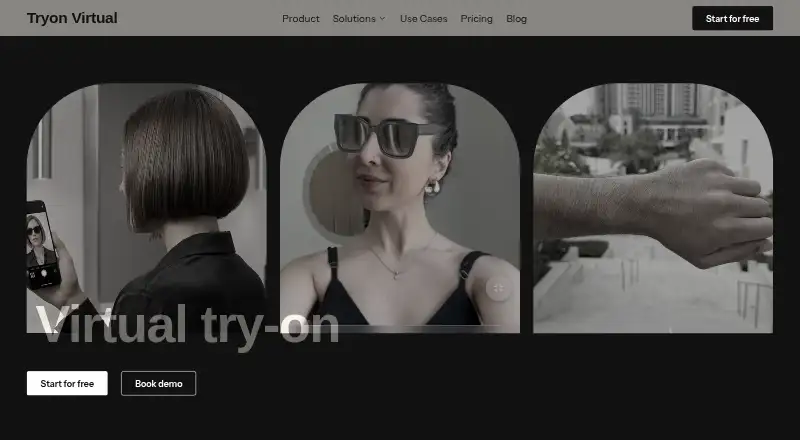
What TryOn Virtual is
TryOn Virtual adds browser-based virtual try-on to retail product pages through real-time AR and AI photo swap. Shoppers can use face or wrist tracking for eyewear and watches; the browser rendering is described as running at 60fps. For clothing, shoes, accessories, and jewelry, they can upload a photo for an AI composite, without requiring a 3D model of the product. The service also lists bags and luggage among its try-on categories. It supports GLB, GLTF, USDZ, SPZ, and PLY formats, with integrations for Shopify, WooCommerce, Magento, BigCommerce, and custom storefronts. Shopify uses a native theme extension; a REST API supports product management and storefront integration. Merchant analytics include try-on sessions, product engagement, and conversion metrics. The company says AR camera processing stays on the shopper’s device, while photo-swap uploads are deleted within 24 hours and not used to train its models.
Good
- Free Starter plan includes 25 monthly try-on sessions.
- Face and wrist tracking supports eyewear and watches.
- Photo swap does not require product 3D models.
- Integrates with Shopify, WooCommerce, Magento, and BigCommerce.
- Merchant dashboard reports engagement and conversion metrics.
Watch out
- Starter usage pauses at its monthly session limit.
- Photo swap requires shoppers to upload a photo.
- Paid Shopify plans charge for overage sessions and 3D generations.
Who it suits
It suits retailers adding virtual try-on to online product pages, including stores selling eyewear, watches, clothing, shoes, jewelry, bags, or luggage. Merchants can choose from listed ecommerce integrations or use the API.
Verdict
TryOn Virtual combines tracked AR for eyewear and watches with photo-based AI composites for other listed product categories. The free plan has a session cap, so retailers should weigh expected usage against the paid plans and their overage charges.
Plans and prices
From TryOn Virtual's own pricing page, checked 14 Oct 2026.
| Plan | Price | What it gives you |
|---|---|---|
| Starter | Free | Entire catalog · 25 try-on sessions/month · basic analytics · email support · 3 AI-built 3D models · usage pauses at limit |
| Essentials | $15 a month | Entire catalog · 150 sessions/month · basic analytics · email support · 5 AI-built 3D models · $0.75 extra 3D generation · $0.15 extra session · or $150/year — save 17% |
| Growth | $49 a month | Entire catalog · 500 sessions/month · basic analytics · priority chat and email · 10 AI-built 3D models · $0.50 extra 3D generation · $0.08 extra session · or $492/year — save 16% |
| Scale | $149 a month | Entire catalog · 2,500 sessions/month · advanced analytics · 24/7 support · 100 AI-built 3D models · $0.50 extra 3D generation · $0.07 extra session · or $1,548/year — save 13% |
| Custom | Priced on request | Entire catalog · unlimited sessions · unlimited AI-built 3D models · advanced analytics · 24/7 support · smart-mirror and in-store deployments in early access · Contract-based |
The facts
Each one read from TryOn Virtual's own pages, with the date it was checked.
What it does
- 3D formats
- The product supports GLB, GLTF, USDZ, SPZ, and PLY formats.checked 4 Oct 2026
- 3D generation
- TryOn Virtual can generate AR-ready 3D models from ordinary product photos, so merchants do not need to create models themselves.checked 14 Oct 2026
- AI photo swap
- The photo mode places clothing, shoes, jewelry, and similar products onto an uploaded shopper photo in roughly 10–20 seconds.checked 14 Oct 2026
- AI processors
- The API page says AI photo try-on images are processed by OpenAI or Google Gemini.checked 14 Oct 2026
- Analytics
- The merchant dashboard reports try-on sessions, product engagement, and conversion metrics.checked 4 Oct 2026
- API
- TryOn Virtual documents a REST API for product management and storefront integration.checked 4 Oct 2026
- API authentication
- API requests use bearer API keys created and revoked by administrators in the merchant panel.checked 14 Oct 2026
- API rate limit
- Each API key is limited to 120 requests per minute and rate-limit responses include a Retry-After header.checked 14 Oct 2026
- API resources
- Documented API resources are products, images, and usage, with product listing, creation, updates, deletion, image upload, and usage endpoints.checked 14 Oct 2026
- AR try-on
- Eyewear and watches use real-time face or wrist tracking, with rendering described as running at 60fps in the browser.checked 4 Oct 2026
- Camera privacy
- Real-time AR processing runs on the shopper's device; the company says camera images, video, and tracking data are not transmitted to or stored by it.checked 4 Oct 2026
- Category coverage
- Documented API categories are eyewear, watch, shoes, jewelry, clothes, bag, and luggage, with realtime mode mainly for eyewear and watches.checked 14 Oct 2026
- Developer extensibility
- The client integration is a JavaScript button plus bootstrap script, and custom code can open the widget with window.openTryOn().checked 14 Oct 2026
- Documentation depth
- Public docs include a quickstart, authentication guide, API operation reference, storefront integration instructions, Shopify guides, and platform notes.checked 14 Oct 2026
- Integrations
- Supported storefront options listed by the maker are Shopify, WooCommerce, Magento, BigCommerce, and custom sites using JavaScript.checked 14 Oct 2026
- Limit: adoption and conversion impact
- The G2 reviewer says usage remained low and conversion improvement was not meaningful, despite improved engagement.checked 14 Oct 2026
- Merchant analytics
- The merchant panel reports try-on sessions, conversion lift, time spent, and top-performing products, with export through the API.checked 14 Oct 2026
- Other integrations
- The pricing page lists WooCommerce, Magento, BigCommerce, and custom storefronts via JavaScript snippet, alongside Shopify.checked 4 Oct 2026
Where it runs
- Browser requirements
- The service says it works on iOS Safari, Android Chrome, and major desktop browsers with WebGL 2.0, covering 98% of browsers.checked 14 Oct 2026
The company
- Company headquarters
- LinkedIn lists Dimenso's headquarters as Dubai, United Arab Emirates.checked 14 Oct 2026
- Company legal name
- The privacy policy identifies the operator as DIMENSO L.L.C-FZ.checked 14 Oct 2026
- Company size
- LinkedIn lists Dimenso as a privately held technology company with 2–10 employees.checked 14 Oct 2026
- Founded
- 2025checked 23 Sep 2026
- Headquarters
- Dubai, United Arab Emirateschecked 23 Sep 2026
The full review of TryOn Virtual
Overview
TryOn Virtual gives retailers two ways to add virtual try-on to browser-based product pages: tracked AR for eyewear and watches, and AI photo composites for other categories. It is best suited to merchants who want to cover varied products without building every item as a 3D model.
The breadth of methods and storefront options is appealing, but the free plan’s 25 monthly sessions make it a small-scale starting point rather than a durable option for busy stores.
Key features
Eyewear and watches use face or wrist tracking, with browser rendering described at 60fps. AR processing stays on the shopper’s device, so camera images, video, and tracking data are not transmitted to or stored by TryOn Virtual. That is a meaningful privacy distinction for camera-based try-on.
For clothing, shoes, accessories, and jewelry, shoppers upload a photo for an AI composite, without a product 3D model. This opens try-on to more of a catalog, though it requires an image upload. TryOn Virtual says it deletes selected photos within 24 hours and does not use them to train its models. Its stated safeguards also include TLS in transit, private object storage, and access controls limiting stored images to processing systems.
Merchants with 3D assets can use GLB, GLTF, USDZ, SPZ, and PLY formats. Shopify gets a native theme extension that requires no custom development; WooCommerce, Magento, BigCommerce, and custom storefronts are also supported. A REST API covers product management and storefront integration, while the merchant dashboard reports sessions, product engagement, and conversion metrics. Those tools make the product more adaptable for retailers with an existing commerce stack, but non-Shopify merchants may need technical integration work.
Pricing
Starter is free and includes 25 try-on sessions a month and three free AI-built 3D models. Usage pauses at the session limit, making it suitable for a modest pilot but not for a store that needs uninterrupted try-on beyond that cap.
Essentials costs $15 a month, or $15 monthly or $150 per year (17% savings). It includes 150 sessions and five free AI-built 3D models; extra sessions cost $0.15 and extra 3D generations $0.75. This is the entry paid tier for stores with moderate activity, though its per-session overage can add up if demand regularly exceeds quota.
Growth costs $49 a month, or $49 monthly or $492 per year (16% savings). Its 500 sessions, 10 free models, and lower overages of $0.05 per session and $0.50 per extra generation suit merchants with more regular use. Scale costs $149 a month, or $149 monthly or $1,548 per year (13% savings), for 5,000 sessions and 100 free models, with the same overage rates as Growth. That larger allowance is the clearer fit for high-volume stores.
Custom has custom pricing and offers unlimited sessions and AI-built 3D models, plus non-Shopify storefronts and in-store retail. Support rises from email on Starter and Essentials to priority chat and email on Growth, then 24/7 support on Scale and Custom. A 14-day trial is offered. The listed plans do not specify seat counts, so team sizing should be confirmed before choosing a tier.
Platforms
TryOn Virtual supports web and API. Storefront integrations include Shopify, WooCommerce, Magento, and BigCommerce, with custom storefronts connected through a JavaScript snippet.
Who it's for
Retailers selling across eyewear, watches, clothing, shoes, jewelry, bags, or luggage can use its mix of tracked AR and photo-based composites. It is especially compelling for Shopify stores seeking a native extension and for merchants who need an API or multiple storefront options. Stores with privacy-sensitive shoppers can distinguish device-side AR from photo try-on, which uploads the selected image for processing.
It is a weaker fit for stores that cannot tolerate a hard stop at 25 monthly sessions on the free plan, or that want predictable costs while exceeding a paid tier’s quota. Those merchants should weigh the included session volume against the listed per-use charges.
Pros and cons
- Pro: Two try-on methods cover tracked eyewear and watches as well as photo-based composites for other categories, including without a product 3D model.
- Pro: Shopify’s native theme extension avoids custom development, while other commerce integrations and a REST API broaden deployment options.
- Pro: Device-side AR keeps camera images, video, and tracking data from being sent to or stored by the company.
- Con: Starter pauses at 25 sessions per month, so it cannot support continued usage after its free allowance is exhausted.
- Con: Paid plans charge for extra sessions and 3D generations, leaving costs variable when quotas are exceeded.
- Con: Photo try-on requires shoppers to upload an image, unlike the on-device AR flow.
Alternatives
AI Virtual Try-On Tools and Virtual Try-On Software are useful starting points for comparing category options.
- WANNA is a paid option available on Android, iOS, and web.
- Fittingbox Virtual Try-On is a paid option with a free trial and broader platform coverage, including Windows and macOS; its Bronze plan starts at $59 a month.
- DRESSX Virtual Try-On is a paid option for Android, API, iOS, and web, with enterprise pricing available by custom quote.
- PICTOFiT is a paid option for Android, iOS, and web.
- TryOnCloud offers a 10-TryOn monthly free trial without a card and a $19.00-per-month Starter plan for 100 TryOns; it is worth comparing for retailers prioritizing a small trial allowance.
- WEARFITS offers flexible pricing at €14 a month per product or a one-time €149 for ultra-quality digitisation.
- Perfect Corp. Virtual Try-On is an enterprise-priced option with a free trial.
- FASHN API sells on-demand credits for $7.50 per purchase, with no required subscription, for API-only deployment.
Verdict
TryOn Virtual is a strong choice for retailers who want both tracked AR and photo-based try-on, especially Shopify merchants or teams integrating through an API. Its chief advantage is covering varied product types with different try-on methods; its main reason to look elsewhere is the free cap and the added cost of usage beyond paid quotas.
Getting started
- Visit https://tryonvirtual.com/.
- Choose the free Starter plan or a paid plan; a 14-day trial is listed.
- Connect a Shopify, WooCommerce, Magento, or BigCommerce storefront, or use the JavaScript snippet for a custom storefront.
- For Shopify, add the native theme extension.
- For custom product or storefront integration, use the REST API.
- Select supported 3D formats as needed: GLB, GLTF, USDZ, SPZ, or PLY.
Limits worth knowing
Starter includes 25 try-on sessions per month and three free AI-built 3D models; usage pauses at the session limit. Paid Shopify plans list per-session and per-3D-generation overage charges.
Questions
How much does TryOn Virtual cost?
Starter is free.
Is there a free trial?
Yes, a 14-day trial is listed.
Which platforms and storefronts does it support?
Its platforms are web and API. Listed storefront integrations include Shopify, WooCommerce, Magento, BigCommerce, and custom storefronts via JavaScript snippet.
What does the free Starter plan include?
Starter includes 25 try-on sessions per month and three free AI-built 3D models. Usage pauses at the monthly session limit.
How does photo-swap image privacy work?
The selected photo is uploaded for processing, deleted within 24 hours, and not used to train TryOn Virtual models.
Does it offer an API?
Yes. Its REST API supports product management and storefront integration.
Alternatives to TryOn Virtual
- 1
Fittingbox Virtual Try-On
AndroidiOSWebAPI7.7From $59 a month - 2

Perfect Corp. Virtual Try-On
AndroidiOSWebAPI7.5From ¥57,657 a month - 3

Fitly
Free planWebAPI7.3From $29 a month - 4
Veesual
AndroidiOSWebAPI7.3 - 5
Kivisense Virtual Try-On
Free planAndroidiOSWeb7.2From $10,000 a year - 6

TryOnCloud
AndroidiOSWebAPI7.0From $19 a month