Trinity
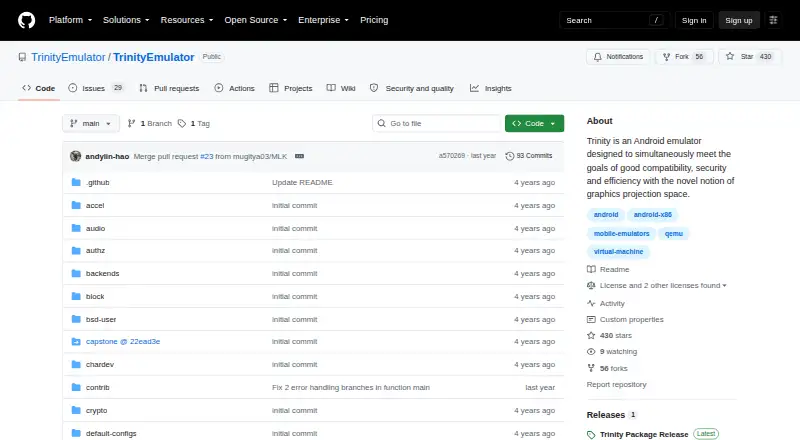
Trinity is a free, open-source Android emulator for Windows, published by the TrinityEmulator organization.
What Trinity is
Trinity is a free, open-source Android emulator for Windows, published by the TrinityEmulator organization. Its graphics projection space uses shadow contexts and resource handles to manage host graphics resources while rendering the Android guest in a window. A direct-express module transfers data between guest and host. The guest OS includes OpenGApps, allowing app installation from Google Play, including ARM-based apps, and keyboard mapping is supported. When WiFi is enabled and connected, Trinity supports ADB connections at 127.0.0.1:5555. Its default virtual device is documented with four CPU cores, 4 GB of memory, 64 GB of storage, and a 1920×1080 display. The project recommends Windows x64 on Intel with an NVIDIA dedicated GPU and a driver newer than 497.09 as its most tested setup, though a dedicated GPU is optional. Intel VT is required; Hyper-V is recommended when available, with Intel HAXM as an alternative. Running without installing the guest OS makes storage volatile and limits it to 8 GB. The project says the released version may freeze or crash.
Good
- Guest OS includes OpenGApps and Google Play support.
- Keyboard mapping is supported.
- ADB connections are documented.
- Release ZIP includes emulator and Android guest images.
Watch out
- Released version may freeze or crash.
- Intel VT is required.
- Uninstalled guest mode limits volatile storage to 8 GB.
- Most-tested setup calls for Windows x64 on Intel.
Who it suits
Trinity may suit Windows users who need an Android guest with Google Play access, keyboard mapping, or ADB connectivity. Users should be comfortable with its stated virtualization requirements and stability caveat.
Verdict
Trinity offers a Windows Android guest with Google Play support and ADB access, but the project says the release is not yet stable. Check the virtualization requirements and storage mode before using it.
The facts
Each one read from Trinity's own pages, with the date it was checked.
What it does
- Acceleration
- Trinity requires Intel VT enabled and recommends Hyper-V when available, with Intel HAXM as an alternative.checked 8 Oct 2026
- ADB
- Trinity supports ADB connections at 127.0.0.1:5555 when its WiFi is enabled and connected.checked 8 Oct 2026
- Architecture
- Trinity is based on QEMU 5.0 and adds modules for data transfer between guest and host and host-side graphics rendering.checked 8 Oct 2026
- Data transfer
- The direct-express module provides a bidirectional data transfer pipeline between the guest and host.checked 8 Oct 2026
- Developer connection
- The README provides instructions for establishing an ADB connection to Trinity.checked 8 Oct 2026
- Download
- The release provides a ZIP containing the emulator binary and Android guest OS images, with Trinity.exe to run them.checked 8 Oct 2026
- Google Play support
- Yeschecked 19 Sep 2026
- Hardware
- The listed minimum configuration is a 4-core CPU, 8 GB memory, 1920×1080 display, and 128 GB storage.checked 8 Oct 2026
- Host requirements
- The project says Windows x64 on Intel with an NVIDIA dedicated GPU and a driver newer than 497.09 is the most tested setup, while a dedicated GPU is optional.checked 8 Oct 2026
- License
- The project states its code is under the GPLv2 license.checked 8 Oct 2026
- Minimum configuration
- The listed minimal hardware configuration is a 4-core CPU, 8 GB memory, 1920x1080 display, and 128 GB storage.checked 8 Oct 2026
- Persistent storage limit
- Running without installing the guest OS makes virtual storage volatile and limits it to 8 GB.checked 8 Oct 2026
- Product
- Trinity is an Android emulator designed for compatibility, security, and efficiency using graphics projection space.checked 8 Oct 2026
- Release package
- The release provides a ZIP containing the emulator, Android x86_64 guest OS images, and a Trinity.exe launcher.checked 8 Oct 2026
- Research use
- The project provides measurement data, scripts, and guides for reproducing figures and experiments from its paper.checked 8 Oct 2026
- Stability
- The project says the released version is not yet stable and may freeze or crash, and that rebooting can sometimes resolve issues.checked 8 Oct 2026
- Support
- The README directs users to troubleshooting guides and says to send log.txt from the binary directory if Trinity will not start properly.checked 8 Oct 2026
Where it runs
- Android apps
- The guest OS includes OpenGApps and supports installing apps from the Google Play Store, including ARM-based apps.checked 8 Oct 2026
- App compatibility
- For guest apps, Trinity reports device CPU, GPU, and vendor information as a Samsung Galaxy S20 Ultra 5G to unlock some high-end-device features.checked 8 Oct 2026
- Desktop platforms
- Windowschecked 19 Sep 2026
- Graphics approach
- Its graphics projection space uses shadow contexts and resource handles to manage host graphics contexts and resources while rendering frames in a window.checked 8 Oct 2026
- Host platform
- The project recommends Windows x64 on Intel as its most tested environment and documents building on 64-bit Windows 10/11.checked 8 Oct 2026
- Keyboard mapping
- Yeschecked 19 Sep 2026
The company
- Maker
- The GitHub repository is published under the TrinityEmulator organization.checked 8 Oct 2026
Alternatives to Trinity
- 1

Genymotion Desktop
Free planLinuxmacOSWindows8.2From $49 a year - 2
Android Emulator
Free planAndroidLinuxmacOSWindows7.9Free plan - 3

BlueStacks App Player
Free planmacOSWindows7.9From $7.99 a month - 4

Appetize
Free planAndroidiOSWebAPI7.9From $59 a month - 5
QEMU
Free planOpen sourceAPILinuxmacOSSelf-hosted7.8Free plan - 6
VMOS Cloud
AndroidiOSWebAPI7.5