
TREK
TREK is a free, self-hosted travel planner for organizing trips with other people in real time.
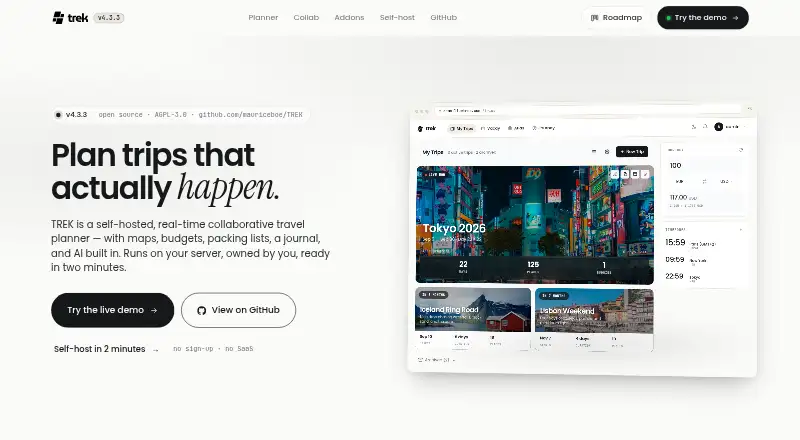
What TREK is
TREK is a free, self-hosted travel planner for organizing trips with other people in real time. Collaborators can edit itineraries together, use trip chat and polls, mark attendance, and share read-only public links. Users can move places between days, optimize routes by distance, and send a day to Google Maps for turn-by-turn directions. Reservation records can hold confirmation numbers, files, and statuses for flights, stays, and restaurants. Budgets support multiple currencies and per-person or per-day totals; packing lists include templates and item assignments. OpenStreetMap is the default place search, Google Places is optional, and 16-day forecasts use Open-Meteo without API keys. Optional addons include Atlas travel statistics, Vacay vacation planning, Journey travel journaling, and MCP integration. The software can be installed as a PWA on a device home screen. It runs on hardware controlled by the operator, stores trip data in a SQLite file, and offers scheduled snapshots with retention policies. Deployment documentation covers Docker, Kubernetes, Unraid, Proxmox, Raspberry Pi, and Apple Silicon. TREK is open source under AGPL-3.0 and free for personal and internal company use.
Good
- Collaborators can edit itineraries in real time.
- Budgets support multiple currencies and per-person totals.
- Stores flight, stay, and restaurant reservation details.
- Runs on operator-controlled hardware.
- Free for personal and internal company use.
Watch out
- Self-hosted deployment requires hardware the operator controls.
- Trip data is stored in a SQLite file.
- Google Places is optional rather than the default search.
- The live demo resets every hour.
Who it suits
TREK suits travelers who want to host their own collaborative trip planner and manage itineraries, reservations, budgets, and packing lists in one place.
Verdict
TREK offers a broad set of trip-planning and collaboration tools for people willing to self-host. Its open-source plan is free for personal and internal company use.
Plans and prices
From TREK's own pricing page, checked 30 Sep 2026.
| Plan | Price | What it gives you |
|---|---|---|
| TREK (self-hosted) | Free | Free for personal and internal company use · AGPL-3.0 |
| TREK self-hosted | Free | Free for personal or internal company use · AGPL-3.0 · self-hosted deployment |
The facts
Each one read from TREK's own pages, with the date it was checked.
What it does
- Addons
- Optional addons include Atlas travel statistics, Vacay vacation planning, Journey travel journaling, and MCP integration.checked 30 Sep 2026
- Authentication security
- Supported login protections include OIDC, passkeys, TOTP two-factor authentication, rate limits, encrypted secrets and SSRF protection.checked 14 Oct 2026
- Booking imports
- Reservation confirmations can be imported from EML, PDF, PKPass, HTML and TXT files using KItinerary.checked 14 Oct 2026
- Budget and packing
- Budgets support multiple currencies and per-person or per-day totals, while packing lists support templates and assigning items to people.checked 30 Sep 2026
- Changelog: v4.2.1
- Release 4.2.1 addressed offline PWA update behavior, redirect credential handling and several sharing and synchronization bugs.checked 14 Oct 2026
- Changelog: v4.3.3
- The September 26, 2026 release fixed OIDC login failures caused by IPv6 link-local DNS records.checked 14 Oct 2026
- Collaboration
- WebSocket synchronization makes edits appear live for people viewing the same trip.checked 14 Oct 2026
- Data and backups
- TREK runs on hardware the operator controls and offers scheduled snapshots with retention policies; trip data is stored in a SQLite file on a volume.checked 30 Sep 2026
- Demo
- The live demo requires no email or sign-up and resets every hour.checked 30 Sep 2026
- Deployment
- Official deployment paths include Docker, Docker Compose and Helm/Kubernetes, with a default application port of 3000.checked 14 Oct 2026
- Documentation
- The repository includes a wiki, environment-variable reference, installation guides, update instructions, security policy and plugin documentation.checked 14 Oct 2026
- Expense tracking
- Costs support integer-cent splitting, custom shares, multiple payers, settlement suggestions, settlement history and CSV export.checked 14 Oct 2026
- Independent project activity
- GitHub Highlights reported 13,616 stars, 1,337 stars added during its discovery window, a March 19, 2026 creation date and version 4.2.1 on September 6, 2026.checked 14 Oct 2026
- Integrations
- The MCP server supports OAuth 2.1 and is described for use with Claude, Cursor, or another agent; Journey can sync photos from Immich or Synology Photos.checked 30 Sep 2026
- Licence
- TREK is licensed under AGPL-3.0; modified network deployments must provide corresponding source under the same licence.checked 14 Oct 2026
- License and audience
- TREK is open source under AGPL-3.0 and is free for personal and internal company use.checked 30 Sep 2026
- Limit: expense customization
- Reddit users request custom expense categories, more flexible payer and split relationships, and subaccounts for spouses or children.checked 14 Oct 2026
- Limit: external services
- Independent coverage notes that routing, transit, POI lookup, currency rates and other functions depend on public third-party services that may become unavailable.checked 14 Oct 2026
- Limit: integrations
- The maintainer said integration with Dawarich was not yet available when a Reddit user asked about it.checked 14 Oct 2026
- Limit: road-trip workflow
- A Reddit user says planning a personal-car road trip feels awkward because the car transport form expects booking-style return and confirmation fields.checked 14 Oct 2026
- Limit: self-hosting effort
- Independent coverage says the product requires users to operate their own server, database, uploads, backups and upgrades instead of using a hosted SaaS service.checked 14 Oct 2026
Money
- Day planning
- Places, notes and bookings can be dragged between days and reordered with undo support.checked 14 Oct 2026
- Free plan
- Yeschecked 21 Sep 2026
- Itinerary planning
- Users can move places between days, optimize routes by distance, and send a day to Google Maps for turn-by-turn directions.checked 30 Sep 2026
The full review of TREK
Overview
TREK is a travel-planning workspace built around the trip rather than the booking: it brings itinerary, reservation, budget, packing, and journal records together. Its emphasis on self-hosting makes it a particularly strong fit for technically confident travelers and groups who want to run their own service.
It is unusually broad for a free, open-source planner, but choosing it also means taking responsibility for deployment and upkeep. Travelers seeking a conventional hosted app should compare alternatives.
Key features
Collaborative trip planning
Collaborators can edit itineraries together, see live presence, chat, run polls, and track attendance. Read-only public links offer a useful middle ground for sharing plans with people who should not change them. This makes TREK well suited to group trips where coordination matters as much as the schedule itself.
Routes and reservations
Places can be moved between days, routes optimized by distance, and a day handed off to Google Maps for turn-by-turn directions. Reservation import is supported, and records for flights, stays, and restaurants can hold confirmation numbers, files, and statuses. Keeping those details with the itinerary is practical; Google Maps provides the final directions rather than replacing a dedicated navigation app.
Budgets, packing, and journaling
Budgets handle multiple currencies and can be summarized per person or per day, useful for groups splitting costs or tracking a daily allowance. Packing-list templates and assignments help divide preparation among travelers. Optional Journey adds travel journaling and can sync photos from Immich or Synology Photos; other optional addons include Atlas travel statistics and Vacay vacation planning.
Maps, weather, and AI integration
OpenStreetMap powers place search by default, with Google Places as an option. Weather forecasts extend 16 days through Open-Meteo without requiring API keys. An optional MCP server supports OAuth 2.1 and is intended for use with Claude, Cursor, or another agent. These integrations extend the planner, but the core appeal remains organizing a trip in one shared workspace.
Self-hosting and data control
TREK runs on hardware its operator controls, storing trip data in a SQLite file on a volume and offering scheduled snapshots with retention policies. The maker lists JWT sessions, OAuth 2.1, OIDC single sign-on, and TOTP multi-factor authentication, as well as compatibility with Authelia, Authentik, and Keycloak. Those options will matter to operators who want control over deployment and access; they also put setup, backups, and ongoing operation in the user's hands.
Deployment documentation covers Docker, Docker Compose, Helm/Kubernetes, Unraid, Proxmox, Raspberry Pi, and Apple Silicon, with AMD64 and ARM64 images. A PWA can be installed on a device's home screen, and offline access is supported. The live demo needs no email or sign-up and resets every hour, making it a low-commitment way to explore the app.
Pricing
TREK (self-hosted): free. The plan is free for personal and internal company use under the AGPL-3.0 open-source license. There is no free trial because the plan is free, and the available pricing model has no paid tier to weigh against it. The trade-off is operational rather than financial: users supply and manage the hosting.
Platforms
TREK is primarily a web app, with support for Android, iOS, Linux, and self-hosted deployment. Its installable PWA can be added to a device's home screen. Calendar sync and offline access are supported.
Who it's for
TREK is a strong choice for technically capable travelers, families, and trip groups who want shared planning plus control over where their data lives. It is also compelling for internal company use, which the free license explicitly permits. People who do not want to host or maintain software themselves should favor a hosted alternative instead.
Pros and cons
- Pro: It combines shared itineraries, reservation records, budgets, packing, and journaling, keeping practical trip details alongside the schedule.
- Pro: Free use for personal and internal company purposes, with open-source AGPL-3.0 licensing, avoids a recurring plan charge.
- Pro: Operator-controlled hosting, scheduled snapshots, and several authentication options offer meaningful control over data and access.
- Con: Self-hosting requires the user to provide and operate the deployment, a real burden for travelers who expect a managed service.
- Con: The live demo resets every hour, so it is useful for a quick look but not for keeping a trial trip intact.
Alternatives
For a broader category browse, start with Travel Itinerary Apps or AI Travel Planners.
- Stippl is a better fit for travelers who want a hosted Android, iOS, or web planner with a free plan covering unlimited trips, destinations, activities, co-planners, expenses, and journal entries, plus AI generation, PDF export, and calendar sync.
- Pilot suits travelers who want a free Android, iOS, or web itinerary app with route and map tools, reservation and file import, and real-time collaboration, without taking on self-hosting.
- TripBuddy is another free Android, iOS, and web option, with every trip, day, and crew size included.
- NxVoy Trips may suit travelers interested in a chat-based planning option; its free plan includes 5 chats and 50 messages per session, with a premium plan for fuller access to Shasa features.
- Navly is an iOS and macOS alternative centered on an AI travel-planning assistant, map and location context, and itinerary building; its free plan can be supplemented by a 2.99 USD once Day Pass that does not renew automatically and lasts 24 hours.
- Mindtrip offers a web and iOS alternative with Basic and Premium plans whose prices are custom pricing.
- Layla is a web, iOS, and Android alternative with a Premium plan offering unlimited app access at custom pricing.
- GripaTrip is a web, iOS, and Android alternative with weekly, monthly, and yearly subscriptions at custom pricing.
Verdict
Choose TREK if your group wants a capable, collaborative trip planner and you are comfortable running the software yourself. Its combination of trip tools, data control, and free personal and internal company use is the case for choosing it; the need to self-host is the clearest reason to look elsewhere.
Getting started
- Open the live demo without providing an email or signing up; it resets every hour.
- For a persistent installation, choose a documented deployment route such as Docker, Docker Compose, Helm/Kubernetes, Unraid, Proxmox, Raspberry Pi or Apple Silicon.
- Run TREK on hardware you control; AMD64 and ARM64 images are available.
- Install it as a PWA and add it to a device’s home screen if desired.
- Invite collaborators to work on itineraries or share a read-only public link.
Limits worth knowing
The free TREK self-hosted plan is for personal and internal company use under AGPL-3.0. The live demo resets every hour.
Questions
Is TREK free?
Yes. TREK’s self-hosted plan is free and is free for personal and internal company use under AGPL-3.0.
Is TREK open source?
Yes. TREK is open source under the AGPL-3.0 license.
Which platforms can I use for TREK?
TREK is self-hosted and web-based, supports Android, iOS and Linux, and is installable as a PWA. Its deployment documentation covers several hosting options, including Raspberry Pi and Apple Silicon.
Can I try TREK without creating an account?
Yes. The live demo requires no email or sign-up, but resets every hour.
What integrations does TREK support?
Google Maps can provide turn-by-turn directions for a day, and Google Places is an optional place-search provider. MCP integration is available as an addon, while Journey can sync photos from Immich or Synology Photos.
Alternatives to TREK
- 1

GuideGeek
Free planAndroidiOSWebAPI8.7From $10,000 a year - 2
Travolp
Free planAndroidiOSWebAPI8.5From $119 a month - 3
Yanvara
Free planAndroidiOSWeb8.4From $39 a year - 4

Pilot
Free planAndroidiOSWeb8.2$49 one-time - 5
Onytrip
Free planAndroidiOSWeb8.1Free plan - 6
Itinica
Free planAndroidiOSWebLinux8.1From $14.99 a month