
Traefik Proxy
Traefik Proxy is an open-source reverse proxy and ingress controller for deploying services and APIs.
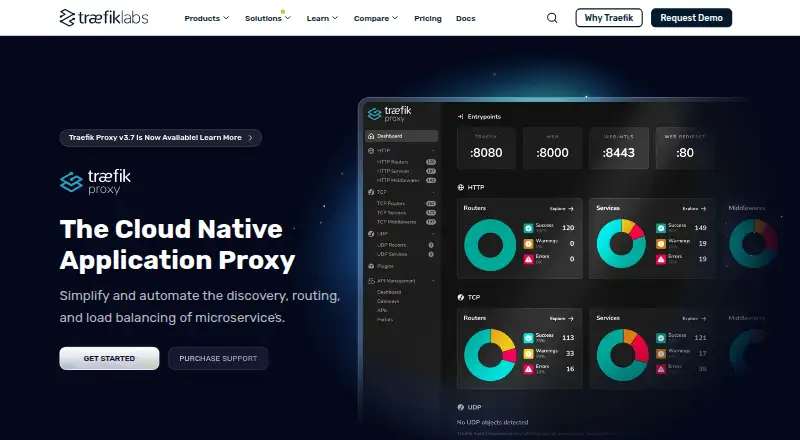
What Traefik Proxy is
Traefik Proxy is an open-source reverse proxy and ingress controller for deploying services and APIs. It discovers services and adjusts routing dynamically, with Layer 4 and Layer 7 routing and support for HTTP, HTTP/2, HTTP/3, TCP, UDP, WebSockets and gRPC. Traffic features include mirroring, blue-green and canary deployments, stickiness and active health checks. For security, it offers automatic HTTPS, Let’s Encrypt support, custom certificates, authentication and Web Application Firewall support. Traefik integrates with platforms including Kubernetes, Docker, Docker Swarm, OpenShift, Rancher and Amazon ECS, and can run on environments such as virtual machines and bare metal. It also supports WebAssembly plugins through a public catalog. Observability features include a built-in dashboard, OpenTelemetry and distributed tracing, plus metrics integrations. The software is self-hosted and listed for Linux, macOS and Windows. The Traefik Proxy plan is free. Traefik Labs offers commercial support with expert assistance available 24/7/365.
Good
- Free, open-source reverse proxy and ingress controller
- Supports HTTP, HTTP/2, HTTP/3, TCP, UDP and gRPC
- Includes automatic HTTPS and custom certificate support
- Integrates with Kubernetes, Docker and Amazon ECS
- Provides a built-in dashboard and distributed tracing
Watch out
- Deployment model is self-hosted
- Commercial support is separate from the free plan
Who it suits
Traefik Proxy suits teams deploying services or APIs across supported container platforms, Kubernetes distributions, virtual machines or bare metal. It is also relevant for operators seeking dynamic routing and traffic controls in a self-hosted proxy.
Verdict
Traefik Proxy offers dynamic routing, security controls and observability options for self-hosted service deployments. Its breadth of protocol and platform support is useful, but deployment remains your responsibility.
Plans and prices
From Traefik Proxy's own pricing page, checked 1 Oct 2026.
| Plan | Price | What it gives you |
|---|---|---|
| Traefik Proxy | Free | Open source · Ingress controller · Reverse proxy · Load balancer · Services auto-discovery |
| Traefik Proxy Open Source | Free | Reverse proxy, ingress controller, load balancer, service discovery; commercial support and enterprise features excluded · Free download |
| Traefik Hub API Gateway | Priced on request | Adds WAF, LDAP/JWT/OAuth/OIDC, Vault, distributed rate limiting, caching, multi-cluster management and FIPS options · Contact vendor |
| Traefik Hub API Management | Priced on request | Adds API discovery, versioning, subscriptions, granular access control, developer portal, monitoring and mocking · Contact vendor |
The facts
Each one read from Traefik Proxy's own pages, with the date it was checked.
What it does
- API security warning
- Official documentation warns that enabling the API or dashboard in production can expose sensitive configuration and recommends authentication plus network restriction.checked 15 Oct 2026
- Canary deployments
- Canary deployment capability is listed for Traefik Proxy.checked 15 Oct 2026
- Core operation
- It uses service discovery to dynamically configure routing.checked 1 Oct 2026
- Dashboard
- The built-in dashboard displays active routes and obtains its data from Traefik's API.checked 15 Oct 2026
- Deployment environments
- Traefik Proxy supports Docker Swarm, HashiCorp Nomad, Azure Service Fabric, Kubernetes distributions, virtual machines, and bare metal.checked 1 Oct 2026
- Docker support
- The Docker quick start requires Docker and optionally Docker Compose, and uses the Docker provider to discover containers.checked 15 Oct 2026
- Documentation depth
- Documentation includes personas, core concepts, getting-started guides, provider configuration, API/dashboard reference and product comparison material.checked 15 Oct 2026
- Extensibility
- Traefik supports WebAssembly plugins and provides a public plugin catalog.checked 1 Oct 2026
- Integrations
- The project identifies Docker, Docker Swarm, Kubernetes, Consul, Etcd, Rancher and Amazon ECS among its supported infrastructure integrations.checked 15 Oct 2026
- Investors
- Traefik Labs' About page names Balderton, Elaia, 360 Capital Partners, Kima Ventures and OSS Capital among its investors.checked 15 Oct 2026
- Kubernetes support
- The Kubernetes quick start supports Helm installation, IngressRoute CRDs, standard Ingress resources and Gateway API routing.checked 15 Oct 2026
- Latest release
- GitHub lists Traefik v3.7.15 as released on October 15, 2026, with CVE fixes and a fix rejecting CONNECT requests regardless of HTTP version.checked 15 Oct 2026
- Licence
- The Traefik source repository is distributed under the MIT License.checked 15 Oct 2026
- Limit: documentation navigation
- A G2 reviewer reports that finding environment-specific examples in the documentation can be challenging.checked 15 Oct 2026
- Limit: learning curve
- G2 and Capterra reviewers say the flexibility creates a learning curve and makes initial configuration difficult.checked 15 Oct 2026
- Limit: premium features
- A Capterra reviewer says caching was available only in the paid Pro version at the time of review.checked 15 Oct 2026
- Limit: troubleshooting
- A Capterra reviewer says middleware and service matching can be confusing and that debugging output could be more comprehensive.checked 15 Oct 2026
- Observability
- Proxy includes real-time logs, access logs, metrics and distributed tracing.checked 15 Oct 2026
- Plugin extensibility
- Plugins are available through an online catalog and can provide middleware or provider functionality.checked 15 Oct 2026
- Plugin limitation
- Plugins are loaded only at startup, so adding or changing one requires a restart while the running instance cannot be modified.checked 15 Oct 2026
The company
- Company
- Traefik Labs was founded in 2016.checked 1 Oct 2026
- Company facts
- LinkedIn lists Traefik Labs as privately held, founded in 2016, headquartered in San Francisco with 11–50 employees and an additional Lyon location.checked 15 Oct 2026
- Founded
- 2016checked 23 Sep 2026
- Headquarters
- Lyon, France and San Francisco, USAchecked 23 Sep 2026
The full review of Traefik Proxy
Traefik Proxy is an open-source reverse proxy and ingress controller for deploying services and APIs. It suits operators who want routing to follow changing services across self-hosted environments. Its breadth is compelling, but you take responsibility for deployment and operation.
Overview
Service discovery dynamically configures routes as services change, which can reduce manual routing upkeep in evolving deployments. Traefik combines proxying, ingress control and load balancing in one free, self-hosted product. That makes it a strong fit for teams managing their own infrastructure, but not for readers seeking a hosted service that removes operational work.
Key features
Protocol support spans HTTP, HTTP/2, HTTP/3, TCP, UDP, WebSockets and gRPC, with Layer 4 and Layer 7 routing. This range accommodates mixed service environments; deployments needing only a narrow ingress function may find its breadth unnecessary.
Traffic controls include mirroring, stickiness, active health checks, and blue-green and canary deployments. These options help operators shape traffic and manage staged releases. Security features include automatic HTTPS, Let’s Encrypt support, custom certificates, authentication and Web Application Firewall support, covering several common proxy concerns in the same system.
Integrations include Kubernetes, Docker, Docker Swarm, Red Hat OpenShift, Rancher, Amazon ECS, Consul and key-value stores. Deployment environments extend to HashiCorp Nomad, Azure Service Fabric, Kubernetes distributions, virtual machines and bare metal. This makes Traefik adaptable across varied infrastructure, though teams must choose and manage the deployment that fits their setup.
OpenTelemetry, distributed tracing, a built-in dashboard and metrics integrations for Datadog, Grafana, InfluxDB, Prometheus and StatsD give operators several ways to observe traffic. WebAssembly plugins and a public plugin catalog provide room to extend it. Traefik Labs also offers commercial support with expert assistance 24/7/365. An in-place upgrade takes less than one minute and preserves proxy configuration, a practical advantage for operators maintaining existing deployments. Its vulnerability process ships accepted fixes before advisories, which include affected versions, a CVSS v4 vector, mitigations where available and reporter credit.
Pricing
Traefik Proxy: free. The open-source plan includes an ingress controller, reverse proxy, load balancer and service auto-discovery. There are no paid tiers or usage caps stated for this plan, so it is the natural starting point for teams able to run and maintain the software themselves. Commercial support is offered by Traefik Labs; no price is given for it.
Platforms
Traefik Proxy is listed for Linux, macOS, Windows and self-hosted use. Its deployment environments include Docker Swarm, HashiCorp Nomad, Azure Service Fabric, Kubernetes distributions, virtual machines and bare metal. The choice of environments is a strength for infrastructure teams, but it does not change the self-hosted operating responsibility.
Who it's for
Traefik is a good choice for teams running services or APIs across containers, orchestrators or other self-managed infrastructure, especially when they need multiple protocols, dynamic discovery and rollout controls. It is less suitable for users who want a managed proxy or have no need for its broad integration and traffic-management options.
Pros and cons
- Pro: Dynamic service discovery adapts routing as deployments change, reducing routine manual updates.
- Pro: Broad protocol support and Layer 4 and Layer 7 controls accommodate varied workloads and rollout strategies.
- Pro: Free open-source use includes ingress, proxying, load balancing and auto-discovery, with multiple observability integrations.
- Con: Self-hosting leaves deployment and ongoing operation to the user.
- Con: Its wide range of platforms and integrations can be more than a simple ingress use case requires.
Alternatives
For an open-source Kubernetes ingress controller with community support, consider Contour. HAProxy Ingress is another free option when a Kubernetes cluster is already in place; its stated v0.16 requirement is Kubernetes 1.21 or newer.
agentgateway is a free open-source gateway deployable as a binary, Docker container or on Kubernetes. Choose ngrok if its freemium model, free trial and free tier with up to three online endpoints and 1GB data transfer better fit your needs. Airlock Microgateway offers a free Community Edition for small environments or local development, with throughput enforced and six-month license validity.
NGINX Ingress Controller offers a free NGINX Open Source option for Kubernetes deployments. LiteSpeed Ingress Controller is a paid alternative, with Web ADC Small at $65 a month and Web ADC Medium at $130 a month, both billed monthly. For broader browsing, see Kubernetes Ingress Controllers and Reverse Proxy Software.
Verdict
Choose Traefik Proxy if you need a free, flexible proxy and ingress controller for services you operate yourself: dynamic discovery, broad protocol support and traffic controls are its strongest reasons to choose it. Look elsewhere if you want managed operations or a more narrowly scoped solution.
Alternatives to Traefik Proxy
- 1

Pomerium
Free planOpen sourceWebAPILinuxmacOS8.3From $7 a month - 2

ngrok
Free planWebAPILinuxmacOS7.8From $10 a month - 3
HAProxy Community Edition
Free planOpen sourceAPILinuxmacOSSelf-hosted7.4Free plan - 4

Apache Traffic Server
Free planOpen sourceAPILinuxmacOSSelf-hosted7.2Free plan - 5
Openport
Free planWebAPILinuxmacOS7.1From $1 a month - 6
PageKite
AndroidWebAPILinux7.0From $3 a month