
agentgateway
Agentgateway is a free, open-source HTTP and gRPC gateway for routing, securing, observing, and governing traffic involving services, LLMs, MCP, and agent-to…
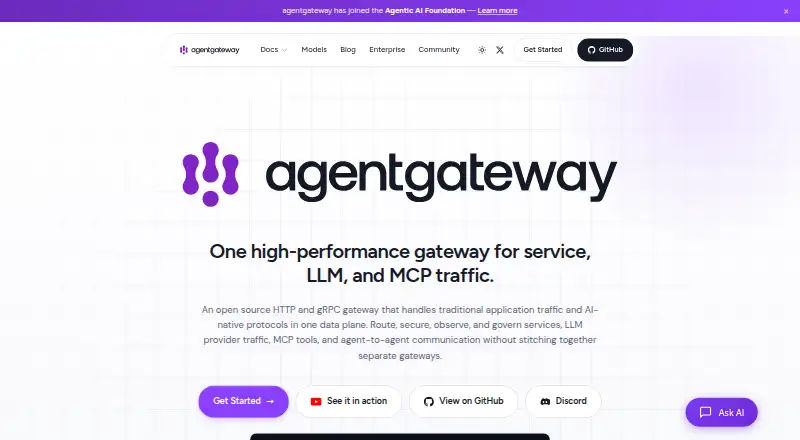
What agentgateway is
Agentgateway is a free, open-source HTTP and gRPC gateway for routing, securing, observing, and governing traffic involving services, LLMs, MCP, and agent-to-agent systems. Its LLM gateway exposes an OpenAI-compatible API for providers such as OpenAI, Anthropic, Bedrock, Gemini, Vertex, and OSS Llama runs. Self-hosted inference routing supports vLLM, TGI, and Triton, with routing decisions based on latency, cost, and model. For MCP, it supports server discovery, scoped tool calls, and audit trails; for A2A, it routes between agent runtimes including LangChain, CrewAI, and ADK. Security controls include JWT and OIDC, API keys, authorization policies, TLS and mTLS with certificate rotation, and rate limiting. MCP and prompt guards can check calls and responses for prompt injection or unsafe payloads. Observability includes OpenTelemetry, Prometheus token-usage histograms, Jaeger traces, and request logs showing latency, token counts, and realized USD cost. The gateway can be deployed as a standalone binary, in Docker, or on Kubernetes. The project is self-hosted; commercial support is listed through a partner.
Good
- Free and open source.
- Supports HTTP and gRPC traffic.
- Includes rate limiting and authorization policies.
- Offers OpenTelemetry, Prometheus, and Jaeger observability.
- Deploys as a binary, Docker container, or Kubernetes workload.
Watch out
- Deployment is self-hosted.
- Commercial support is listed through a partner.
- TLS certificate rotation and gateway operation require deployment management.
Who it suits
Agentgateway is aimed at platform engineers, tool-builders, and AI enthusiasts who need self-hosted traffic controls for services, LLMs, or agent systems. It also suits platform teams seeking routing, security, and observability features in one gateway.
Verdict
Agentgateway brings routing, access controls, guardrails, and observability to multiple kinds of AI and service traffic. Teams should account for operating its self-hosted deployment and arrange support if needed.
Plans and prices
From agentgateway's own pricing page, checked 2 Oct 2026.
| Plan | Price | What it gives you |
|---|---|---|
| agentgateway (open source) | Free | Open-source gateway; binary, Docker, or Kubernetes deployment |
The facts
Each one read from agentgateway's own pages, with the date it was checked.
What it does
- A2A support
- The A2A gateway supports capability discovery, modality negotiation and long-running task collaboration between agents.checked 19 Oct 2026
- API and configuration
- Standalone deployments use flat YAML configuration, while Kubernetes deployments use a controller, Gateway API resources and documented API references.checked 19 Oct 2026
- Authentication
- Documented authentication methods include JWT, API keys, basic authentication and MCP authentication specifications.checked 19 Oct 2026
- Authorization
- Fine-grained authorization uses role-based policies and the CEL expression engine.checked 19 Oct 2026
- Binary installation
- The official installer is a curl script that downloads a release binary, verifies its checksum and installs it into /usr/local/bin.checked 19 Oct 2026
- Deployment
- The project provides standalone binary, Docker and Kubernetes deployment paths.checked 19 Oct 2026
- Documentation
- Documentation is split into standalone and Kubernetes sites with quickstarts, integration guides, configuration references and API documentation.checked 19 Oct 2026
- Enterprise support
- Solo Enterprise for agentgateway advertises 24×7 coverage, upstream collaboration and operational guidance.checked 19 Oct 2026
- Guardrails
- Guardrails include regex checks, OpenAI moderation, AWS Bedrock Guardrails, Google Model Armor and custom webhooks.checked 19 Oct 2026
- Inference
- Self-hosted inference routing supports vLLM, TGI, and Triton, with latency-aware, cost-aware, and model-aware routing.checked 2 Oct 2026
- Inference routing
- Kubernetes Inference Gateway extensions route self-hosted models using GPU utilization, KV-cache use, LoRA adapters and work-queue depth.checked 19 Oct 2026
- Integrations
- Official integration categories cover identity providers, AWS, Google Cloud, Azure, LLM providers, MCP, networking tools, agent frameworks and NetBird.checked 19 Oct 2026
- Intended users
- The site invites tool-builders, platform engineers, and AI enthusiasts to join the community and describes the controls as suited to platform teams.checked 2 Oct 2026
- Licence
- The open-source project is licensed under Apache-2.0.checked 19 Oct 2026
- Limit: fast-changing configuration
- An independent review cautioned that the project is actively developing and its configuration surface is not yet stable.checked 19 Oct 2026
- Limit: insecure defaults
- A hands-on review found optional API-key authentication, fail-open deny expressions and an unauthenticated localhost admin interface as defaults requiring hardening.checked 19 Oct 2026
- Limit: operational complexity
- A reviewer said the Kubernetes controller and policy model add too much machinery for a single service with one model provider and a fixed tool list.checked 19 Oct 2026
- LLM gateway
- It offers one OpenAI-compatible interface for providers including OpenAI, Anthropic, Gemini and Bedrock, with budgets, failover and load balancing.checked 19 Oct 2026
- LLM routing
- Its LLM gateway provides an OpenAI-compatible API for providers including OpenAI, Anthropic, Bedrock, Gemini, Vertex, and OSS Llama runs.checked 2 Oct 2026
- MCP and A2A
- The gateway supports MCP server discovery, scoped tool calls and audit trails, and A2A routing between LangChain, CrewAI, ADK, and other runtimes.checked 2 Oct 2026
The company
- Company origin
- Solo.io originally created agentgateway and donated it to the Linux Foundation in August 2025.checked 19 Oct 2026
- Maker company facts
- Solo.io is listed on LinkedIn as founded in 2017, headquartered in Cambridge, Massachusetts, with 51–200 employees.checked 19 Oct 2026
- Maker legal name
- Crunchbase lists the maker as solo.io, Inc.checked 19 Oct 2026
Money
- Cost controls
- Virtual keys, token and dollar caps, model cost catalogs and dashboards attribute and enforce agent spending.checked 19 Oct 2026
The full review of agentgateway
Overview
agentgateway is an open-source HTTP and gRPC gateway for teams that need one control point for service, model, MCP, and agent-to-agent traffic. It suits platform engineers, tool-builders, and technically confident AI teams running infrastructure themselves. The broad policy and telemetry toolkit is a strong fit for governed deployments, while organizations wanting a fully managed endpoint should choose another approach.
Key features
The LLM gateway exposes an OpenAI-compatible API while connecting to OpenAI, Anthropic, Bedrock, Gemini, Vertex, and open-source Llama deployments. That compatibility can simplify provider switching for applications, and the extensive integration list also includes Azure OpenAI, Mistral, DeepSeek, Ollama, xAI, and Snowflake. For self-hosted inference, routing to vLLM, TGI, and Triton can account for latency, cost, and model characteristics, making it useful when a platform mixes cloud APIs with its own GPU-backed services.
MCP capabilities go beyond proxying: server discovery, scoped tool calls, and audit trails provide a basis for controlling which agents can invoke which tools. A2A routing links runtimes such as LangChain, CrewAI, and ADK. These features are valuable for multi-agent platforms, but they require teams to design scopes and review recorded activity rather than assuming the gateway supplies a finished governance policy.
Security controls include JWT and OIDC, API keys, authorization policies, TLS and mTLS with certificate rotation, and rate limiting. MCP guardrails inspect calls and responses for prompt injection and unsafe payloads; prompt guards add checking and redaction. Together they address identity, transport, abuse, and agent-specific risks, although operating the policies and certificates remains the customer's responsibility.
Observability is built around OpenTelemetry, with Prometheus token-usage histograms, Jaeger traces, and request logs that include latency, token counts, and realized USD cost. Scoped virtual keys plus per-key or per-team token and dollar caps help enforce budgets, while dashboards group spend by model, provider, and user. This combination is particularly practical for platform teams accountable for both reliability and AI usage bills.
Pricing
| Plan | Price | What you get |
|---|---|---|
| agentgateway (open source) | free | Open-source gateway with binary, Docker, or Kubernetes deployment |
The free plan has no subscription charge and is self-hosted, so its trade-off is operational rather than a published seat or quota limit: your team supplies deployment, upgrades, infrastructure, and policy administration. TLS automation, canary routing, rate limiting, and authorization policies are included capabilities. Commercial help is available through partners; Solo.io's enterprise offer includes 24×7 coverage, upstream collaboration, and best-practice guidance. Choose the free plan when you have the platform skills and control requirements to run the gateway; budget for partner support when downtime or specialist guidance carries a higher cost.
Platforms
agentgateway targets API and Linux environments and is self-hosted. Deployment is offered as a standalone binary, Docker container, or Kubernetes installation. It is therefore a natural fit for infrastructure already managed through Linux, containers, or clusters, but not for readers seeking a native desktop client or a hosted web service.
Who it's for
Platform teams can use the gateway to standardize access across model providers, internal inference, MCP tools, and agent runtimes while applying shared authentication, guardrails, telemetry, and spend limits. Tool-builders benefit from the OpenAI-compatible interface and scoped tool access. AI enthusiasts can join the community and run the open-source project, provided they are comfortable maintaining self-hosted software. Small application teams without operations capacity may find the deployment burden outweighs the breadth of controls.
Pros and cons
Pros
- Wide traffic coverage: One gateway handles HTTP, gRPC, LLM, MCP, and A2A flows instead of forcing separate control layers.
- Provider and inference flexibility: OpenAI-compatible access and routing for both hosted providers and vLLM, TGI, and Triton support mixed architectures.
- Governance with measurable spend: Identity controls, guardrails, audit trails, token and dollar caps, and cost-focused telemetry give platform owners concrete levers.
- Deployment choice: Binary, Docker, and Kubernetes options accommodate different self-hosted operating models.
Cons
- Self-hosting is mandatory: Teams must operate infrastructure, certificates, upgrades, and policies rather than handing those tasks to a vendor.
- Controls demand administration: Guardrails and authorization help only when teams define appropriate rules and monitor their results.
- Support is partner-based: Organizations needing guaranteed assistance must arrange a commercial support relationship.
Alternatives
Choose ngrok instead when you want a freemium service with web and desktop platform coverage, online endpoints, and a free allowance of up to three endpoints and 1GB of transfer.
Kusk Gateway is a simpler open-source, MIT-licensed gateway for teams prioritizing a conventional API gateway over agent and model governance.
Pick BFE Ingress Controller for an Apache 2.0-licensed ingress option, or Traefik Proxy for an open-source ingress controller, reverse proxy, load balancer, and service auto-discovery.
HAProxy Ingress fits Kubernetes-focused deployments that can meet its cluster requirement. Airlock Microgateway targets small environments or local development with a throughput-enforced, six-month community license.
Contour is an open-source Kubernetes ingress controller with community support, while Envoy Gateway is an open-source Apache-2.0 project for teams seeking that ecosystem.
Verdict
Choose agentgateway if your platform team needs centralized routing, security, guardrails, observability, and cost controls across models, tools, and agents, and can run a self-hosted gateway. Look elsewhere if you need a managed service or do not have the operational capacity to maintain infrastructure and policies; its breadth is most valuable when you can actively govern it.
Alternatives to agentgateway
- 1

ngrok
Free planWebAPILinuxmacOS7.8From $10 a month - 2

Higress
Free planOpen sourceWebAPILinuxmacOS7.7Free plan - 3

Traefik Proxy
Free planOpen sourceWebAPILinuxmacOS7.7Free plan - 4
Kusk Gateway
Free planOpen sourceWebAPILinuxmacOS7.5Free plan - 5

BFE Ingress Controller
Free planOpen sourceAPILinuxmacOSSelf-hosted7.2Free plan - 6
LiteSpeed Ingress Controller
WebLinuxmacOSSelf-hosted6.6From $715 a year